
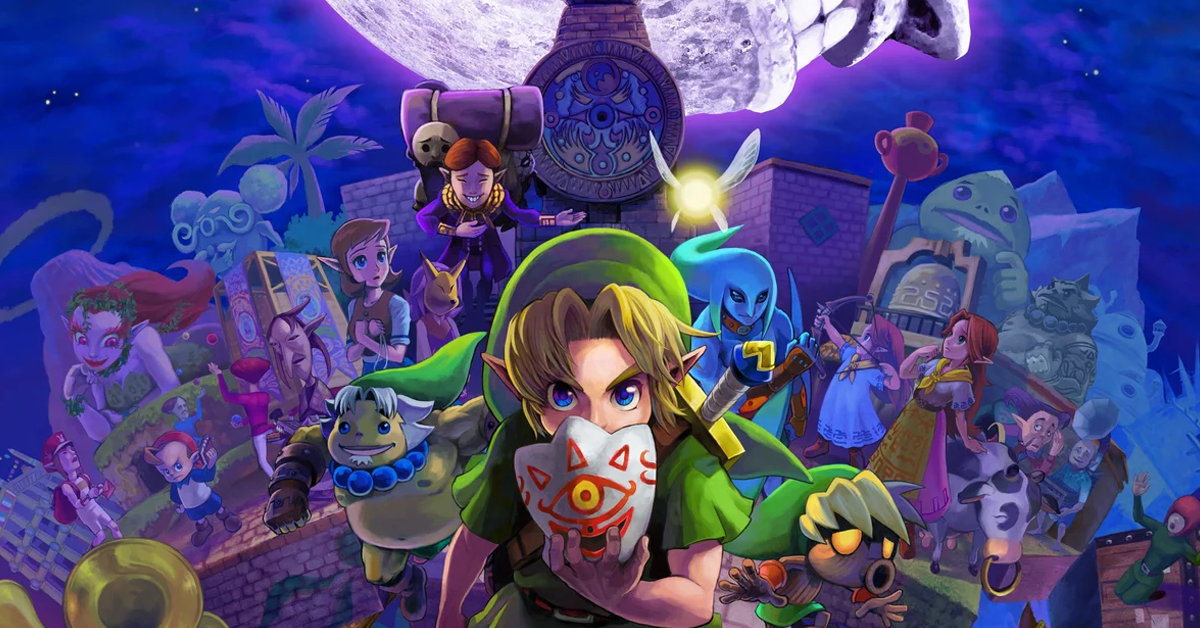
The clock is always ticking in Termina.
Every moment you spend here, the world edges closer to its end. The sky burns red, the music trembles, and above it all hangs the moon — not distant or abstract, but impossibly close, grinning down with hollow eyes. It doesn’t drift lazily like a celestial body should. It looms, watching, waiting. You can feel its weight pressing on the world, on you. It’s not a question of if it will fall — only when.
Most Zelda games begin with light — a kingdom in peril, a prophecy, a hero destined to bring balance. Majora’s Mask begins with disorientation. Link has already saved Hyrule. He’s already been the hero. But this time, there’s no prophecy, no guidance — only loss. He’s wandering through the woods, searching for a friend who’s gone, when fate pulls him into another world entirely. And from the very first moments, something feels wrong. The world looks familiar, yet wrong — like a dream you half-remember, or a memory you’ve replayed too many times.
You’re stripped of your identity before the story even begins. Your horse is stolen, your body transformed, your voice taken away. You’re not the Hero of Time anymore — you’re just a scared child trapped behind a mask. It’s a cruel inversion of everything Ocarina of Time made you feel. You’ve gone from legend to stranger, from savior to survivor. That sense of helplessness — of being caught in a nightmare that refuses to end — defines everything that follows.
And then you learn about the clock. Three days. Seventy-two in-game hours before the moon destroys everything. You can’t save everyone. You can’t even save yourself — not completely. You can only rewind the clock, undo the damage, and try again. Every reset restores the world, but erases your victories. The people you helped forget you. The pain you eased returns. The tragedy repeats. And still, you keep playing. Because even if you can’t stop the end, you can’t walk away from it either.
That’s the genius — and the cruelty — of Majora’s Mask. It asks what happens after the hero’s story ends. When there’s no destiny, no applause, no eternal peace — just a world that keeps breaking and beginning again. It’s a game about the weight of repetition, about grief that never resolves, about hope that flickers even when time runs out. You can’t escape the loop. But you can learn to live in it.
From the moment the clock starts ticking, Majora’s Mask tells you what kind of story it’s going to be. Not one about saving the world, but one about living in the shadow of its end.
A story about how every beginning carries its own ending — and how, sometimes, that’s what makes life beautiful.
The Game That Wasn’t Supposed to Exist
When The Legend of Zelda: Majora’s Mask released in 2000, it felt like a miracle that it existed at all. Ocarina of Time had just redefined what video games could be — a sprawling, cinematic adventure that transformed the series and the industry forever. It was a phenomenon: critics adored it, players worshiped it, and Nintendo could’ve easily rested on its success. But inside the company, one man was already restless.
Eiji Aonuma, a young director on Ocarina of Time, didn’t want to make another epic. He wanted to make something strange — something smaller, riskier, more personal. When he told Shigeru Miyamoto that he didn’t want to simply remake Ocarina, Miyamoto gave him an ultimatum: you can make a new Zelda game, but you have one year. A single year to follow one of the most acclaimed games ever made. Most developers would have said no. Aonuma said yes.
The result was chaos — and creativity. With no time to start from scratch, the team recycled assets from Ocarina of Time. Characters, models, animations — all pulled from Hyrule and reshaped into something new. But what could’ve felt lazy instead became haunting. Familiar faces were twisted into unfamiliar roles. The cheerful mask salesman became eerie and unhinged. Villagers smiled the same smiles, but their eyes seemed heavier. In trying to save time, Nintendo accidentally created a world that felt like a dream of the old one — or maybe a nightmare.
Aonuma’s team was small, too — roughly half the size of Ocarina’s. In interviews, especially in the Iwata Asks series years later, he described those months as frantic, experimental, and exhausting. They were forced to cut corners, but in doing so, they cut deeper. Instead of making a vast world, they made an intimate one — built not for breadth, but for depth. The three-day cycle wasn’t just a clever mechanic; it was born from necessity. They needed to make a world that reused the same space and characters efficiently, while still feeling alive. The looping timeline was a practical solution — but it became the heart of the entire game.
That’s what makes Majora’s Mask so fascinating: every creative limitation became a thematic one. The time pressure that haunted the developers became the same pressure that haunts the player. The sense of déjà vu, of repetition, of reusing what’s familiar — it wasn’t just a design shortcut. It was storytelling. It mirrored the emotions of both the people making the game and the people playing it: the exhaustion, the repetition, the beauty in doing something again and again until it finally feels right.
Even the music echoes this. Composer Koji Kondo layered the soundtrack with looping motifs that subtly shift in tone depending on the day — bright and hopeful at first, weary and frantic by the end. It’s a sonic metaphor for development itself: a cycle of optimism, panic, and creative transcendence.
In hindsight, Majora’s Mask shouldn’t have worked. It was made too quickly, by too few people, under too much pressure. But maybe that’s why it endures. It’s a game born from limitation, from the terror of time running out — both in its story and behind the scenes. And just like its hero, the developers had to learn to live within that ticking clock. They didn’t have time to build perfection — so they built meaning instead.
Majora’s Mask wasn’t supposed to exist. And yet, because of that, it feels more alive than almost any game that does.
Time as the Enemy
Time in Majora’s Mask isn’t just a mechanic — it’s the antagonist. Every second counts. From the moment you set foot in Termina, a giant clock tower looms overhead, its hands spinning faster than you’d like. The game constantly reminds you that the world is ending, not in some abstract prophecy, but in exactly 72 in-game hours — about an hour of real-world playtime. The moon isn’t waiting for you to save the world. It’s falling, and you’re in its shadow.
Unlike other Zelda games, progress in Majora’s Mask feels fragile. You gather rupees, help townsfolk, solve puzzles — but when the third day ends, the Song of Time wipes it all away. The game forces you to restart, to repeat, to relearn. Items reset, people forget you, and the world begins again as if nothing happened. It’s frustrating at first — almost cruel — but that’s the point. The cycle of time strips away permanence, leaving only what truly matters: knowledge and empathy. You don’t win by rushing forward; you win by understanding how this world breathes.
Every NPC follows a strict schedule. The innkeeper checks guests in, the postman delivers letters, the mayor debates evacuation — all unfolding minute by minute. You can watch it all happen, fail to intervene, rewind, and try again. It’s like a living clockwork theater, and you’re both the audience and the actor. That repetition turns side quests into emotional loops: you see people’s fears and hopes play out again and again, powerless to stop them until you find the right mask, the right moment, the right choice.
Critics at the time were divided. Some, like IGN and RPG Ranked, praised its innovation — calling it one of the most ambitious experiments in Nintendo’s history. Others, like HonestGamers and GameCritics, found it oppressive, even exhausting. But whether you loved it or hated it, you couldn’t ignore how it made you feel. The time limit creates tension, dread, and urgency — emotions rarely found in Zelda’s comforting formula. It transforms exploration into ritual, and heroism into routine. You aren’t saving the world once; you’re saving it over and over, hoping that this time, it might last.
The brilliance of Majora’s Mask lies in how it makes the player live through the same cycle as its protagonist. You learn patterns, memorize lives, anticipate tragedy. The three-day loop becomes second nature — a rhythm of failure, repetition, and progress. And by the time you finally stop the moon, you realize you’ve become fluent in inevitability. Time isn’t just your enemy anymore — it’s your teacher.
Masks of Grief and Identity
At its core, Majora’s Mask is a story about how people deal with loss — and how they hide it. Every mask you collect isn’t just an item; it’s a metaphor for the faces people wear to survive. Beneath its colorful surfaces and quirky designs, the game is quietly dissecting the human response to trauma. Where Ocarina of Time celebrated heroism, Majora’s Mask questions it. What happens when the adventure ends, but the pain remains?
Link’s masks are not mere disguises — they’re vessels for memory. The Deku Mask is the petrified grief of a dead child. The Goron Mask carries the regret of a fallen hero. The Zora Mask holds the sorrow of a musician who died trying to save his people. Every transformation is an act of empathy through possession — Link literally wears the dead, carrying their unfinished stories forward. When he dons their faces, he becomes them — their bodies, their pain, their hopes. The player doesn’t just control Link; they inherit his burdens.
This idea extends far beyond gameplay. It’s psychological — even spiritual. Majora’s Mask treats grief as a cycle, not a wound to be healed but a pattern to be lived through. Each of the four regions reflects a stage of that cycle: denial in the poisoned swamp, anger in the frozen mountain, depression in the drowned bay, and acceptance among the ghosts of Ikana Canyon. The game never tells you this outright, but you feel it — through the music, the color palette, the way NPCs speak just a little slower on the final day. Termina is a world frozen in mourning, and you are its silent witness.
Even the act of rewinding time carries symbolic weight. Every time you play the Song of Time, you erase your deeds — you undo good and bad alike. The world forgets you. You’re the only one who remembers. That creates a strange kind of loneliness: an emotional disconnect between what you’ve done and what the world believes. It’s a powerful metaphor for how grief isolates us — how we carry memories others can’t share, experiences that time refuses to acknowledge. The player feels that isolation deeply. You save someone, watch them smile… and then watch them forget you. You become addicted to repetition because it’s the only way to feel seen.
The masks you gather from side quests — the postman’s hat, the couple’s mask, the bunny hood — each represents a different kind of human experience. Some are funny, some tender, some tragic. Together, they form a mosaic of what it means to live under the shadow of time. And when you finally earn the Fierce Deity Mask, it feels less like a reward and more like transcendence — the moment when all those fragments of identity converge into something whole. It’s as if Link’s empathy, collected piece by piece, becomes divine.
But Majora’s Mask never lets you forget the cost of that understanding. Even at its most heroic, the game remains somber. The people of Termina don’t need saving from monsters — they need saving from fear, regret, and forgetting. And yet, you can’t truly save them. You can only keep trying. The world will always end. The masks will always fall. But every loop, every act of kindness, every fleeting moment of connection — it all matters, even if it disappears.
That’s the quiet truth at the heart of Majora’s Mask: grief doesn’t end when the clock resets. We just learn how to carry it differently. And sometimes, that’s enough.
A Mirror of Hyrule
Stepping into Termina feels unsettling from the very beginning — not because it’s alien, but because it’s almost familiar. The characters you meet look like people you knew in Ocarina of Time, but they aren’t the same. The happy mask salesman, the guards, the carpenters, even the innkeeper — they all wear familiar faces, yet their lives are different. It’s as if Link has fallen into a dream of Hyrule, one that’s been reshaped by memory and guilt. This subtle reuse of characters, born from the need to save development time, became one of Majora’s Mask’s most powerful creative choices. It makes Termina feel like a reflection — warped, personal, and deeply human.
Where Hyrule was a world of adventure, Termina is a world of intimacy. The map is smaller, but every corner of it breathes with routine and purpose. Each townsperson has a story that begins, peaks, and ends across the three-day cycle. The woman waiting for her missing fiancé, the swordsman masking fear with pride, the dancer practicing for an audience that may never see her — they live and die on schedule. And you, the player, exist outside their timeline, watching them from the edges of eternity. You’re not the hero of their world; you’re an intruder in their tragedy.
The architecture and geography reinforce that dreamlike tension. Clock Town sits at the world’s center, its spinning clock tower both a landmark and a warning. The regions beyond — swamp, mountain, ocean, canyon — feel isolated, almost forgotten, as if time itself has abandoned them. Every area carries an echo of decay: poisoned waters, endless winter, cursed souls, haunted ruins. This isn’t a land awaiting salvation; it’s a world suspended between life and death, between action and paralysis.
And yet, there’s beauty in Termina’s melancholy. The colors are muted, the skies bruised with purple and orange sunsets, the music looping between hope and despair. The passage of time is visible everywhere — the way shadows stretch differently each day, how the townspeople’s voices grow more anxious as the moon sinks lower. By the final day, the world doesn’t just feel doomed — it sounds doomed. The familiar Zelda optimism is replaced by a quiet fatalism that feels all too real.
Termina lingers in the player’s mind because it feels like a place that shouldn’t exist, yet somehow does. It’s a mirror not just of Hyrule, but of ourselves — a distorted reflection of the worlds we build and lose, the people we remember and forget. It asks a quiet, unsettling question: If everything you loved could vanish in three days, how would you spend them? And by the time you’ve lived through enough cycles to know the answer, you realize that Termina — with all its strange, sorrowful faces — has become as real to you as Hyrule ever was.
From Divisive to Divine
When Majora’s Mask launched in 2000, not everyone understood it. Many players, fresh off the triumph of Ocarina of Time, expected another grand adventure — more dungeons, more exploration, another victory lap for the Hero of Time. What they got instead was something stranger, darker, and more intimate. Some critics praised its ambition, calling it a bold subversion of the Zelda formula. Others dismissed it as confusing, stressful, even incomplete. The time limit mechanic, especially, divided fans — it was either a brilliant innovation or a cruel experiment in player anxiety.
Yet over time, Majora’s Mask did something remarkable: it aged into relevance. As the years passed, its ideas began to resonate in ways few games from that era could. Players who once found it frustrating began to see it for what it truly was — a reflection of transience, loss, and emotional resilience. The looping time system, once seen as a gimmick, became its defining genius. It anticipated mechanics and themes that modern games like Outer Wilds, Undertale, and Deathloop would later explore — worlds where repetition breeds meaning, not monotony.
When Nintendo released Majora’s Mask 3D in 2015, the critical conversation shifted again. Reviewers who had grown up with the original now looked back on it as one of the most daring sequels ever made. Nintendo World Report called it “a masterwork of atmosphere and tension.” Source Gaming went further, describing it as “the perfect game” — not because it’s flawless, but because its flaws are what make it human. The discomfort, the time pressure, the melancholy tone — all of it felt intentional, purposeful, and rare in a medium that so often chases escapism.
In hindsight, Majora’s Mask feels like a game that was misunderstood by its own time. It didn’t offer the fantasy of heroism — it offered the reality of limitation. It wasn’t about destiny fulfilled, but about coping with impermanence. And that’s precisely why it endures. The more we replay it, the more its loops feel like life itself — fleeting moments, small kindnesses, and inevitable goodbyes.
Today, it stands not just as one of the most beloved entries in the Zelda series, but as one of the most profound pieces of storytelling in video game history. What was once seen as a strange detour has become a timeless mirror — a game that, like its world, keeps ending and beginning anew with every generation that rediscovers it.
Acceptance
The dawn of the final day always feels different. The sky glows a deep orange, the bells toll one last time, and the music slows into something that feels like a goodbye. You’ve been here before — hundreds of times, maybe more — and yet this time, it feels heavier. You know how this story ends. You’ve memorized every heartbeat of this doomed world. But even with all that knowledge, there’s still something beautiful about watching the sun rise one last time.
When the credits finally roll, Majora’s Mask doesn’t congratulate you. There’s no grand speech, no parade, no triumphant fanfare. The world simply continues — quietly, as if it never knew how close it came to ending. The people you saved go back to their lives, unaware of your sacrifice. It’s an ending that refuses closure, because that’s not what life offers either. It’s about learning to live in cycles — of loss and renewal, fear and courage, ending and beginning again.
What lingers after the game ends isn’t victory, but understanding. You realize that Link — and you — were never really trying to save the world. You were trying to make meaning out of time. Every small act of kindness, every mask you wore, every life you touched — they mattered, even if no one remembers. The Song of Time doesn’t just rewind the clock; it asks a question: If everything fades, what do we hold onto? And Majora’s Mask answers softly — we hold onto empathy.
Because that’s what the game is truly about. Not power, not destiny, but connection. The ability to reach out, again and again, even when you know it won’t last. Every loop, every restart, every fleeting smile — they all become part of you. And maybe that’s what acceptance really means: understanding that things end, and loving them anyway.
As the moon disappears and Termina breathes again, you set the controller down and listen to the silence. The world has ended, and yet it continues — somewhere, somehow. And maybe, after all these cycles, that’s the point.
The world always ends. But you get to choose how you live before it does.
Leave a Reply