
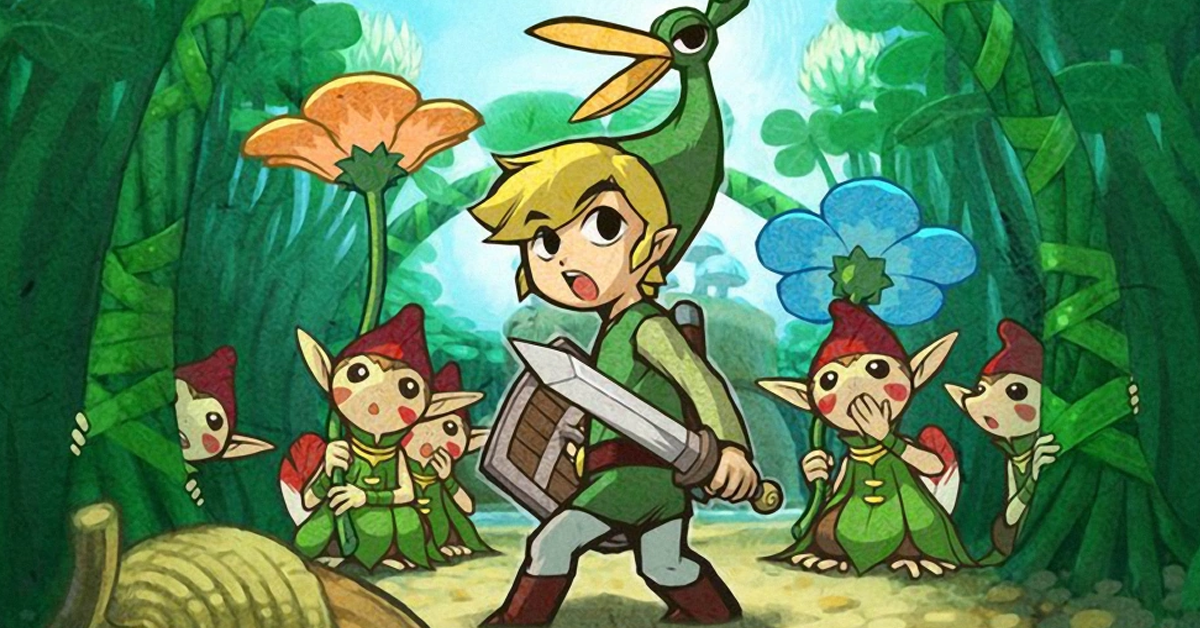
A vacuum jar inhales the giant Chuchu until it falls down. A pair of Mole Mitts digs through solid rock, uncovering a hidden room. Beneath it all, the world is rebuilt at Picori height: two Hyrules, one familiar and one miniature, all layered together.
We have 6 dungeons in total. About fifteen hours to complete. It’s one of the shortest mainline Zelda games most people will play, yet it features some of the most creative item design Nintendo and Capcom have ever included in the series. Nintendo and Capcom worked together on three Zelda games. That partnership ended twenty years ago and hasn’t happened since.
Today I’m going to look back at one of my favourite topics, top-down Zelda, and we’re going to go through my retrospective of The Minish Cap.
Before we go on, welcome back. I’m Triforce Times. Here, we dive deep into The Legend of Zelda—its design, lore, hidden stories, and everything Nintendo leaves unexplained. If you enjoy that, consider subscribing. Members get exclusive Zelda videos, early access to new content, and an invite to our community Discord. The link is below.
THE CENTRAL CONCEIT
Minish Cap came out in 2004, developed by Capcom and its subsidiary Flagship, and published by Nintendo. It’s the third and final Zelda game to come out of that partnership, after Oracle of Seasons and Oracle of Ages on the Game Boy Colour back in 2001.
Those two Oracle games used a seasons/time duality to get more out of a very small cartridge. It’s the same map, but with different rules depending on the game or season. It was a clever trick, and it worked. So when it was time to make a new Zelda for the Game Boy Advance, the team, led again by director Hidemaro Fujibayashi (who would later go on to direct Breath of the Wild and Tears of the Kingdom), needed a new version of that idea—something that could double the value of one overworld without doubling the work on art and level design.
The answer they landed on was scale.
Here’s the core idea: what if the map you know is actually two maps layered together? One is visible at your normal height, and the other is hidden at a tiny size, only revealed when you search for it.
Mechanically, this works through a portal system. Tree stumps, jars – when you find one, you shrink with Ezlo’s power, and the world around you changes completely. A wall turns into a canyon. A puddle that Link would normally walk through becomes a body of water you need the Flippers to cross. It’s the same top-down Zelda structure as A Link to the Past, but now there’s a second layer directly underneath, sharing the same space.
There’s also a clever bit of environmental storytelling here. When you find Minish villages hidden in stumps and walls, you realise this isn’t just a fantasy layer added to Hyrule. These are Hyrule’s original inhabitants, living their lives beneath the feet of people too big to notice them. The Minish, or Picori as the game calls them, aren’t a new species made up for this story—they’re shown as the ancient people who gave Hyrule the Picori Blade and the Light Force. So the idea of shrinking down to discover a hidden world is reflected in both the gameplay and the story.
The shrinking mechanic is heavily promoted in the opening hours—it’s on the box art, in the title, and it’s the first thing Ezlo teaches you within ten minutes of starting. But after a few dungeons, it feels less like a core feature and more like a traversal trick you use occasionally. Even though the game emphasises the concept early, there isn’t much Minish-sized combat or puzzling after the beginning. I checked my own notes, and I agree. The best use of the mechanic is right at the start, in Deepwood Shrine, where being Minish-sized makes every regular enemy suddenly dangerous—a normal Green Chuchu becomes a huge boss. After that, shrinking is mostly just a tool to get through certain gaps, find Kinstones, or reach heart pieces before you return to normal size for the rest of the dungeon.
That’s not a criticism that ruins the game. But it’s a starting point for this retrospective, since much of what Minish Cap does well is making up for the fact that its main mechanic isn’t as deep as the marketing suggested.
HOW CAPCOM ACTUALLY BUILT THIS
This wasn’t a rushed sequel. Development actually began in 2001, right after the Oracle games, but was put on hold so the team could finish Four Swords first. By the time they returned to Minish Cap, they had two more years to think things through, and they brought over assets and story ideas from the other Zelda games they had worked on—like the Roc’s Cape, which started there before being added to this game.
In interviews from the time, director Hidemaro Fujibayashi and Zelda producer Eiji Aonuma said they wanted Minish Cap to feel like a true Capcom game, not just a Nintendo game with a different logo. Their solution was to focus on beautiful, detailed 2D art, which Capcom’s team was known for. Fujibayashi also explained that the “big and small” concept was meant to be a structural opposite, like light and dark in earlier Zelda games, giving the team a foundation to build the world around instead of just adding a gimmick at the end. This changes how we see the shrinking mechanic—it isn’t underdeveloped because of time constraints. It’s exactly as large as it needed to be for the “big and small” idea, with the items and dungeons designed to carry most of the gameplay.
It’s also worth noting that Fujibayashi didn’t stop here. He left Capcom for Nintendo right after this game in 2005, and went on to direct Skyward Sword, Breath of the Wild, and Tears of the Kingdom. By some counts, he now has more directorial credits on the series than anyone else. Minish Cap isn’t just a footnote in his career—it’s the last game he made before joining Nintendo full-time.
THE ITEMS
Here’s where I think Minish Cap actually separates itself from every other 2D Zelda, including some I’d rank higher overall. The item design in this game is doing something different from the formula Zelda had settled into by this point.
Think about the usual item pattern in the series. You get a tool, and it has one main job. The Hookshot pulls you across gaps and sometimes stuns enemies. The Boomerang stuns enemies and grabs items from a distance. The Bow shoots arrows in a straight line. These items are well designed, but they mostly act as single-purpose keys for single-purpose locks. Within about thirty seconds of picking one up, you know exactly what kind of puzzle it will solve for the rest of the game.
Minish Cap’s items don’t work that way. They act more like small systems than simple keys.
Take the Gust Jar, the item out of the very first dungeon, Deepwood Shrine. On paper, it’s a vacuum. It sucks things toward you or blows them away. That’s the entire base rule. But look everywhere, the designers actually point out that rule across the rest of the game. You use it to blow a lily pad across water when you haven’t got the Flippers yet. You use it to strip the shell off certain enemies before you can damage them properly. You use it to redirect projectiles back at whoever fired them. And in the Deepwood Shrine boss fight itself, against the Big Green Chuchu, you use the Gust Jar to physically inhale the bulk off the boss’s lower half over the course of the fight, shrinking it down piece by piece until it’s vulnerable. One item, one rule, and the dungeon team kept finding new verbs to attach to it for the rest of the game.
Then there’s the Cane, found in the second dungeon, Cave of Flames, which I think is the cleverest item Capcom added to this game. Its main function is simple: it flips things upside down. With just that rule, the designers created a minecart puzzle where you flip a derailed cart back onto its wheels to keep moving. They also made a trick where using the cane on a hole charges it, and stepping in launches you up to a ledge you couldn’t reach otherwise. In combat, flipping certain enemies exposes weak points that are protected when they’re right-side up. This single idea—flipping—gets used in puzzles, movement, and combat, and it never feels overused by the time you finish the dungeon.
Mole Mitts, the item from the third dungeon, Fortress of Winds, seem simple at first—they let you dig through soft dirt walls that would otherwise block your way. But across the game, large areas of the overworld that looked like solid rock actually hide pockets with rupees, heart pieces, or Kinstone fusions you wouldn’t have found otherwise. This makes exploration something you do actively with a tool, not just by wandering around.
Then there’s Roc’s Cape, the item from the fifth dungeon, Palace of Winds. It gives you real vertical freedom in a game that’s kept you on the ground until now. After more than twenty hours of top-down, screen-locked Hyrule, being able to jump and glide changes how you see earlier areas. You remember ledges you couldn’t reach and gaps you had to walk around, and now you can simply go over them.
I also want to give a nod to how the item system dovetails with the game’s side content, because it’s not just dungeon puzzles benefiting from this. Bombs, Bow and Arrow, the Pegasus Boots you get from Rem the shoemaker after waking him up with a Wake-Up Mushroom bought off Syrup the witch — all of these have secondary uses baked into the overworld, feeding into the four Mysterious Shell figurine machines dotted around Hyrule Town, or the Tingle Brothers’ Kinstone fusions, or the sword-upgrade quest with Swiftblade. None of it feels like it exists purely to pad out a checklist. It’s all built to reward you for actually carrying your toolkit around and poking at the world with it.
I think it’s why Minish Cap is underrated compared to bigger Zelda games. Capcom wasn’t trying to make items that act like traditional dungeon keys. They wanted items that feel like toys—things you keep playing with even after the puzzle they were made for is done. That’s a different design philosophy from A Link to the Past, Ocarina of Time, or even some later games. The closest comparison isn’t another 2D Zelda but how Nintendo later designed the runes in Breath of the Wild: give players a few flexible tools and let the level design do the rest.
As clever as this toolkit is, it supports a game that is, structurally, one of the smaller entries in the series. That’s what I want to talk about next, because the dungeons offer a different perspective from the items.
THE DUNGEONS AND WHAT THEY COST
Minish Cap has six dungeons in total: Deepwood Shrine, Cave of Flames, Fortress of Winds, Temple of Droplets, Palace of Winds, and Dark Hyrule Castle, the final dungeon. Compare that to A Link to the Past’s twelve or the Oracle games’ eight each, and you can see the compromise right away. It’s beautiful and inventive, but clearly shorter and less ambitious than other Zelda games.
Six dungeons, each offering something unique, are better than twelve, half of which are just filler. But it also means each dungeon in this game has to do more, so the weaker ones stand out more than they would in a longer game.
Deepwood Shrine, the first dungeon, is themed entirely around the forest and the fact that you’re Minish-sized for the whole thing — every regular enemy reads as dangerous because of the scale trick I mentioned earlier. It’s a strong, atmospheric opener, but by design it’s also the simplest dungeon mechanically, since it’s mostly there to teach you the Gust Jar rather than push it to its limits.
Cave of Flames, the second, turns the mine setting into a genuine minecart puzzle box, using the newly acquired Cane of Pacci to flip carts back onto their tracks and cross patches of cooling lava before they harden. It’s got a clear identity, even if — and this is a criticism that comes up a lot in fan discussion of this game — the actual boss, Gleerok, is a fairly simple pattern-based fight that doesn’t push the Cane of Pacci nearly as hard as the dungeon leading up to it does.
Fortress of Winds, the third dungeon, often ranks lowest in fan polls and discussions, and after replaying it, I see why. It’s the most maze-like of the six and easy to get lost in. Despite its name, there’s not much of a wind theme in the atmosphere or puzzles—it feels like a generic stone fortress. The Mole Mitts you get here are also the least exciting item in the game, which makes the dungeon less memorable than the others.
Temple of Droplets, the fourth dungeon, is the one fans debate the most, and opinions are split. It’s centred on melting ice with the Flame Lantern, which is a clever idea, but it also means you can only move through certain areas after changing the terrain in a specific order. It’s easy to get lost and end up backtracking through rooms that look different from before. Some players enjoy this challenge, but many find it frustrating, and it’s often ranked as the game’s low point.
Palace of Winds, the fifth dungeon, is where everything comes together, and it’s still talked about years later. It’s vertical instead of flat, fast-paced instead of methodical, and it’s the first real showcase for Roc’s Cape. The dungeon ends with a boss fight against a pair of Gyorg that fans and critics alike call one of the best boss battles in handheld Zelda games—tense and responsive to how well you use the Cape, not just a simple pattern to memorise.
And then Dark Hyrule Castle, the sixth and final dungeon, plays like a victory lap through everything the game has taught you up to that point, with a clear visual and structural nod to Ganon’s Tower from A Link to the Past in how it escalates. It’s where you finally face Vaati directly, across a genuinely multi-stage fight that makes proper use of the Four Sword you’ve spent the whole game rebuilding.
Minish Cap doesn’t have as many dungeons as earlier games, and the middle two—Fortress of Winds and Temple of Droplets—are clearly weaker than the rest. But overall, the dungeons are more consistently creative than the filler you sometimes find in longer Zelda games. It’s a quality-over-quantity trade, shaped by the format Capcom was working with, and whether that works for you depends on what you want from a Zelda game.
KINSTONES AND THE FOUR SWORD
The other key part of Minish Cap’s identity, besides the dungeons, is Kinstones. This is Capcom’s elegant solution to a real problem. A handheld Zelda on a Game Boy Advance cartridge can’t fit a lot of extra content—there’s only so much art and map space available. So instead of adding big new areas like a console Zelda, Capcom created a fusion system. Almost every character—villagers, shopkeepers, Gorons, even some enemies—has half a Kinstone. When you match your half to theirs, something happens. Sometimes you get a heart piece, sometimes a new area opens up, like the beanstalk you unlock by fusing with Melari, and sometimes it’s just extra dialogue or a rupee. This turns all the NPCs into resources you interact with.
It’s a genuinely clever solution to the small-cartridge problem, because it doesn’t cost the developers a single new tile of map to implement. It just asks the player to talk to everyone twice and rewards that curiosity directly.
Then there’s the clone mechanic, which is the most obvious influence from Four Swords. At certain pedestals, you can split into up to four identical Links and use them together to solve puzzles—like standing on pressure switches at the same time, forming a chain across a gap, or surrounding a tough enemy. It’s a single-player game that borrows a multiplayer idea and makes it work solo. It’s a small feature overall, but it’s the clearest link between Minish Cap and Four Swords.
BETWEEN THE DUNGEONS
I want to stay on this idea of Capcom solving problems without new map space, because Kinstones are only half of it. The side content threaded between the dungeons is doing exactly the same job, and it’s worth actually walking through, because most of it never gets talked about outside of guide sites.
Start with the sword itself. Link’s default combat in this game is thin if you never go looking for anything extra — a basic slash and not much else. Capcom built an entire optional network of sword dojos around Hyrule, each one run by a different member of Swiftblade’s family, and each one teaching you a specific technique in exchange for training with them. There are eight Tiger Scrolls to find across the whole game this way — spin attacks, dash attacks, a roll, a proper down thrust — and finding every dojo means exploring corners of the map you’d otherwise have no reason to visit. Mount Crenel, the waterfalls around Castor Wilds, a cave you’d only stumble into if you were already digging with the Mole Mitts. You only strictly need the first one, the basic Spin Attack, to finish the story. Everything past that is optional — it’s Capcom rewarding exploration rather than gating progress behind it, which keeps the sidequest from ever feeling like mandatory homework.
Then there’s the figurine collection, which is the game’s clearest nod to what Capcom had already done with the Nintendo side of things — built around a resource unique to this game called Mysterious Shells. You pick these up constantly without really trying — cutting grass, breaking pots, defeating enemies, opening chests — and you feed them into a gashapon-style machine in Hyrule Town run by a character called Carlov, who spits out a random figurine of something you’ve encountered on your travels. There are a hundred and thirty of them in total, covering everything from major characters down to individual enemy types, and collecting the full set unlocks a proper reward from a character called Herb, who hands over a heart piece and the key to his own house for your trouble. None of this needed new areas to be built. It’s entirely repurposing things you’re already doing — fighting, exploring, cutting grass — and turning them into a second layer of progression running underneath the main one.
And then there’s Tingle, and his brothers Ankle, Knuckle, and David Jr., scattered individually across different corners of Hyrule. On the surface, they’re comic relief, the same slightly odd energy Tingle’s brought to the series since Majora’s Mask. But mechanically, they’re doing real work — each one tracks how many Kinstone fusions you’ve got left to find, which turns four otherwise-throwaway characters into genuine progress markers for the wider fusion system. Fuse with all four of them, and you’re rewarded with the Magic Boomerang, an upgraded version of the standard one that can carry items and hit multiple enemies in a single throw. It’s a small, slightly silly sidequest on its face, and it’s actually load-bearing for how the whole Kinstone system tracks your progress.
What ties all three of these together, and what I think is the throughline of this whole section, is that none of it required Capcom to build a single new tile of overworld. The sword dojos reuse existing terrain. The figurines reuse the combat and exploration you’re already doing. Tingle and his brothers reuse the existing Kinstone system for a completely different reason. It’s the same design instinct that built the Kinstone fusion system in the first place, just applied three more times over, in three different directions. On a bigger cartridge, a lot of this probably becomes new dungeons, new areas, new set pieces. On this one, it becomes a clever reuse of what’s already there — and I’d argue that constraint is a reason the side content in this game holds together as well as it does, rather than feeling like padding stapled onto the map for the sake of a longer completion time.
VAATI, THE PICORI, AND THE STORY
Minish Cap is a prequel — specifically to Four Swords and, by extension, Four Swords Adventures. Its story explains where the Four Sword and Vaati both originated. During the events of the game, the Picori — tiny, ancient beings, also referred to as the Minish — gifted Hyrule both the Light Force and a blade called the Picori Blade, and the two together were used to seal away evil in the land.
Ezlo, your talking cap companion for the entire adventure, was once a Picori sage in his own right. Vaati was his apprentice. Vaati grew greedy, stole a hat Ezlo had crafted for the Hylian people, and cursed his old master, turning him into the very cap you’re wearing on your head for the whole game. That single act of betrayal is the engine for everything that follows — Vaati turning Hyrule Castle itself into the corrupted Dark Hyrule Castle, Zelda being drained of the Light Force hidden inside her, and Link’s entire quest to reforge the Picori Blade into the restored Four Sword in order to stop him.
By the time you reach the credits, you’re explaining the origin of an item and a villain that a different Capcom-made game had already put directly in players’ hands years earlier, in Four Swords. Playing Minish Cap after Four Swords means watching a mystery get solved. Playing it before, which is how most people encountered it given the release order, means watching a mystery get set up that a different game answers.
HOW IT LOOKED AND SOUNDED
Minish Cap borrows its visual style almost directly from The Wind Waker, and you can see it as soon as Link moves. The GBA didn’t have the power of the later Nintendo DS or3DS, so it couldn’t be as close to Wind Waker as Phantom Hourglass or Spirit Tracks.
The proportions, exaggerated expressions, and lively animation all feel like Wind Waker in 2D. What’s impressive is how much personality Capcom’s artists fit into a Game Boy Advance cartridge. The Picori Festival at the start is full of background characters, banners blowing in the wind, and life happening in the corners of the screen, even if it’s not part of your quest. When you shrink into the Minish world, the attention to scale is impressive—you’ll find Minish homes made from everyday objects. It’s a small detail, but it shows the art team cared about even the parts most players might miss.
The sound design holds up just as well. The composer here is Mitsuhiko Takano rather than series regular Koji Kondo, and Takano’s doing something clever throughout — new original pieces sitting comfortably alongside classic Zelda motifs, occasionally slipping in a direct nod to older themes. The Mount Crenel track, for instance, quietly echoes the Dark World theme from A Link to the Past without copying it. It’s the kind of soundtrack choice that rewards longtime fans without alienating anyone hearing it for the first time.
WHY IT HOLDS UP
Taking all of that into account, here’s my conclusion after replaying the game for this video. Minish Cap isn’t the most ambitious Zelda game – six dungeons, a clear handheld-sized scope, and a shrinking mechanic that’s more limited than the marketing suggested. But what it does with its smaller scale is unique, and it still stands out even twenty years later.
In my opinion, the items are the best-designed toolkit in any 2D Zelda—each one is a flexible system, not just a single-purpose key. The Kinstone system solves the limited-content problem better than adding extra dungeons would have. And the whole adventure is tied together by a Four Sword prequel story that actually fits into the larger Zelda timeline, rather than feeling like it was added just for continuity.
Twenty years later, Minish Cap has become one of those Zelda games that isn’t discussed with the same respect as A Link to the Past or the original Link’s Awakening. But almost everyone who’s played it will defend it in detail as soon as it’s mentioned. After replaying it for this video, I think that’s the right take. It’s a smaller game that’s much smarter than its size suggests.
CLOSING THOUGHT
Quick closing thought, because I know some of you are already thinking it too, and it’s part of why I wanted to make this video in the first place. Three games. Oracle of Seasons, Oracle of Ages, Minish Cap. All three are genuinely great. All three came directly from the same brief window of collaboration between Capcom and Nintendo, built largely by the same team under Fujibayashi. And then it just stopped. Capcom has since gone back and remade A Link to the Past and Four Swords as a combined package for the 3DS, but there hasn’t been a new Capcom-made Zelda game since 2004.
Here’s why I think the timing is interesting again, not just wishful thinking. Capcom is focusing on Nintendo’s current hardware, with several major titles already out or coming soon (RE9 and Pragmata to name a few recent examples).
Zelda just celebrated its 40th anniversary. Nintendo has also shown this year that it’s open to letting outside studios work on the series—like Grezzo with the Link’s Awakening remake and Echoes of Wisdom. None of this means a fourth Capcom Zelda is coming, and I’m not saying it’s happening. But the conditions that made the first three games possible are coming together again in a way they haven’t for nearly twenty years.
That’s Minish Cap. A smaller game than the rest of this series, and a smarter one for it.
If you enjoyed this one, the best thing you can do is hit subscribe — it helps a channel like this get in front of more people who love this series as much as we do, and there’s a lot more of this coming.
Before I go, I want to say a proper thank you to everyone who supports this channel through membership. Whether you’re a Hylian, a Sheikah Scholar, or one of our Ancient Sages, this channel simply doesn’t happen without you, and I mean that.
Speaking of Ancient Sages — huge thanks to supersonicmariokirby, EldritchKhaotic, PrepayingOne, Romulus879, and ElfQuest01. You lot keep this channel running, and I appreciate every single one of you.
If you’re not a member yet and you want in on the exclusive Zelda club, membership gets you access to our growing library of exclusive Zelda videos, early access to everything we put out, and an invite to our community Discord. Link’s down below if you fancy it.
Thanks so much for watching. I’ll see you in the next one.
Leave a Reply