
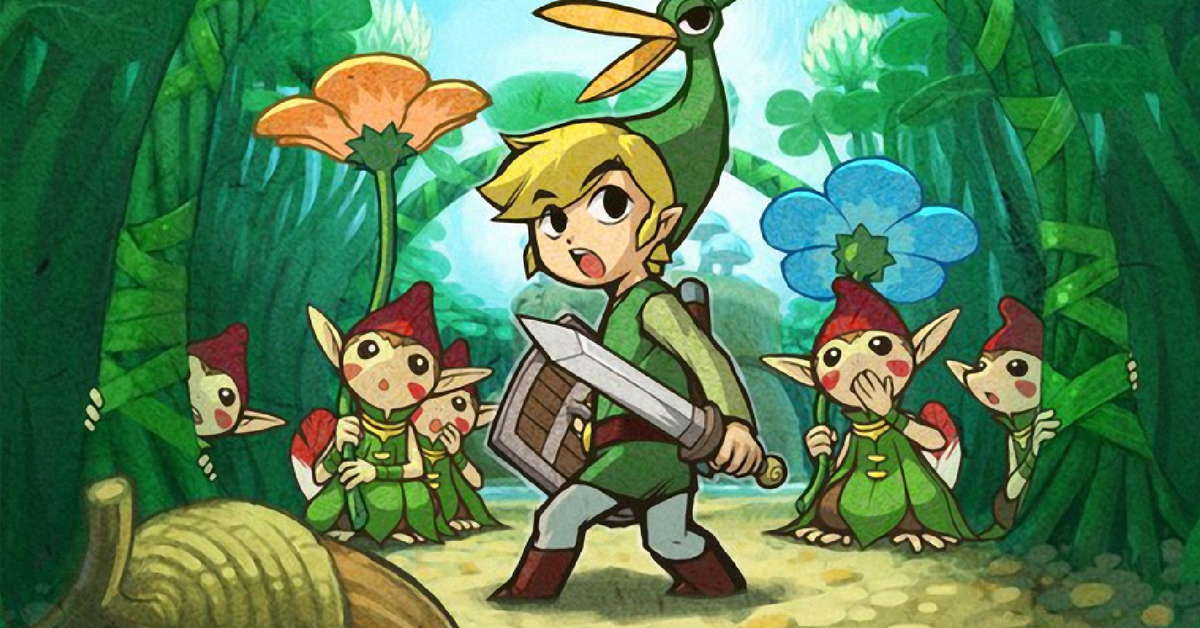
Three games. That’s the entire career of the second most recurring villain in this entire series. Three games, and in one of them, he’s not even really running the show any more. Somebody else walks in, takes the credit for his return, and finishes what should have been his fight.
That villain is Vaati. And by the end of this video, I want to make the case that he might be the best-written villain the series has ever put together.
Before we go on, welcome back. I’m Triforce Times. Here, we dive deep into The Legend of Zelda, its design, lore, hidden stories, and everything Nintendo leaves unexplained. If you enjoy that, consider subscribing. Members get exclusive Zelda videos, early access to new content, and an invite to our community Discord. The link is below.
THE FULL RECORD
Let’s start with the numbers. Vaati appears in three mainline games. Four Swords in 2002, where he debuts. The Minish Cap in 2004, which tells his origin story. And Four Swords Adventures, also 2004, his last appearance in the main series.
That’s the whole run, three games in two years, and then almost nothing officially for over two decades. He shows up once more as a background Spirit in Super Smash Bros. Ultimate, based on his demon form rather than the design most fans actually remember him by.
There’s a stranger footnote buried in the trivia rather than the main story. Long before Vaati had a name attached to him in any released game, a design resembling his monstrous final form turns up on a poster in Ocarina of Time, in the Shooting Gallery back in Kakariko Village. It’s a small easter egg if you know where to look.
He’s also had a life outside the games proper. Akira Himekawa’s Four Swords manga puts him through a broadly similar arc to the game it adapts. However, it adds its own material along the way, including a stretch where Vaati disguises himself as Princess Zelda to trap Link’s father, and a final battle where he traps the four Links inside a surreal world of his own making before Shadow Link helps bring him down.
The Minish Cap manga sticks closer to its source game, keeping his background mostly intact while making some real changes to how the final battle actually plays out. None of it is treated as series canon, but it’s more material built around this character than most one-off Zelda villains ever get.
Vaati is the second most recurring villain in the entire Zelda series, behind only Ganon. Not third. Not somewhere in the pack with Zant or Ghirahim or Onox. Second. And he got there in three games, all released within two years, and then the series stopped using him.
Compare that to how the series treats literally every other villain of note. Ganon shows up across most of the mainline entries in one form or another, spanning decades rather than a couple of years. Even side characters like Zant and Ghirahim, who each got exactly one game, are remembered fondly and discussed constantly. Vaati got three games, earned a genuine claim to being Ganon’s closest rival in terms of sheer presence, and still ended up talked about less than villains with a single appearance to their name.
MANY FORMS, ONE CHARACTER
Vaati separates himself from almost every other villain in the franchise, given the sheer amount of forms he has.
Across Minish Cap alone, Vaati moves through five distinct forms over the course of the story. He starts as a Minish, small, unremarkable, indistinguishable from any other member of Ezlo’s world. Then a Hylian, the one time in his entire three-game career he looks like an ordinary person. From there he escalates through a demonic sorcerer state, and finally a true demon form for the endgame.
Each transformation lines up with a specific stage of his corruption. He’s Minish while he’s still Ezlo’s apprentice, before he’s done anything unforgivable. He’s a Sorcerer during the Picori Festival, turning Zelda to stone. He impersonates the King. By the time you reach the final fight, there’s nothing human-shaped left of him at all as he works through escalating Demonic forms.
That’s a rare piece of character design for this series. Most Zelda villains get one look, maybe two if there’s a final boss transformation tacked onto the end. Vaati’s entire visual arc is his character arc, staged out in multiple designs, and it’s telling you exactly how far gone he is at every single point in the story without a line of dialogue needed to explain it.
The boss fights themselves carry this idea even further than the story cutscenes do. The stages of his final battle have their own individual names, Vaati Reborn, Vaati Transfigured, and Vaati’s Wrath, each one a further escalation from the last. Vaati Reborn is the closest to his Hylian form, larger and more elaborate but still recognisably shaped like a person. From there, the fight pushes him further from anything human, adding protective barriers of floating eyes and increasingly abstract features like whips or crescent-shaped headdresses, until Vaati’s Wrath, the final stage, looks nothing like the apprentice this story started with. You’re watching the last traces of a person get replaced by something else, one phase at a time, and the game is asking you to fight your way through that transformation rather than watch it happen in a cutscene.
His name in the original Japanese release is Gufū, which translates roughly to windstorm or violent gale. It’s the same identity he eventually settles into for good, the Wind Mage, tying his final design directly back to what his own name meant from the very start.
Vaati isn’t unique in having several stages to his fight. Ganon himself typically escalates through at least two forms in his major appearances, a humanoid Ganondorf stage followed by the beast form. What separates Vaati’s version of this idea is how directly tied to narrative meaning each stage is. Ganon’s transformation is mostly about raising the stakes and the difficulty. Vaati’s transformation does that too, but it also functions as the visual conclusion to a character study that’s been building since the beginning of Minish Cap.
THE FORM ALMOST NOBODY REMEMBERS
Out of those five forms, one of them only appears once, briefly, in the entire three-game run. His Hylian form, the version of Vaati that could pass for an ordinary person, shows up for a short stretch in Minish Cap and then never again. Every appearance after that, in Four Swords, in Four Swords Adventures, sticks with the orb-shaped Wind Mage design instead.
Most people who’ve played all three games have seen the Wind Mage form dozens of times. Comparatively few have any strong memory of the version of Vaati that looked remotely human, because it’s on screen for such a small fraction of his total time as a character. The version of him with the most personality, the most obvious tie back to the “apprentice betrays his master” story the whole character is built on, is the version the series spent the least time showing anyone.
I think that’s a missed opportunity. The demonic, further-from-human designs work brilliantly as boss fight silhouettes, striking and immediately readable in combat. But it means the actual person underneath all of it, the character with a real motive and a real relationship to Ezlo, gets buried under three games’ worth of increasingly abstract monster designs. Fans who only know the orb form are only meeting Vaati after the character has already been mostly erased.
THE VICTIM WHO NEVER LEAVES
Vaati’s backstory is told brilliantly in Minish Cap, and it’s one of the reasons why, for me, Vaati lingers as a great villian. It’s tied to his betrayal of his master. Ezlo, the character Vaati curses, doesn’t disappear afterwards the way most wronged mentors in this kind of story usually do. He becomes the cap sitting on Link’s head, present in literally every conversation, every cutscene, every dungeon, for the entire length of the game.
In most stories built around a betrayed mentor, the mentor exists mainly in flashback, or shows up occasionally to deliver wisdom before stepping back out of the frame. Ezlo never gets that distance. He’s talking to Link constantly, reacting to events in real time, and every single one of those conversations is happening because of what Vaati did to him. The game never lets you forget the crime, because the victim of it is quite literally never out of frame.
It also does something clever with how players relate to Vaati emotionally, without the game ever needing to spell it out. You spend the adventure alongside Ezlo before you properly understand what Vaati actually did to him, which means the eventual reveal recontextualises a character you’ve already spent hours with, turning a slightly grumpy talking hat into visible, ongoing proof of exactly how much damage this villain caused. Few Zelda games manage to make a betrayal feel that strong, because few Zelda games keep the consequence of that betrayal sitting on the hero’s head as a constant reminder to us, the players.
Compare that structure to how most Zelda games handle their villain’s past victims. Usually they’re mentioned, or briefly glimpsed, or shown once in a flashback before the story moves on to the present-day threat. Zelda herself, turned to stone for a stretch of Minish Cap, is closer to that more conventional pattern, a victim whose condition drives the plot forward but who isn’t physically present for most of the adventure while it’s happening. Ezlo breaks that pattern. He’s not a plot device you check in on periodically. He’s a constant presence, opinionated and talkative, who also happens to be the clearest possible evidence of what this story’s villain is capable of. That’s an unusual way to keep a betrayal alive across a full game’s runtime, and it’s one more example of Minish Cap doing something structurally interesting with Vaati that the rest of the series never replicated.
THE DEMOTION
This is the part of Vaati’s story that actually explains why he ended up underrated, and it happens in his very last appearance.
In Four Swords Adventures, Vaati comes back. But he doesn’t come back on his own terms. He returns after Ganondorf tricks Link into drawing the Four Sword, releasing him, and it’s Ganondorf who curses the Royal Jewel to let Vaati spread darkness across Hyrule again. Vaati isn’t the mastermind of his own comeback. He’s a piece someone else moves into place, and reference material covering the game describes his role there plainly: secondary antagonist, acting as a puppet of Ganon.
Across Four Swords and Minish Cap, Vaati is the one making decisions. He’s the one who betrays Ezlo, the one who kidnaps Zelda, the one whose ambition drives every single beat of the plot. Then, in his third and final game, the series’ biggest name walks in, engineers his release, and becomes the real architect of everything that follows.
The rest of Four Swords Adventures’s plot only compounds it. Ganondorf doesn’t just free Vaati and step back. He steals the Dark Mirror, an artefact that lets him create Shadow Link, who then goes on to capture Zelda and the Shrine Maidens entirely independently of anything Vaati does. For a large stretch of the game, Vaati and Ganondorf are running two separate threats in parallel, and it’s Ganondorf’s plot, the Shadow Link kidnapping, the corrupted mirror, that carries most of the game’s actual dramatic weight. Link ends up fighting both of them by the end, and it’s Ganondorf, not Vaati, who gets sealed away in the climactic final scene with the help of Zelda and the Shrine Maidens, in the moment the whole game has been building towards.
Vaati still gets his own boss fight in Four Swords Adventures. He’s still defeated properly, by name, by the four Links. But structurally, he’s no longer the point of the story he’s appearing in. He’s a complication Ganondorf created, and Link has to clear out of the way before dealing with the actual threat. That’s the moment this character’s momentum stops. Two games of him being a fully realised villain in his own right, then one game where he becomes somebody else’s tool, sharing the spotlight with a kidnapping plot he isn’t even responsible for, and then nothing, ever again.
Bringing Ganondorf into Four Swords Adventures wasn’t a random decision. It gave the game a bigger, more mythologically weighted final threat, and pairing two villains against a four-player co-op cast is a reasonable structural choice on its own terms. But the cost of that choice fell entirely on Vaati. His story doesn’t get a proper final chapter. It gets folded into somebody else’s, sharing screen time with a mirror and a shadow clone that have nothing to do with his own arc, and the series never circled back to give him one afterwards.
There’s a version of this same story that plays out constantly in ongoing franchises where a strong secondary antagonist gets pulled into a bigger crossover event and never quite recovers their own narrative footing afterwards. The difference here is that Vaati never got a fourth game to recover in. Two entries building him up properly, one entry diminishing him, and then the door closed. Most characters who go through a demotion like that eventually get a chance to reclaim their story. Vaati’s demotion turned out to be permanent because the series moved on to other things.
WHY HE WORKED BEFORE THAT HAPPENED
Set the demotion aside for a second and look at what made Vaati worth building up in the first place.
Ganon’s evil barely gets explained. He’s ancient, he wants the Triforce, and across most of his appearances that’s roughly the entire character. It works, largely because the series treats him more like a force of nature, and that’s a legitimate way to write a mythic villain. But it also means there’s very little actually to analyse. Ganon doesn’t have a relationship that curdled. He doesn’t have a specific moment where he crossed a line. He’s just always already evil, in nearly every version of him the series has offered.
Vaati has all of the things Ganon doesn’t—a named mentor. A specific act of betrayal, stealing a cap Ezlo made and cursing him with it. A clear motivation: a student who got a taste of power and decided the person who taught him no longer mattered. It’s a smaller story than Ganon’s, in scale, but it’s a considerably more legible one. You can actually explain why Vaati does what he does in a sentence, in a way that doesn’t reduce to “he’s evil.”
Minish Cap doesn’t spend hours building up the mentor relationship before the betrayal happens. Most of what players learn about Ezlo and Vaati’s history together comes out gradually, through dialogue scattered across the adventure, pieced together rather than delivered as one long explanatory scene. It means the emotional weight of the betrayal builds slowly, alongside everything else the player is doing, rather than being front-loaded and then forgotten.
THREE VILLAINS, ONE COMPARISON
To make the case properly, it’s worth putting Vaati next to two other villains who represent very different ends of what this series is willing to do with its antagonists, because the contrast makes his case stronger, not weaker.
Ganondorf, first, because he’s the obvious benchmark. His defining trait, across most of his appearances, is patience. He gets himself trusted before he gets himself powerful, and by the time anyone realises what he actually wants, he’s already inside the system, already holding the tools he needs. It’s a well-constructed version of evil, methodical and political rather than simply monstrous. But it’s also, by design, distant. Ganondorf’s plans unfold over years, and the character himself often says relatively little about what any of it actually means to him personally. He’s compelling as a strategist. He’s rarely compelling as a person you understand emotionally, because the games are far more interested in what he does than in what he feels while doing it.
Then there’s Null, the villain at the centre of Echoes of Wisdom, sitting at the opposite extreme entirely. The Golden Goddesses describe null as a near-mindless being of pure chaos that only seeks to consume and destroy, imprisoned beneath the world after its indiscriminate killing threatened to wipe out any potential for life at all. That’s about as far from a personal, legible motivation as a villain can get. Null isn’t betraying anyone or scheming for a throne. It’s closer to a force that predates the concept of motive altogether, and the game leans into that reading throughout, right up until a late twist complicates it. Despite that initial description, Null turns out on closer inspection to be a highly intelligent being once it actually appears before Zelda, rather than the mindless force it was first assumed to be. Even that reveal doesn’t make Null more relatable in the way Vaati is relatable. It makes it more frightening, a calculating intelligence hiding behind what looked like blind hunger. Demise’s own reasons for wanting the Triforce’s power are comparatively vague too, both figures reading as embodiments of destruction more than characters with an inner life anyone’s meant to understand fully. It’s compelling in its own right, but it’s compelling in a completely different way to either Ganondorf or Vaati, closer to cosmic horror than to tragedy.
Vaati sits directly between those two poles, and that’s exactly what makes him valuable. He’s not a patient political operator like Ganondorf, spending years cultivating trust before revealing his hand. He’s not an incomprehensible force like Null, whose motivations only make sense once you accept that it barely thinks the way a person thinks at all. He’s small-scale, specific, and entirely explicable. A gifted apprentice who watched the people around him and decided their weaknesses were an opportunity rather than something to guard against. That’s the most human failure mode of any major villain this series has produced, and it’s precisely why so many other Zelda antagonists, mythic or cosmic by design, don’t offer the same thing.
None of this is an argument that Ganondorf or Null are badly written. They’re doing a different job, and doing it well within their own scope, one as a patient mythic threat woven across the whole timeline, the other as an ancient horror sitting outside conventional motive entirely. Vaati is doing a job neither of them ever really attempts: an ordinary betrayal escalating into something monstrous, told at a scale small enough that every step of it makes sense. Put simply, if you asked a player to explain why each of these three villains does what they do, Ganondorf takes a paragraph, Null takes a shrug, and Vaati takes a single sentence that any of them could understand instantly.
THE SNUB
Fans have been asking for Vaati back for over a decade, loudly, in a specific and very public place, and Nintendo has never delivered.
When Hyrule Warriors first launched, and through every DLC wave that followed, Vaati consistently showed up on fan-made most-wanted character lists. Appearing in three titles, second only to Ganondorf across the wider Ganon lineage’s roughly ten, Vaati was recognised as having displayed a genuine array of forms and appearances over time, most memorably the design from Minish Cap. Petitions were made specifically asking for him as a playable character. Fan forums built entire, detailed movesets for how his forms could work in a crossover brawler, mapping out unique moves, wind-based attacks, and even a curse mechanic drawn straight from his ability to transform people and objects in the source games. The case fans made was straightforward: he’s a recurring villain across three games with a genuine range of forms and attacks to draw from, and would have been a more versatile inclusion than some of the other one-off villains the game did add.
That fan campaign wasn’t a fringe curiosity either. It ran for years, across multiple platforms, well organised enough that outlets covering the game’s DLC speculation kept bringing his name up unprompted. And it never once translated into an actual announcement.
Hyrule Warriors went on to add Zant. It added Ghirahim. Both of them are one-game villains, each remembered fondly, and each one added to the roster before Vaati ever got a look in. A game built specifically to celebrate this series’ entire back catalogue found room for two single-appearance antagonists, plus Twilight Princess’s Midna in an alternate Twili form specifically because, in the developers’ own words, it felt like a waste that players only saw her briefly near the end of her original game, and yet never made space for the character who, by pure numbers, has the second strongest claim to inclusion in the entire franchise. If a producer was willing to add a variant character purely to give an underused design more screen time, it’s a genuinely strange gap that the same courtesy never extended to Vaati.
WHY HE NEVER CAME BACK
Vaati and the Four Sword are both still sealed away in the same timeline strand where Four Swords Adventures takes place. Since Minish Cap and Four Swords both lead into that same timeline before the eventual split, Vaati himself is locked into a corner of Zelda continuity that the series hasn’t revisited.
The series has shown, repeatedly, that it’s willing to introduce entirely new villains rather than reach for characters already sitting in its own back catalogue. A Link Between Worlds builds Yuga from nothing, no prior appearance anywhere in the series, purely because the story needed a villain with a specific gimmick, turning people and objects into two-dimensional paintings, that no existing character offered. The series clearly isn’t precious about reusing established characters when it wants a particular idea badly enough. It’s simply never wanted Vaati back badly enough to bother, even with an existing character and an established fanbase already sitting there waiting.
The series built one of its most legible, human villains, gave him a genuinely five-stage visual arc tracking his own corruption, wrapped his entire betrayal around a companion character who never leaves the screen, made him the second most prolific antagonist in its history, and then quietly decided he wasn’t worth the effort of writing back in.
CLOSING
Put all of it together. A villain with the most detailed, most human motivation of any major antagonist in the series rather than a vague hunger for ancient power. A design that tracks his own corruption across distinct forms. A victim, in Ezlo, who never leaves the screen, turning that betrayal into something the player carries for the entire adventure. Second only to Ganon in total appearances. And still, by his third and final game, he was reduced to a supporting complication in somebody else’s story, then passed over for series regulars in the one game built specifically to bring every Zelda villain back for one more round.
Vaati is underrated because he’s a great character who’s gone underused. The motivation is there. The design is there. The material was never the problem. The series just never gave him enough room. Arguably the best villain Zelda’s written, and almost certainly the one it’s done the least with.
If you enjoyed this one, the best thing you can do is hit subscribe; it helps a channel like this get in front of more people who love this series as much as we do, and there’s a lot more of this coming.
Before I go, I want to say a proper thank you to everyone who supports this channel through membership. Whether you’re a Hylian, a Sheikah Scholar, or one of our Ancient Sages, this channel doesn’t happen without you, and I mean that.
Speaking of Ancient Sages, huge thanks to Tarnished_Hylian, supersonicmariokirby, EldritchKhaotic, PrepayingOne, Romulus879, and ElfQuest01. You lot keep this channel running, and I appreciate every single one of you.
If you’re not a member yet and you want in on the exclusive Zelda club, membership gets you access to our growing library of exclusive Zelda videos, early access to everything we put out, and an invite to our community Discord. The link’s down below if you fancy it.
Thanks so much for watching. I’ll see you in the next one.
Leave a Reply