
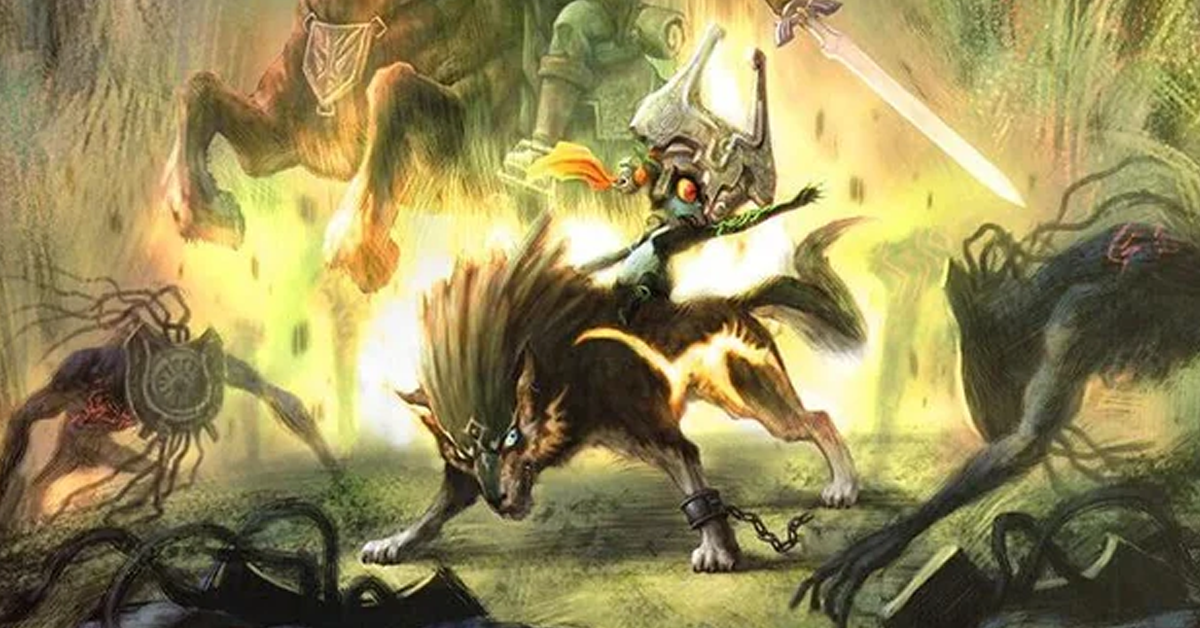
It was 2006. I bought a Nintendo Wii, and I bought Twilight Princess with it. I remember unwrapping it. I remember the box art, Wolf Link, Hyrule Field… all of it. But I did not finish that game. I barely started it.
Around that time, I was deep into Halo. Xbox Live was new, and Nintendo slid off my radar for a few years. It wasn’t until the Switch 1 and Breath of the Wild that my love for Zelda and Nintendo reignited.
I recently finished Twilight Princess for the first time, twenty years after the original launch, on Twilight Princess HD on the Wii U. It left me wondering why I never got to it sooner. It’s one of the best Zelda games I’ve ever played, and I’m someone who’s now spent hundreds of hours across most of this series.
Today I want to dive into my thoughts on Twilight Princess, and make good on something I should have done 20 years ago.
THE GAP
If you came to Zelda through Breath of the Wild or Tears of the Kingdom, which is true for a huge number of people watching this, you have it easier than any Zelda fan in history when it comes to playing the back catalogue. Ocarina of Time, Majora’s Mask, Wind Waker, Link’s Awakening, Skyward Sword. All of it is reachable on a Switch you probably already own, either as a native remaster or through Nintendo Switch Online.
Twilight Princess is the exception.
Unless you own a Wii, a Wii U, or a GameCube with the right memory card setup, or unless you’re willing to hunt down ageing hardware that’s no longer in production, you cannot play this game through any means Nintendo currently offers. Not through Switch Online. Not through a modern storefront. Nothing.
And this isn’t some minor, forgettable entry we’re talking about missing. This is, by most measures, one of the biggest Zelda games Nintendo has ever made. Combined across GameCube and Wii, it’s one of the best-selling Zelda games in the franchise’s history at around 10m sales, behind Breath of the Wild, Tears of the Kingdom and Ocarina of Time. It was also the highest-rated game released in 2006 across any platform and genre.
Here’s the important question I want to address today. Not “was Twilight Princess good?” We already know the answer. The question is why a game this significant, this well-reviewed, this commercially dominant, is the one major 3D Zelda left stranded on hardware most of the current fanbase has never owned. And whether Nintendo owes this game, and everyone who’s never had the chance to play it, a way back in.
I’m going to make that case by walking through what’s actually in the game. The dungeons. The items. The characters. The moments that make Twilight Princess, mechanically and structurally, one of the strongest entries the series has ever produced. I would love to hear what you think; share your Twilight Princess memories and thoughts in the comments.
ARRIVAL
I remember Twilight Princess’ arrival. It coincided with my first solo trip outside the UK. I went to New York City, and it was near Christmas because all the lights were up and the Christmas tree was there. I went to the Nintendo Store and got to play Twilight Princess a few days early. Not long before, fans had erupted at E3 in one of the most famous reactions to a game reveal ever. This was it, the grown-up Zelda game we had all wanted.
Wind Waker, released a few years earlier, had gone in a completely different direction: bright, cartoonish, oceanic. It divided fans on release, and a section of the fanbase spent years afterwards asking for something closer to Ocarina of Time in tone. Twilight Princess was Nintendo’s answer to that. Darker, more grounded, more overtly “mature” in its presentation, without losing the series’ core identity.
Twilight Princess landed as exactly what a large part of the fanbase had spent years asking for, and the reviews and sales at the time reflect that. The idea of it as the divisive one, the one fans argue about, developed later, well after release, once the series had moved on and people had years to compare it against what came next. That’s different from it always being the underdog. None of this is a case for an overlooked game finally getting its due. It’s a case for a game that was already recognised as excellent, and has been left behind by hardware since.
You start the game as Link, a ranch hand in Ordon Village, herding goats, fishing, doing chores for the village elder. It’s a slower opening than most Zelda games, and it works because it establishes what gets taken away. Ordon is a place with weight. When the children of the village are dragged into the Twilight Realm, and Link is pulled in after them, transformed into a wolf, the stakes feel personal.
That transformation is the game’s first real statement of intent. Link spends a meaningful stretch of the opening hours not as the hero with a sword, but as an animal, disoriented, unable to speak, dependent on a strange, sharp-tongued imp who has her own agenda. It’s a bold way to open a Zelda game. You’re stripped of power and have to claw your way back.
Once you’re returned to Hyrule proper as human Link, the scale of the world becomes apparent. Hyrule Field here is enormous, and traversing it on horseback, engaging enemy camps at a gallop, chasing down a runaway cart, riding with Epona through open plains, gives the game a sense of momentum earlier 3D Zelda titles never quite had. Twilight Princess is the first entry to build horseback riding into something you use constantly, not just in isolated set-pieces. Yes, you can ride Epona in Ocarina of Time, but here you actively battle on horseback in some of the most epic moments in the series.
By the time you reach Kakariko Village and start piecing together what’s actually happening to Hyrule, the game has already told you, mechanically, what kind of adventure this is going to be. Much bigger.
That slow build extends to how the game handles its side content too. Fishing is a fully realised minigame in its own right, not a throwaway distraction. Horseback archery and jousting turn Epona from a mode of transport into an actual combat platform. Poe hunting sends you tracking down ghostly enemies scattered across every region, rewarded through Jovani, a side character locked in his own house until you clear enough of them. All of it reinforces the same idea the opening hours already established: Hyrule here is a place you’re meant to spend time in, not just pass through on the way to the next dungeon marker.
The presentation backs all of this up. Michiko Naruke and Toru Minegishi’s score leans into the darker tone without ever losing the series’ melodic backbone, Hyrule Field’s theme in particular doing a lot of work to sell the sense of open, slightly lonely scale the game is going for. Visually, this was the most technically ambitious the series had ever looked at the time, and even now, viewed on the HD version rather than the muddier original release, the character work on Midna especially holds up: her expressions do a huge amount of the emotional lifting in scenes where Link, staying silent as the series has always kept him, physically can’t.
DUNGEONS AND ITEMS
If there’s one argument I’d put forward as the strongest case for Twilight Princess, it’s this: dungeon for dungeon, this might be the best lineup in the entire series.
Forest Temple opens things gently but cleverly. The dungeon’s signature trick is using monkeys scattered throughout to reach otherwise inaccessible platforms and ledges, turning traversal into a small puzzle of its own before you even factor in combat. Free a monkey from a cage, and it’ll carry Link to places he can’t reach alone, which turns what could have been a simple key hunt into something closer to a series of small trust exercises with the environment. The item you pick up here is the Gale Boomerang, an upgraded version of the classic boomerang that can pull air currents toward Link, letting him manipulate windmills, fan blades and enemies alike, and even yank distant items straight into his hands. The boss, Diababa, a plant-like creature with multiple heads, is built entirely around that new toy: you’re using the boomerang to sever heads and expose the weak point beneath, before the fight escalates into a straightforward but satisfying finish. It’s a clean, well-taught introduction to the dungeon-item-boss loop the whole game runs on, and a reminder that Ook, the monkey who guides you through the opening rooms, is doing more storytelling work than his few lines of dialogue suggest.
Goron Mines does something visually striking: the entire dungeon is rotated at will, using switches to reorient rooms and change which paths are open, sending Link and any nearby rolling boulders sliding to new positions as the geometry itself shifts. It’s a mining complex, so the puzzle logic makes sense as a place, and the Goron enemies patrolling it, rolling into a ball and charging like living wrecking balls, tie directly into that industrial theme. The Iron Boots, picked up here, let Link stick to magnetic surfaces and walk along ceilings and walls, which the dungeon uses constantly. The boss, Fyrus, is a corrupted Goron patriarch, and the fight against him uses the Iron Boots, pulling him down by a chain with the boots’ weight to expose him to attack before finishing him off. There’s a gut-punch to this one too: once the corruption is beaten out of him, he has no memory of what he did while transformed, and the dungeon’s antagonist turns out to be a victim of the same threat Link is fighting throughout the rest of the game.
Lakebed Temple puts Link fully underwater for the first time in the game, using the Zora armour acquired shortly beforehand to breathe and swim freely, and gives him the Clawshot. This grappling hook latches onto specific targets and pulls Link toward them, or pulls objects toward him. The dungeon is built almost entirely around chaining Clawshot movement together to traverse a flooded, vertical structure, swinging between grated ceilings and submerged targets in a way that makes the whole space feel like a single connected puzzle rather than a series of separate rooms. Morpheel, the boss, is a giant eel-like creature that spends the fight submerged, using the flooded arena itself as cover, and you’re using the Clawshot to latch onto its eye before it can retreat, before finishing the job on its exposed skeletal form once the water drains away.
Arbiter’s Grounds is where the game’s tone shifts. It’s an ancient prison built to hold something Hyrule itself once exiled, and the atmosphere alone – all cracked stone, sand pouring through broken ceilings, and forgotten Sheikah imagery – does a lot of narrative heavy lifting without a word of dialogue. The item here is the Spinner, a discus Link rides across specific tracks and walls, letting him cross gaps and scale surfaces no other item in the game allows, and it doubles as an effective weapon, mowing down groups of enemies as Link spins through them. It’s one of the most unusual traversal tools in the series’ history, closer to a vehicle than a weapon, and its restriction to specific rail-like tracks keeps it from ever feeling like it trivialises the level design around it. Stallord, the boss, is a reanimated skeletal guardian, and the fight uses the Spinner to wind around and dismantle its spine before the fight shifts into a frantic wall-riding chase against its detached, still-hostile skull, one of the more memorable tonal swings of any fight in the game.
Snowpeak Ruins is arguably the peak of the dungeon roster. Structurally, it’s a mansion rather than a temple, home to Yeto and Yeta, a couple whose domestic subplot – cooking soup, searching for a missing pot – runs alongside the puzzle-solving and gives the dungeon a warmth none of the others attempt. You’re actively helping Yeto track down ingredients and repair his relationship with his ailing wife long before you understand what’s actually wrong with her. The Ball and Chain, found here, is a heavy, satisfying wrecking weapon used to smash through ice blocks and armoured enemies, with a weight and impact to its swing that none of the game’s other items quite match. The boss, Blizzeta, is a corrupted version of Yeta herself, and beating the dungeon means saving her, which reframes the entire fight as a rescue rather than a kill.
Temple of Time strips things back to old-school Zelda puzzle logic: pressure plates, statues that must be repositioned to redirect beams of light, and a slower, more deliberate pace than the dungeons around it, closer in spirit to the temple puzzles of Ocarina of Time than anything else in the game. The Dominion Rod, picked up here, lets Link briefly control certain statues directly, walking them into position himself and effectively turning the environment into a controllable tool rather than a fixed obstacle. The boss, Armogohma, a giant infected eyeball spider, drops from the ceiling in a genuinely unsettling reveal, and is beaten by shooting its eye and then, memorably, finishing it off by slamming a statue down on it with the Dominion Rod, one of the few finishing blows in the series that draws a laugh rather than a cheer.
City in the Sky is a visual and structural high point: an entire dungeon built into a floating, mechanical Oocca city, all cogs, propellers, and updrafts, populated by the bird-like Oocca race, who feel alien compared to anything else in Hyrule. You get the second Clawshot here, turning the single grapple from Lakebed Temple into Double Clawshots, letting Link swing rapidly between two separate targets in quick succession, which the dungeon uses for some of the game’s best traversal sequences, chaining swing after swing across open air with nothing beneath but a very long drop. Argorok, the dragon boss guarding the way to the Mirror of Twilight, is fought almost entirely in mid-air, grappled onto with the Double Clawshots. At the same time, Link is pulled along its back, arguably the single most ambitious boss staging in the whole game.
Palace of Twilight and the final stretch through Hyrule Castle close the loop differently from the rest. Rather than introducing a new toy, they ask you to master everything you’ve already been given. Palace of Twilight sends you through a gauntlet built around the abilities Midna gains as her power returns, using her growing strength as both a story beat and a gameplay mechanic simultaneously, before the fight against Zant, a boss encounter that recycles the boss arenas and tactics from earlier dungeons as a callback to the whole journey.
Hyrule Castle, and the escalating fight against Ganondorf that follows, closes things out with one of the most drawn-out, dramatically staged final battles in the series: a puppeted Zelda forced to fight against her will, a monstrous Dark Beast form, a horseback joust across Hyrule Field with Zelda herself riding alongside, and finally a straight sword duel with no items, no gimmicks, just swordplay, timed parries and the Master Sword doing all the talking.
Taken as a whole, that’s eight main dungeons and a finale that consistently pair a distinctive space, a genuinely useful new item, and a boss fight built specifically around that item, better and more consistently than almost anything else in the 3D era.
Before we go on, thanks for watching. I am Triforce Times, and here, we dive deep into The Legend of Zelda, its design, lore, hidden stories, and everything Nintendo leaves unexplained. If you enjoy that, consider subscribing. Members get exclusive Zelda videos, early access to new content, and an invite to our community Discord. The join link is below.
THE TOOLKIT
Beyond the dungeon-specific items, Twilight Princess’s structure rests on the Light Spirits and the Twilight itself. Twilight consumes large sections of Hyrule, a corrupted, shadowy version of the map that only Wolf Link can properly navigate, with ordinary Hylians reduced to lost, wandering spirits within it and Shadow Beasts patrolling the gloom. Clearing it requires collecting Tears of Light, guided by Midna, restoring the Light Spirits one region at a time, and the Vessel of Light, the container used to gather and hold those tears, functions almost like a secondary collectable objective layered on top of the main quest for each region. As Wolf Link, Link also gains sense-based abilities: picking up scent trails, seeing hidden enemies, digging through specific patches of ground, none of which are available in human form, which means the two states of the character play differently rather than one simply being a costume on top of the other.
There’s a smaller but well-loved wrinkle to all of this too: the Hero’s Shade, an unnamed spectral figure who appears at set points to teach Link new sword techniques, hidden skills that expand combat well beyond simple sword swings, into spin attacks, jump strikes and finishing blows. It’s a quiet, almost melancholy subplot running alongside the main story, and it rewards players who go looking for it with useful new tools.
The most common complaint I’ve seen is pacing. Constantly toggling between wolf and human form, especially in the Twilight-covered regions, does interrupt momentum. You’ll be riding Epona at full speed through Hyrule Field, hit a Twilight boundary, and suddenly you’re on foot, fighting Shadow Beasts, chasing Tears of Light through unfamiliar terrain, before you’re allowed to continue. It is, at points, stop-and-go, and it’s a completely reasonable thing for a player to bounce off.
The wolf sections aren’t padding bolted onto the “real” game. They’re doing real work: gating access to areas, teaching you to read the map differently, and setting up Midna’s arc, since almost all of her character development happens specifically during the time Link can’t speak and has to trust her without argument. Cut the wolf sections out entirely, and you’d smooth the pacing, but you’d also gut a large part of what makes the back half of the story land the way it does. It’s a trade-off, not a design mistake, even if it’s a trade-off that won’t work for every player.
MIDNA AND ZANT
Midna is introduced as an unlikeable imp. Sarcastic, dismissive, openly using Link for her own ends, with no real interest in explaining herself. She mocks his wolf form, withholds information about what’s actually happening to him, and treats the entire opening act as a means to an end. That’s a brave choice, and it’s a risk few Zelda companions before or since have taken. Most of the series treats its companion characters as instantly warm guides, there to help from the first meeting. Midna spends the opening act actively withholding trust, which makes every small shift afterwards, a moment of genuine concern, a flash of vulnerability, land far harder than it would if she’d been likeable from the start.
The turning point most players remember is Zelda’s sacrifice roughly a third of the way through, giving up her own power to save Midna’s life after Midna is gravely injured. It’s a quiet scene, easy to underplay against everything else happening around it, but it’s the hinge the entire relationship turns on. From there, Midna slowly stops treating Link as a tool and starts treating him as someone she’s actually invested in. Her humour softens without disappearing entirely, because the game never turns her into a straightforwardly sweet character. She stays sharp-edged right up to the moment near the end where her own survival is put on the line for his, and that consistency of character is a large part of why the ending lands as hard as it does.
Zant, meanwhile, is one of the stranger villains in the series. He doesn’t play the fight straight, and he doesn’t play the character straight either, lurching between eerily calm and violently unhinged within single conversations. His boss encounter in Palace of Twilight throws Link back through the tactics and boss arenas of earlier dungeons, forcing you to recall and reapply what you learned fighting Diababa, Fyrus, Morpheel and the rest, before the fight escalates into something more hostile once those tactics stop working on him. It’s a clever piece of design: a final confrontation with the game’s secondary villain that’s built entirely out of the game’s own dungeon history, rewarding a player who’s been paying attention the whole way through, and it doubles as a narrative statement, since Zant’s power was never truly his own to begin with.
By the time Ganondorf is revealed as the true force behind everything, and the game shifts into its extended, multi-stage finale, both Midna’s arc and Zant’s fall are already resolved emotionally. Ganondorf gets the spectacle: the horseback duel, the sword fight, the last stand of the entire quest. Midna and Zant got the story that actually earns it.
THE CASE FOR BRINGING IT BACK
Twilight Princess is a game that launched to some of the best reviews of its console generation and went on to become, combined across two platforms, the best-selling entry the series has ever produced. It got a full HD remaster in 2016 complete with improved controls and quality-of-life improvements.
And yet here we are. Almost twenty years after release, and roughly a decade after that remaster, Twilight Princess remains the one major 3D Zelda without a genuine path onto modern hardware. Ocarina of Time, Majora’s Mask, Wind Waker and A Link To The Past are playable through Nintendo Switch Online. Skyward Sword got its own HD remaster on Switch. Twilight Princess got its HD treatment too, but it’s stranded on a console Nintendo has stopped supporting, with no Switch release, no Switch Online slot, nothing.
There’s an easy business case for fixing this, never mind the fan case. This is a proven seller, already fully built, already optimised for modern controls through the HD version. A Switch port is close to a formality, since the hardest work of dragging the game into a modern control scheme was already done a decade ago. Nintendo Switch Online adding GameCube titles has already set a precedent that this kind of back-catalogue access is something the company is willing to build, and it makes the continued absence of Twilight Princess specifically feel like a gap that’s gone on for a long time.
Think about what that gap actually means in practice for a newer fan. Someone who picked up a Switch for Breath of the Wild, fell in love with the series, and decided to work backwards through the catalogue can, with very little friction, play Ocarina of Time, Majora’s Mask, Wind Waker, Link’s Awakening and Skyward Sword, all on hardware they already own. Then they hit Twilight Princess and the trail stops.
And there’s a simpler case too, the one I opened this video with. I owned this game in 2006, on the console it was built to sell, and I still nearly missed it. There wasn’t anything wrong with the game. Life happened, and a decade slipped by. I only got there because I happened to have TPHD on Wii U. Still, most people currently discovering this series through Breath of the Wild and Tears of the Kingdom don’t have that. They have a gap in the collection, and no easy way to fill it.
Twilight Princess needs to be rescued from a hardware generation nobody plays anymore. That’s a much smaller ask than it sounds like, and it’s one Nintendo is entirely capable of granting.
THE ART DIRECTION
Nothing in Twilight Princess looks quite right, and that’s down to the art direction in the game.
Art director Satoru Takizawa split the design work across specialists rather than handing it to one team. Yusuke Nakano led the design of Link, Midna, and the game’s other major characters. Satomi Asakawa led general character design. Yoshiyuki Oyama led enemy design. Three different design sensibilities worked from the same brief: grounded and realistic, but never photorealistic, and never quite comfortable.
Midna is the clearest example. In her imp form, she’s asymmetrical by design: a single glowing red eye, sharp uneven teeth, hair that moves like it has its own intentions. She’s designed to be a little wrong to look at, which mirrors exactly how the game wants you to feel about her before you trust her. Zant’s helmet takes that further. Nakano has said he drew directly from bronze artefacts of the Shang dynasty for both the Fused Shadow and Zant’s helmet, which is an unusual reference point for a Zelda villain, closer to ancient ritual metalwork than anything typically associated with fantasy game design. It gives Zant a texture. The helmet itself is a piece of character design too: it has a retractable mouth guard, closed when Zant is holding himself together, drawn back the moment his control finally slips in the Palace of Twilight.
That same instinct runs right down to the game’s lightest characters. Ooccoo, the warp item turned character, is literally an older woman’s head poking out of a bird’s body, riding around in a jar. Agitha is a bug-obsessed young noblewoman dressed somewhere between a Victorian doll and a beetle. Neither is remotely frightening; both are played for laughs, and both are still a little unsettling to actually look at. Even the more grounded human designs carry it: NPCs across Hyrule tend to have slightly too-large heads, slightly too-small eyes, or proportions that sit just off from naturalistic, close enough to real to unsettle rather than comfort.
This isn’t just a byproduct of the game’s realistic art style. It’s a tonal choice, applied across heroes, villains, enemies, and comic relief alike, and it’s what makes the Twilight itself work as more than a plot device. This is a game about a boundary between two worlds bleeding into each other, and that idea shows up on every character model, not just the map. Even the friendliest face in Kakariko Village carries a hint of the same strangeness as the monsters in Arbiter’s Grounds. Twenty years on, and across every art style this series has tried since, nothing else in the Zelda catalogue looks quite like this game does.
WHAT THE DEVELOPERS SAID
Nintendo ran a series of Iwata Asks interviews around the game’s release, developer roundtables led by then-president Satoru Iwata, and reading back through them now, twenty years later, is a useful way to understand why this game holds up the way it does.
The wolf transformation, one of the game’s biggest risks, started as a throwaway pitch. Director Eiji Aonuma has said he floated the idea almost as a test to see how seriously the team would take it, and that Miyamoto’s first reaction was blunt: a four-legged animal is a lot harder to animate convincingly than a two-legged human. That tension between ambition and craft runs through the whole development story. Iwata himself pushed the team with a phrase that stuck: he wanted this to be, in his words, “120% Zelda,” and that demand is part of why the game’s release slipped by a full year.
The Wii conversion nearly went badly wrong in public. When an early motion-control build showed at E3, the reaction from hardcore fans and from people close to Miyamoto was, by Aonuma’s own account, close to brutal. The team went back to first principles afterwards, watching what players did instinctively with the Wiimote rather than what the original control scheme assumed they’d do. It was that instinct, players naturally swinging the remote like a sword or miming a fishing rod even when the game didn’t require it yet, that shaped the control scheme that eventually shipped.
There’s a whole physics system for wooden signpost pieces floating down the river once you’ve cut them apart, built, by Miyamoto’s own account, at roughly the same cost in development time as animating one of the horses. A handful of the village children were coded to visibly flinch and duck if Link swings his sword near them, a detail nobody asked for and that most players will never notice. And Nishimori, the animator responsible for Link’s movement and the horseback combat sections, has talked about going out and actually riding a horse himself during development, specifically to understand what it feels like to not quite be in control of a large animal, because he felt it would show up in the finished animation if he didn’t.
The order in which Link learns his hidden sword techniques wasn’t fixed by design logic; Miyamoto overturned it personally. The finishing thrust was originally saved for later in the game, and Miyamoto pushed to have it taught right at the start instead, on the basis that nobody wants to be taught a boring move first. The team had to rework a chunk of the early game to accommodate it. In the final week before the game’s playable debut at E3 2005, with a fully realistic Link already built, Miyamoto caught something the team had carried over unquestioned from every previous Zelda game: Link used the same climbing animation for a ladder as he did for a wall of ivy.
OUTRO
I nearly missed one of the best games this series has ever produced, by accident, through Nintendo just falling off my radar. Twenty years later, I got lucky enough to find my way back to it. Right now, Nintendo is making that outcome difficult for newer Zelda fans.
Before I go, I want to briefly summarise why I now love Twilight Princess, and why you should seek it out. A lot of this video has been making the case with facts and figures, and that’s not really why I love this game.
The story is one of the best the series has told. Full stop. One of the best, start to finish.
I didn’t like Wolf Link to begin with. I found the early hours with Midna difficult to warm to. But that’s exactly why the turn works. There’s a stretch, after Zant strikes Midna down in the Palace of Twilight, where you’re racing through Hyrule Field as human Link with Midna dying in front of you, trying to get her to Zelda in time, and by that point in the game I wasn’t rolling my eyes at either of them anymore. I was gripping the controller. That ride is one of the best individual moments I’ve experienced in any Zelda game, and it only lands because the game earned my patience with both characters first.
The dungeons feel like a return to form after Wind Waker, and I don’t say that as a knock on Wind Waker; I say it as someone who wanted exactly what Twilight Princess delivered. Temple of Time, Snowpeak Ruins, and the whole back half of the dungeon list are some of the best the series has ever built.
Zant is just a brilliant villain. Strange, unstable, unsettling in a way Zelda villains rarely get to be, and the fight against him is one of the best boss encounters in the series precisely because of that.
And I love the art direction. It’s a strange, moody, slightly off-kilter look that nothing else in the series has quite matched since, and twenty years on, it still doesn’t look like anything else Nintendo has made.
Twilight Princess deserves better than being locked away. It’s earned its place on modern hardware several times over, through its reviews, through its sales, through the sheer amount of it that still holds up today, from the dungeon design right through to characters like Midna who still stand among the best the series has ever written. Here’s hoping it finally gets there, and here’s hoping it doesn’t take another twenty years.
If you enjoyed this one, the best thing you can do is hit subscribe. It helps a channel like this get in front of more people who love this series as much as we do, and there’s a lot more of this coming.
Before I go, I want to say a proper thank you to everyone who supports this channel through membership. Whether you’re a Hylian, a Sheikah Scholar, or one of our Ancient Sages, this channel doesn’t happen without you, and I mean that.
Speaking of Ancient Sages, huge thanks to Tarnished_Hylian, supersonicmariokirby, EldritchKhaotic, PrepayingOne, and Romulus879. You lot keep this channel running, and I appreciate every single one of you.
If you’re not a member yet and you want in on the exclusive Zelda club, membership gets you access to our growing library of exclusive Zelda videos, early access to everything we put out, and an invite to our community Discord. Link’s down below if you fancy it.
Thanks so much for watching. I’ll see you in the next one.
Leave a Reply