
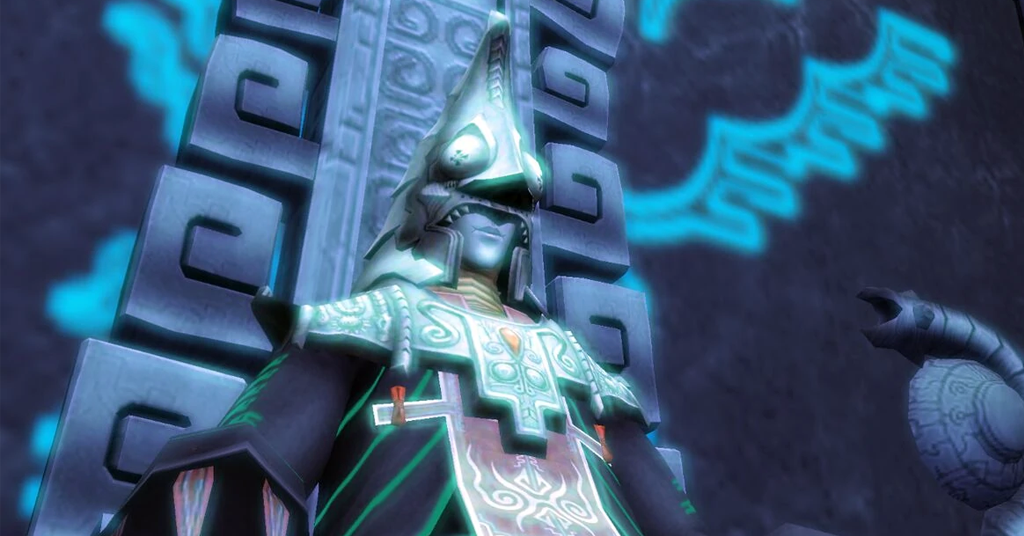
Picture the throne room in Hyrule Castle. Zant stands in front of Zelda, posing a single question: Live or die. She surrenders her kingdom on the spot to save her people.
Zant never once sits on that throne. He gets Zelda’s total, unconditional surrender, and he still doesn’t sit down. He doesn’t claim the seat. He stands over it, asks his question, and moves on. That image is the closest this game ever lets him get to looking like he’s won, total command over the one kingdom left standing between him and everything he wants, and even here, in the one moment written to look like victory, something about it doesn’t quite sit right. He’s got the surrender. He never takes the throne itself.
By the time the credits roll, Zant will have lost the throne he wanted (a throne he never even properly took), lost the power he used to take it, and lost even the right to decide how his own story ends. Someone else will make that decision for him. Not Link. Not Ganondorf. Someone he spent the whole game trying to destroy.
Today I want to talk about Zant. Not that he’s mad. Not that he’s a pawn, though he is one. The case is bigger than that. Across the entire game, in every scene he appears in, Zant never actually rules anything. Not the Twilight Realm. Not the power he wields. Not even, in the end, his own death. He’s called the Usurper King. Midna calls him the King of Shadows. He earns neither title.
I’m going to walk through three things that were supposedly his: his throne, his power, his composure, and his death. And I’m going to show you that none of them ever really belonged to him.
Before we go further: I’m Triforce Times. Here, we dig into The Legend of Zelda, its design, its lore, and the stories Nintendo tells without ever quite spelling them out. If that’s the kind of thing you’re into, subscribe and stick around; there’s a lot more of this coming. Right, back to Zant.
THRONE
Twilight Princess never gives Zant an origin scene. No flashback, no monologue explaining his childhood, no moment where the game sits you down and says “here is why this man became this”. Compare that to Ganondorf, who gets a backstory stretching across multiple games, a motive rooted in the suffering of his people, a tragedy underneath the villainy even when the game doesn’t dwell on it. Zant gets none of that. What he gets instead is a single, late-game revelation, delivered not by him, but about him.
It happens at the Mirror Chamber, and not early either. Only once Link and Midna have tracked down all four Shards of the Mirror of Twilight, scattered across Snowpeak, the Temple of Time, and the City in the Sky, and returned to piece it back together, do the Ancient Sages finally tell them something the game has been sitting on for most of its runtime. Midna isn’t just a Twili with unusual power. She is the original ruler of the Twili. Zant suppressed her power and transformed her body into the imp form Link has been travelling with since the opening hours.
It doesn’t come from Zant explaining himself. It comes from a third party, confirming a fact the audience didn’t even know was in question. You’ve been travelling alongside the rightful ruler of the Twilight Realm for the better part of the game, and the game never told you. Which means you’ve also been fighting the man who took that from her, without ever being shown, at this point, the moment he decided to take it.
Twilight Princess HD labels him, on screen, the Usurper King. Not a neutral description. A verdict, built right into the name the game hangs on him. Before Zant gets a single word to explain himself, the label has already told you how to read everything he does.
Zant eventually gets a scene where he explains himself in his own words. It’s just much later than you’d expect, and it comes at a very specific moment, right before the fight that ends his run as the story’s active threat. For the entire first two-thirds or so of the game, his motive exists purely in the past tense, confirmed by other people, never spoken by him.
A villain who explains himself early is a villain the story is willing to spend time on from the start. A villain the story only describes secondhand, for as long as this one does, is a villain the story has decided isn’t worth that time yet.
Ganondorf, across nearly every game he appears in, gets his motive stated plainly and repeatedly: a leader of a desert people who watched Hyrule’s fertile land go to everyone but his own, reaching for the Triforce to correct that. You don’t have to sympathise with him to understand him. The game wants you to understand him. Zant spends most of Twilight Princess with no equivalent moment. Whatever grievance sits underneath “I should have had that throne” stays entirely secondhand, filtered through other people’s testimony, for the majority of Twilight Princess.
POWER
So if the throne was never really his, what about the power he used to take it? Surely that much is his own. Actually, no.
Ganondorf’s presence in Twilight Princess is hidden for most of the game. You don’t hear his name at all until well past the halfway point. The first hint comes earlier, though, roughly a third of the way through, when Zant ambushes Link and Midna at Lanayru Spring, having just collected all three Fused Shadows. He seizes them, curses Link into wolf form, and, when Midna refuses to join him, exposes her directly to the light of the Lanayru Spirit rather than let her walk away. In the middle of all that, he lets slip something else: that whatever power he’s wielding, it isn’t his own. He doesn’t name a source. Just an admission that it’s borrowed.
The name comes later, and from someone else entirely. Once Link and Midna reach the Mirror Chamber, having fought through Arbiter’s Grounds, the Ancient Sages tell them plainly: Zant’s power comes from Ganondorf. Not some passing mention either. The Sages lay out exactly who Ganondorf is and how he ended up in a position to make Zant an offer at all—sentenced to death for trying to seize control of the Sacred Realm, executed by the Sages themselves, and surviving that execution only because he already carried the Triforce of Power. He broke free of his chains, killed one of the Sages outright, and was banished into the Twilight Realm with the last of their strength, sealed away using the very Mirror Zant would later shatter trying to reach Hyrule.
That reveal recontextualises everything Zant did up to that point. His invasion of Hyrule. His curse on Midna. The Shadow Beasts his own people have been turned into. None of it happened because Zant found some hidden reservoir of power within himself. It happened because he was handed a weapon by a prisoner using him.
And think about what that means for the Twili people. Zant doesn’t just usurp a throne; he inflicts real, visible suffering on his own people to secure it, turning them into mindless Shadow Beasts as part of his invasion. That’s the cost of the power he’s borrowing. He is doing to an entire race exactly what’s about to be revealed as having been done to him: used as an instrument by something stronger, with no say in the outcome.
Ganondorf, in this timeline, is a sealed, banished threat, a prisoner in the Twilight Realm at the exact moment Zant comes looking for power. A dangerous one, but a prisoner all the same. Which means the entire chain of events that lets Zant invade Hyrule exists only because Ganondorf needed a vessel to act through while he was contained.
There’s a version of this story where Zant discovers this power on his own terms, wields it as an equal partner in whatever Ganondorf is planning, and the game frames their relationship as an alliance between two ambitious men. Twilight Princess never frames it that way. Every scene between them, even the ones we only hear about secondhand, positions Zant as the recipient of a gift he didn’t earn and doesn’t fully understand the terms of. He talks about darkness and light meeting at last, about grand cosmic purpose, in the exact register of someone who has been told what to believe rather than arrived at it himself.
Every region Link travels through on the way to restoring the Light Spirits is, at that point, still cloaked in Twilight, its Hylian inhabitants reduced to lost, wandering spirits, unaware of what’s happened to them. That’s the visible, ongoing cost of Zant’s rule, playing out across the entire overworld for as long as it takes Link to undo it region by region. And it’s worth asking what that actually demonstrates about him as a ruler. A king who had genuinely mastered the power he was using might have shaped that occupation into something with intent behind it, a new order imposed deliberately, however monstrous. What you get instead is closer to a wound left open across the map. Spirits drifting without purpose. Enemies patrolling without direction beyond guarding territory that was never meant to be governed, only held.
And then, once he’s used that power to secure the throne and invade Hyrule, what does Zant actually do with it? He doesn’t build anything. He doesn’t establish some new order, twisted or otherwise, across the Twilight-shrouded Hyrule he now supposedly rules. He sends Shadow Beasts out to drain the light from each province and waits. That’s the extent of his rule. Occupation. A king who took a kingdom and then had nothing to do with it beyond guarding what he’d stolen.
Compare that, again, to how differently the game could have shown a villain in genuine command of stolen power. Total confidence. Visible expansion of control. Zant spends the middle stretch of the game essentially static, waiting for Link to come to him, because the power he’s holding was never something he knew how to wield beyond the initial theft. He forced the surrender. He never actually settled into ruling anything.
If any of this sounds familiar, it should. This series has built this exact shape of villain before. A Link to the Past gives you Agahnim, the wizard who worms his way into the King of Hyrule’s trust, murders him, and seizes the castle in his name. For most of that game, Agahnim looks like the source of the threat—the final confrontation. And then, right at the end, it turns out he’s a servant of Ganon the whole time, a vessel Ganon is using to reach Hyrule while sealed away himself. Kill Agahnim, and Ganon’s spirit simply leaves the body and returns to its own.
Zant is doing the same job, fifteen years and several console generations later—a local face for a larger, imprisoned power that needs a vessel to act through. The details differ. Agahnim disguises himself as a trusted advisor; Zant takes the throne outright. But the underlying architecture is identical: a man who looks, for most of the runtime, like the villain you’re supposed to be worried about, who turns out to be borrowing every bit of the authority that makes him frightening. Twilight Princess didn’t invent this shape of villain. It’s one of this series’ oldest tricks, and Zant might be the version of it the game commits to most fully, because unlike Agahnim, Zant never even gets the dignity of disguising the fact that he’s someone’s tool. He knows exactly what he is, and reaches for it anyway.
ONE KEY DECISION
If the throne wasn’t his, and the power wasn’t his, was there ever a single moment in this entire story where Zant acted purely on his own will? There’s one. And it’s the moment that destroys him.
After seizing the Fused Shadows at Lanayru, Zant tries to recruit Midna. Offers her a place alongside him, in whatever partnership he imagines the two of them having with the power he’s just claimed behind it. She refuses. And here, for the only clear time in the entire game, Zant makes a decision that isn’t handed to him, isn’t dictated by the terms of the power he’s borrowing, isn’t a reaction to something Link has just done to him. He chooses, out of nothing but his own spite, to manipulate the Light Spirit Lanayru into exposing Midna directly to its light, an act he knows will tear her apart from the inside.
Midna dead achieves nothing for his throne, nothing for his alliance with Ganondorf, nothing that the power he’s already holding requires of him. It’s punishment, plain and simple, for being told no.
And it’s the worst decision he could have made, because it’s the one that unravels everything. Link, transformed back into a wolf and unable to stop what’s happening, carries Midna’s dying body to Zelda. Zelda sacrifices her own physical form to save her. And that act, Zant’s one truly independent choice rippling outward through someone else’s selflessness, is the exact hinge the entire rest of the story turns on. It’s the moment Midna stops treating Link as a tool and starts treating him as someone worth trusting. It’s the emotional turning point of the whole game.
Zant’s only unscripted act in Twilight Princess doesn’t advance his own cause even slightly. It turns his enemy from an unlikeable ally into an invested one. He reaches for the one moment of pure agency available to him, and uses it to manufacture his own downfall. Every other beat of his story is reactive, borrowed, or delivered secondhand. This is the one exception. And it backfires so completely that you could argue the rest of the game’s back half- Midna’s growing resolve, her eventual willingness to sacrifice herself against Ganondorf- exists because of that single spiteful decision Zant made entirely on his own.
It’s also, structurally, the last time Zant gets to act as the primary threat driving the plot forward. From this point on, the story’s momentum belongs to Link, Zelda, and Midna. Zant becomes more of an obstacle to be cleared.
So that’s two of the three things this video is arguing were never really Zant’s. The throne, confirmed by other people rather than earned on screen. The power, borrowed from a prisoner who needed a delivery mechanism. One more to go, and the third one is about something you can watch happen in real time, in a single scene, if you know to look for it.
COMPOSURE
For most of Twilight Princess, Zant presents as calm. Deliberate. Almost ceremonial in how he carries himself, a figure who speaks slowly and moves with the stillness of someone entirely certain of his own authority. That composure is doing a huge amount of work in how the game wants you to read him early on. It reads as mastery. As someone who has this all under control.
It isn’t. And the game tells you that outright, the moment Link actually catches up to him.
When you finally confront Zant directly, in the Palace of Twilight, he talks before he fights. It’s the one place in the entire game where Zant explains himself, in his own words, at last. He tells Link and Midna he was denied the Twili throne, so he turned to what he calls a “God”, who gave him the power to usurp Midna and take the crown for himself.
Listen to the shape of that explanation, because it’s not the case for himself you might expect after waiting two-thirds of a game for it. It’s not “I deserved this and here’s why.” It’s “I was denied this, and someone else gave me the means to take it anyway.” Even in the one scene the game finally hands him to justify everything, his own account of his own rise is still a story about things being done to him and things being given to him. He never once describes seizing anything through his own strength.
And then, mid-conversation, that composure doesn’t hold. He shifts, sometimes within a single exchange, between an eerie, controlled calm and something closer to genuine unravelling, before the fight itself even starts. The performance cracks. Not gradually, not through some slow character arc where you watch the mask slip over hours of gameplay, but suddenly, in the very scene where he’s finally been given the floor.
His stillness was never strength. It was the appearance of strength. The moment Link stands in front of him and refuses to be intimidated, the performance has nowhere left to hide behind. What’s underneath isn’t a colder, more dangerous version of the calm Zant. It’s something closer to panic.
Think about what that says about everything Zant does earlier in the game. The way he manipulates Lanayru against Midna. The way he addresses Link and Midna with that same detached, ceremonial register even while committing genuine cruelty. None of it was ever the behaviour of someone secure in his own power. It was the behaviour of someone who needed everyone around him to believe he was secure in his own power, because the alternative was admitting he wasn’t.
This is a different reading of Zant than “he’s an unstable villain who eventually reveals his madness”. The instability isn’t a late-game twist. It’s been there the entire time, just hidden behind a performance good enough that most of the cast, and most players on a first run, don’t clock it until the game forces the mask down. He was never in control.
There’s a useful comparison here to how the game handles Ganondorf’s composure in the very same story. Ganondorf stays largely unruffled even in defeat, right up to his final duel with Link, because his calm is backed by genuine, demonstrated capability across multiple games. Zant’s calm is backed by nothing. Two villains, both presenting the same outward stillness, for two completely different reasons. One of them has earned it.
DEATH
Link is the one who defeats Zant in battle. That’s true, and it’s an easy thing to remember the fight as “you beat Zant”. But defeating him in combat and ending his story are two different things, and Twilight Princess is careful to keep them separate.
After Link brings Zant down in the duel, Midna regains the Fused Shadows Zant stole from them both back at Lanayru Spring. Before it’s over, Zant gets one last line in: Ganondorf has been reborn, he says, and his master will bring him back. Midna doesn’t wait to find out if that’s true. She uses the Fused Shadows, now back in her hands, to destroy him herself, on the spot.
Killing Zant doesn’t even free Midna from her own curse; that only happens later, once Ganondorf himself is finally dealt with. Her decision to end Zant is her decision, made in the moment, for her own reasons. Link wins the fight. Midna kills Zant.
The game’s supposed final confrontation with its secondary villain doesn’t end with the traditional beat of hero triumphing over villain in decisive, narratively satisfying combat. It ends with the hero’s victory becoming a precondition for someone else’s separate, colder decision. Zant’s death isn’t staged as Link’s moment. It’s staged as Midna’s. He doesn’t even get ownership of his own ending.
And once he’s gone, watch how little the plot actually changes. Ganondorf is still out there, and the barrier he’s placed around Hyrule Castle still has to be broken before anyone can reach him. The larger threat the entire game has been building towards was never really Zant, and his death barely functions as a plot beat at all beyond closing off Midna’s personal arc with him. Compare that to how most Zelda games treat a secondary villain’s defeat: as a clear escalation, a raising of stakes, a moment the story pauses to acknowledge before pushing into its final act. Twilight Princess doesn’t really pause for Zant’s death. It happens, and then the game moves on to Ganondorf almost immediately, because Zant, even in dying, was never the centre of the story.
Think back to Agahnim for a second, because the parallel holds right through to this final beat too. Killing Agahnim in A Link to the Past doesn’t actually end the threat either; Ganon’s spirit simply leaves the body and carries on. The vessel dies. The thing using the vessel doesn’t even notice. Zant’s death works the same way structurally, except Twilight Princess adds one further layer of indignity on top of it: he doesn’t even get killed by the hero chasing him.
Every throne, every ounce of power, and every performance of control – none of it was ever fully his. Somebody else always ends up holding the actual authorship of what happens to Zant. The Ancient Sages reveal his usurper status. Ganondorf supplies his power. His one independent act backfires and hands momentum to his enemies. And his death is decided and delivered by the woman he wronged.
THE MANGA, BRIEFLY
Worth a quick note here, because it comes up a lot when people talk about Zant online. The Himekawa manga adaptation of Twilight Princess, published years after the game, gives Zant a considerably more personal backstory involving his relationship with Midna before the events of the story. That’s manga content, not game content. It’s a different creative team’s interpretation, made a decade later, and it isn’t part of what Nintendo actually shipped in 2006.
It’s a different character in places. The manga’s Zant has a specific personal history with Midna that gives his resentment a much more direct, individual shape than anything the game commits to. That’s an interesting version of the character, and if you’ve read the manga, you might find him more sympathetic, or more disturbing, depending on how you read it. Everything we have discussed so far comes from what’s actually on screen when you play Twilight Princess. If you want the manga’s take on him, that’s a separate story for another day.
FINAL THOUGHTS
The throne was never his, confirmed by other people first, and even when he finally explains himself much later, in the Palace of Twilight, his own account is still a story about being denied and being given, never a story about earning anything through his own strength.
The power was never his either, borrowed from a sealed, imprisoned threat who needed a vessel to act through, turning Zant into exactly the kind of instrument he was inflicting on his own people.
His one moment of genuine independent choice, refusing to let go of Midna’s rejection, backfired so completely it created the emotional turning point for his enemies rather than any advantage for himself.
His composure, which reads as mastery for most of the game, cracked the moment he was finally given the floor to explain himself.
And his death, the one thing that should at minimum belong entirely to him, was decided and delivered by someone else, for reasons that were fundamentally about her, not him, and didn’t even resolve anything for her in the end.
That’s a villain who never actually had anything to begin with. The Usurper King, the label the game itself hangs on him, is a verdict dressed up as a title. Even Zant’s own explanation of himself, when he finally gets to give one, never actually contradicts it.
I think that’s actually a more interesting piece of writing than “mad usurper with a god complex”, which is the reading Zant usually gets reduced to. The madness isn’t the point. The madness is a symptom of a much colder observation the game is quietly making about him: some people who reach for power were never built to hold it, and the story doesn’t need to punish them dramatically for that. It just needs to keep gently, patiently showing you that nothing they’ve taken was ever actually theirs.
It’s worth remembering that this series has told a version of this story before, with Agahnim, and will likely tell it again in some form, because it’s a genuinely useful shape for a Zelda villain. The face-level threat who turns out to be someone else’s instrument. What makes Zant the sharpest version of that shape isn’t that the twist is more surprising. It’s less surprising here than it was with Agahnim, since the game shows its hand a third of the way through rather than saving it for the final act. What makes Zant sharper is that the game keeps finding new places to repeat the same idea- throne, power, composure – until it stops feeling like a single twist and starts feeling like the entire design of the character.
Zant thought he was writing the story of his own rise. Twilight Princess was always writing something else. A story about a man who usurped a throne, borrowed a god’s power, and by the end, didn’t get to author a single meaningful part of his own ending.
OUTRO
If you enjoyed this one, the best thing you can do is hit subscribe. It helps a channel like this reach more people who care about this series as much as we do, and there’s a lot more coming.
Before I go, a proper thank you to everyone supporting this channel through membership. Whether you’re a Hylian, a Sheikah Scholar, or one of our Ancient Sages, this channel doesn’t happen without you.
Speaking of Ancient Sages, huge thanks to Tarnished_Hylian, EldritchKhaotic, supersonicmariokirby, PrepayingOne, and Romulus879. You lot keep this channel running. If you’re not a member yet, membership gets you exclusive videos, early access to everything we make, and an invite to the Discord. Link’s below. See you in the next one.
Leave a Reply