
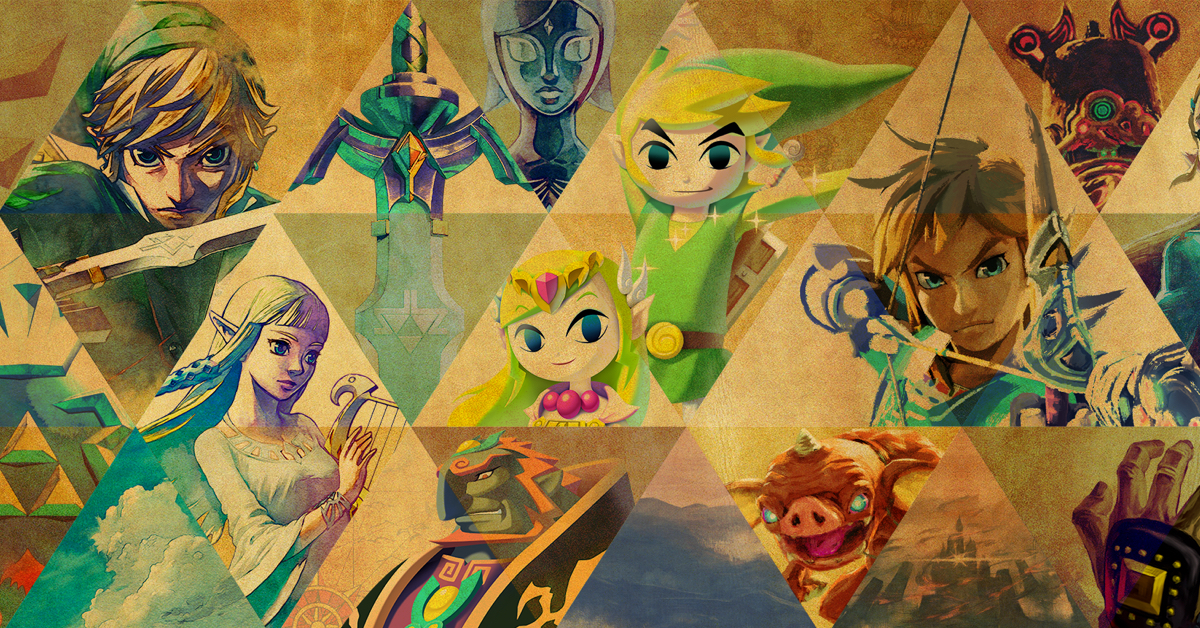
Forty years ago, The Legend of Zelda invited players into Hyrule, offering no instructions or map markers. That sense of exploration and discovery remains core to the series today.
With the 40th anniversary this weekend, speculation has been swirling about Nintendo’s next move —remakes, ports, a return to classic dungeons, or another take on open world gameplay. While these ideas are great fun I didn’t want to make a wishlist video for this anniversary. Rather than look at what I want from Zelda, I thought I’d have a another look at what it’s already given me, and the wider Zelda community.
When I look back on my life, I remember Zelda games — their launches, the places I played them, and the people who played beside me. They mark childhood evenings, summer breaks, rebellious teenage days, first steps into independence, and even the times as an adult when I paused everything just to return to Hyrule.
The Legend of Zelda has been a steady companion in the background of my life. Even as the art style changed, the hardware evolved, and the industry shifted, one thing stayed the same: the feeling of stepping into something bigger and believing you could overcome it.
I know I’m not alone in this feeling. Recently, many of you have shared memories—playing Zelda with parents, siblings, friends, partners, even your own children. Later in this video, I’ll highlight some of those stories, because Zelda’s 40th anniversary celebrates not just a franchise, but the lives intertwined with it.
Next, I’ll share my thoughts on Zelda over the years. Before that, please consider subscribing to the channel and liking the video—it really helps get the word out. I also have some great exclusive content for members, so check out channel memberships by hitting the join button. You’ll get early access to regular videos and special members-only content.
Childhood – Zelda II: The Adventure of Link and My Dad
When I think about my childhood, I think of sitting in front of an old CRT television at night, curtains drawn, the hum of a Nintendo Entertainment System. I’m cross-legged on the floor, controller in hand, my Dad beside me. On the screen: Zelda II: The Adventure of Link.
Zelda II is remembered as the odd one out. The difficult one. It dropped the top-down exploration of the original and introduced side-scrolling combat. This new style felt more reactive and punishing. Enemies blocked your attacks. Ironknuckles forced you to think before swinging. Dungeons required memorisation and precision. When you died, the screen offered no comfort—it faded to black and flashed the chilling words: “Return of Ganon.” It was harsh.
What I remember is playing together with my Dad. Passing the controller back and forth. Watching carefully when it wasn’t my turn, trying to understand how to block correctly, how to crouch at the right moment, how to time a jump. I didn’t fully understand experience points or levelling up Attack, Magic, or Life. I didn’t grasp that Nintendo was experimenting with RPG systems or reinventing Zelda’s identity. I just understood that this world was difficult, and that we were facing it together.
Zelda II replaced the mystery of exploration with the discipline of overcoming tough enemies. It rewarded patience and persistence. Every mistake had consequences. But sitting next to my Dad, those consequences didn’t feel frustrating or annoying. This was something we could do together.
Looking back now, I realise how radical Zelda II was for its time. Nintendo could have easily created a larger version of the original Legend of Zelda and satisfied expectations. Instead, they rebuilt the formula. They introduced towns and named characters. They gave Link spells instead of just items. They layered in levelling systems and a structured world that demanded growth through struggle. It was risky.
Zelda II taught perseverance in a way few games could. It demanded that you learn patterns, accept setbacks, and try again. Without realising it, I was absorbing that lesson. That progress sometimes meant grinding through something difficult. There is something beautiful about the contrast between the game’s tone and the memory it created. On screen, Hyrule was lonely, dangerous, and unforgiving. The music was urgent. The resets were punishing. The game world was harsh, but the experience wasn’t.
When people revisit Zelda II today, often softened by save states and rewind features, they talk about rediscovering its brilliance. They speak about its combat, its ambitious structure, and its forward-thinking design. And they’re right. Beneath its difficulty is a great game. But for me, I never needed to reevaluate it – your first Zelda game always sticks with you.
Forty years of Zelda is a celebration of a series that reinvents itself. For me, it begins with that room, that television, and that shared adventure. When I think about what Zelda has given me, it’s the childhood memory of sitting beside my Dad, facing something difficult together.
Friendship – A Link to the Past in the Summer Holidays
There’s something about the opening of The Legend of Zelda: A Link to the Past that still lives in my memory with almost cinematic clarity. The sound of rain against rooftops. Thunder rolling across a sleeping kingdom. A quiet house at night, while the world outside feels on the edge of something bigger. Even before you press a button, it feels like you’re stepping into a story. During one particular summer holiday, my best friend and I stepped into that story.
As a kid, summer holidays felt endless, time unrushed. No looming deadlines, no early alarms. Only sunlight through the curtains and the understanding: today, we adventure in Hyrule. I never played A Link to the Past alone—it was an adventure shared, sitting with a friend, debating our next move and speculating about secrets.
If Zelda II had been about perseverance with my Dad, A Link to the Past was about discovery with someone my own age. Larger, brighter, more alive—it felt transformed. Hyrule was a living world. Forests stood dense, and villages seemed warm and inhabited. No longer urgent and punishing, the music played adventurously, almost optimistically. With clarity and flow, the game guided us. The world opened gradually, placing trust in you to notice patterns, to test theories, and to experiment.
And then came the Dark World.
I still remember that first transformation. The moment we realised that the map we thought we understood was only half the story. That every location had a reflection — twisted, corrupted, reimagined. It was one of those rare gaming moments. If there are two worlds layered on top of each other, what else are we missing? That idea changed the way we explored. We stopped just moving forward and started thinking. Started experimenting with the mirror, testing how actions in one world might affect the other.
What made that summer special wasn’t just the brilliance of the design, though in hindsight it truly was the blueprint for modern Zelda. Before guides were instant, before every secret was catalogued online, we had to figure it out ourselves. We got stuck. We misread clues. We wandered aimlessly sometimes. We’d talk through puzzles. Debate whether that cracked wall meant something. Return to an earlier area with a new item just to see what might change.
Each dungeon gave you a new ability that didn’t just solve the immediate challenge, but recontextualised the entire world. The Hookshot. The Pegasus Boots. The Magic Mirror. There was something amazing about the pacing of A Link To The Past. The game knew when to challenge and when to let you breathe. It knew when to reward you with a secret heart piece. It never overwhelmed, but it never underestimated you either. And because we had the luxury of summer time without urgency, we could sit with it. Absorb it. Let Hyrule feel like a place we inhabited.
A Link to the Past is still my favourite Zelda today. Often your first Zelda is your favourite, but this was my second. I think it has a lot to do with that summer with my best friend. A time before responsibilities crowded the edges of the day. A time when friendship meant being physically present, sharing a space, sharing a screen. It was the debates about whether to tackle Skull Woods or head back to the Light World. It was the comfort of knowing that tomorrow, we could pick up exactly where we left off.
Zelda is often described as a series about duality — light and dark, past and future, courage and fear. For me, A Link to the Past is about friendship. It’s about how a 16-bit world, made of pixels and melody, can hold an entire summer inside it.
Teenage Rebellion – Ocarina of Time and Skipping School
In 1998, it felt like the world was changing. Games were stepping into 3D, but most of them still felt experimental — awkward cameras, small spaces, ideas that hadn’t quite settled. When The Legend of Zelda: Ocarina of Time was announced, it didn’t just feel like another sequel. This was Link’s first steps in 3D and it felt more cinematic than ever. When it was finally released, I did something that felt monumental at the time. I skipped school to play it.
In that moment, it felt completely justified. This was anticipation that had been building for months. Magazine previews. Word of mouth. That golden cartridge. It felt like a cultural event. Missing a day of school felt small compared to stepping into what everyone believed might be the future of gaming.
The moment that burned itself into my memory — was stepping out into Hyrule Field for the first time. The gate opens. The music swells. The camera pulls back. And suddenly, there’s a horizon. For a teenager standing on the edge of adulthood, that feeling hit differently.
Hyrule Field felt like standing at the edge of something vast and unknown. At that age, life starts to feel bigger. The future stops being abstract and starts being real. Ocarina of Time perfectly mirrored that sensation. But what truly defined that experience wasn’t just scale — it was time.
Ocarina of Time is a game about growing up. You begin as a child, unaware of the weight of the world. Then, you pull the Master Sword, and seven years pass in an instant. The world darkens. Towns empty. Friends change or remain frozen while you move forward without them.
As a teenager, that transformation resonated in a way I didn’t fully understand at the time. Being that age is strange. You’re caught between identities. Childhood hasn’t fully left you, but adulthood is creeping closer. You’re more aware of the fact that time moves forward, whether you’re ready or not.
Skipping school that day feels stupid in hindsight. It was a small act of teenage rebellion. But it was also about presence. About wanting to fully experience something that felt transformative. Ocarina of Time demanded attention. The Forest Temple felt unsettling and surreal. The Shadow Temple carried a darkness. The Spirit Temple splits your identity between past and future. Even the Water Temple, frustrating as it could be, demanded patience and memory.
When I revisit Ocarina of Time now, the polygons are rougher than I remember. The camera occasionally fights you. The world feels smaller than it did in 1998.
Independence – Twilight Princess and New York
There’s a moment in life where adventure stops being something you watch on a screen and starts becoming something you step into yourself. For me, that moment is tied to The Legend of Zelda: Twilight Princess – and to my first solo trip abroad.
By the time Twilight Princess was released, I wasn’t a kid anymore. I wasn’t spending endless summer afternoons with nothing but time on my hands. Life had weight now. I had a job. I’d moved away to a big city. The world felt larger. When Twilight Princess launched, I found myself doing something that felt quietly significant.
I flew to New York to play it.Nintendo were showcasing their new console the Nintendo Wii at The Nintendo Store in New York, and I was going there.
That might sound dramatic for a video game, but at the time, it felt amazing. It was my first trip abroad alone. No family. No safety net. Just a plane ticket, a city I’d only seen in films, and a sense that I was stepping into the unknown.
Twilight Princess opens not with bright colour or childlike wonder, but with mood. There’s a weight to Ordon Village. A groundedness. When darkness spreads across Hyrule, it feels oppressive. The Twilight Realm isn’t a playful reflection like the Dark World of A Link to the Past. It’s colder. Heavier. More isolating. Even Link’s transformation into Wolf Link feels less like power and more like disorientation.
That tone resonated deeply at that stage of life.
Independence isn’t always triumphant. Sometimes it’s unsettling. Sometimes it’s standing in a city you’ve never been to, surrounded by noise and movement, and realising that no one knows who you are there. There’s a strange mix of freedom and vulnerability in that. Twilight Princess captures that feeling beautifully.
Midna, at first mysterious and sharp-edged, slowly reveals depth and vulnerability. Link, silent as ever, becomes steadier, more assured. The dungeons feel grander. This felt like the Zelda we’d always wanted since Ocarina of Time.
Playing Twilight Princess during that time in my life felt different from previous Zelda experiences. Zelda II had been about shared perseverance. A Link to the Past had been about friendship. Ocarina of Time had mirrored adolescence. Twilight Princess felt like stepping into the unknown.
There’s something fitting about experiencing that game alongside my first solo journey abroad. New York itself felt overwhelming, expansive, and exciting of course. Standing in that city, I felt both small and empowered.
It was the first time Zelda didn’t just mark a life stage — it accompanied one in real time. Independence is about stepping forward without certainty. About trusting yourself to navigate unfamiliar spaces. Looking back, that trip to New York and that game are inseparable in my mind. Both represent a shift. I was no longer just observing adventure. I was participating in it.
Community stories
Next I want to move away from me, and focus on you, the Zelda community. When I asked what The Legend of Zelda means to you, I expected nostalgia. I thought I’d read a few memories about favourite games, maybe a couple of stories about Ocarina of Time or Breath of the Wild. What I didn’t expect was how consistent the responses would be. People of different ages, from different countries, who started the series at completely different points, were all describing something remarkably similar. Whether it was the original NES cartridge, the Oracle games on Game Boy, Twilight Princess on GameCube, or Breath of the Wild on Switch, the emotional core of your answers kept circling back to the same ideas.
For many of you, Zelda wasn’t just another game in your childhood rotation. It was the first time a digital world felt larger than your living room. It was the moment you realised games could be about exploration, atmosphere, mystery, and emotion instead of just points and levels. Several of you described Zelda as your gateway into gaming, the series that shaped your expectations for what games should feel like. It wasn’t simply entertainment; it was a beginning.
But what struck me even more was how often Zelda was tied to other people. Again and again, your stories weren’t just about playing alone — they were about playing together. Brothers accidentally overwriting save files and arguing about it. Parents introducing their children to the original NES game. Sitting at a grandmother’s house playing Ocarina of Time. Passing a Game Boy across a bus seat to someone who would become a friend. Watching a niece play Skyward Sword while you voiced the characters beside her. Making promises to siblings that you would keep playing every new Zelda release. The series is woven into relationships.
Another theme that appeared repeatedly was escape. It wasn’t about avoiding life; it was about finding steadiness within it. So many of you described returning to Hyrule when you felt stressed, overwhelmed, or lost. Some of you mentioned that Zelda helped you through difficult periods of your childhood. Others spoke about Breath of the Wild reigniting their love for gaming during adulthood or during the pandemic’s uncertainty. Hyrule was a refuge. It was a world that felt dependable when the real one didn’t.
There was also a powerful undercurrent of identity running through these stories. Tattoos marking anniversaries. Collections of books and amiibo built over the years. Wearing Zelda clothing and feeling proud of it. Playing through the timeline in order to understand the mythology more deeply. Becoming a game developer was sparked by something in A Link to the Past or Ocarina of Time. For some of you, Zelda shaped your taste in stories, in fantasy, in music. For others, it influenced their hobbies or their career. That kind of impact goes beyond liking a franchise.
Even where there were disagreements about the direction of the series — whether newer games feel like “true” Zelda or whether something was lost along the way — the emotion was still rooted in passion. Expectations are high because the series has meant so much for so long. When something has grown alongside you for decades, it becomes personal. Its evolution feels intertwined with your own.
Reading through all of this made me realise that the 40th anniversary isn’t really about a single release or a marketing milestone. It’s about the fact that for four decades, this series has accompanied people through childhood, adolescence, adulthood, joy, grief, exams, road trips, late nights, and quiet moments alone. Zelda has existed inside people’s lives.
The overwhelming theme I kept coming back to was simple but profound: home. Hyrule feels like somewhere you return to. The music, the forests, the temples, the characters — they carry familiarity. They carry memory. They carry the feeling of being younger and older at the same time. That sense of home is not something a franchise can manufacture. It’s something built over years of shared experience.
And that’s what makes this anniversary meaningful. Many of you have never lived in a world without Zelda. Your lives have unfolded alongside it. Your memories are anchored to it. It has been there in the background — steady, evolving, sometimes surprising, sometimes frustrating, but always present.
If there’s one thing your stories made clear, it’s this: The Legend of Zelda is a timeline that runs parallel to our own. And for a lot of us, it has been there through every chapter. Without further delay, let’s get into the community comments and stories.
@Romulus879
Zelda was my entry to the handheld gaming world, when I was 6 or 7 years old. I played several other short games on the Gameboy, but none of them had such an impact on me.
I‘ve played the Oracle Games together with my 2 years older brother and it was one of the few things, which brought us together.
So everytime I play the Oracle‘s nowadays, I always get a lot of memories of special or emotional moments.
After that I‘ve played Link‘s Awakening and A Link to the Past and for a few years I haven‘t known there are more Zelda Games released. I was only focused on Gameboy or Computer medias.
When I was 12 I was sitting in a bus for a class trip and next to me sat someone I only knew by sight. Shortly after the travel began, he took his Gameboy Advance out of his pocket and started playing the Minish Cap.
I just thought that‘s amazing as hell and he was so kind and gave the console to me and let me play. That was another great moment in my personal Zelda history.
Most of the other Zelda games I‘ve played in the past 6-7 years for the first time. But I guess it will be my favorite gaming series forever.
@ElfQuest01
Its always an escape to an amazing world of magic and history where you get to have your own adventure/story as the hero. One of the things that always make the worlds special are its characters, be it zelda, the annoying fido, your friend saria, midna, tatl, the funny delivery man, the mask salesman, ect.
I do like how the wild games added more world to immerse yourself in but im a little sad how little questing there is and how every town is mostly static and how we dont get to have a somewhat linear story we actually play through anymore. They made a great big map and filled it with… Mostly koroks, shrines and enemy camps.
I know this since ive been replaying botw recently.
@kalebcalvert2284
It’s a world I always love to go back into when I’m stressed loved this series since I was little
@ggbetz
This series was my gateway to video games, friendships, resource management, to caring about a fictional world in the at the time new world of video games. It was family bonding (and fighting), to late nights, and to partying. Sometimes I took breaks, and other times found meaning, I’ve even gotten or lost out on jobs due to liking or disliking certain games/opinions/attituds. I’m eternally grateful for what games have done for me, and it wouldn’t have happened if it wasn’t for Zelda.
@lightdarksoul2097
Zelda for me is what gaming is meant to be. I love exploring a world better than my own because it lets me be a hero. It lets me become someone of little real importance and make myself into someone who can stand in the way of evils that can’t even be imagined. Child or adult we stand in the way of greed and power with little more than a bit of courage. You also never do it all alone as people help out here and there showing that united the people are stronger but it takes someone making the first step.
@TwilightZonai
A window to my inner child.
@codster279
I share the love with my brother, but really I think Zelda is best for that lonely feeling. The exploration and the addictive progression of Zelda is what defines the franchise best for me. It’s always something “what could I do next/better” that makes me love the games the most. It’s almost comforting and fun. Who doesn’t want to go on an epic quest?? I’m excited for the franchises future with the movie and the games. Also I haven’t watched your videos in a while but I came back to the channel and am enjoying the long form videos!! Awesome job and keep up the great work!
@SinisterChris
It was one of the first games I owned for the original Nintendo. I’ve played almost every single main line game, and I love almost all of them. It’s truly an incredible series, and I’m always excited to see what they do next. <3
@msw0322
It is my favourite franchise in all of gaming. The love started back in March of 1991 when I unexpectedly got the original NES game for my 10th birthday. What an adventurous and memorable experience that was! I have also enjoyed experiencing the evolution of each game upon their releases over the years too. I enjoy every game, some more than others, but my all time favourite game in the franchise is A Link To the Past.
@TheHeartoftheKing
The Legend of Zelda has been one of my most beloved series of all time. Its stories and worlds crafted to make a vibrant and delightful experience to immerse myself in. Twilight Princess was one of the first story-driven video games that I played through in its entirety, and its cemeted itself as an example of so many of the things that I love to experience from games and other media.
I’ve enjoyed every Zelda game I’ve played, and felt like I came away from them with something new that is invaluable; stories filled with moments of courage, wonder, and joy.
@tagath
From the moment I’ve discovered it as a child, the legend of zelda has been a place where I can escape. I have always loved exploring the game, finding out secrets, meeting the characters and learning about their lives. I also love the puzzles and the boss fights, but it’s really the atmosphere of the games that drew me in, the mix of the stories being told and the mysteries hinted at. Those games are what initially made me start writing and drawing, too, and while I’m a pro at neither, those are hobbies I’ve had for over 20 years now.
To this day, my first impulse when I start a game is exploring every area as deeply as I can, and learning who the characters are. That freedom and connection to the world of the game is what makes me go back to these games again and again.
@Maverick_Marty
I have always been the big gamer in my family. So while i don’t have MANY family memories with the Zelda franchise, it has always brought me adventure, mystery, joy, and growth. Sometimes only presenting a story of taking on the role of a hero… other times, it digs into something a little deeper and ambiguous. I have shared this joy with my niece, who i pretty much turned into the gamer she is today… and I did recently get to enjoy watching my niece play Skyward Sword on the switch, while we both did voice work for characters while she did. She loved my characterization of Ghirahim. All in all, the franchise does hold a special place in my heart as a gamer 1990 to now.
@RustyCannons
I remember getting the original legend for the original nes for Christmas. Getting that gold package opening it up checking out the map inside for hours. We would play and mark the location of secrets on the map, then bring the map to school and trade secrets with friends by marking them on the map. No wikis yet, no YouTube, no cell phones… just meeting up and marking up a physical map and using it to explore in game. Hooked forever…
@benineight4750
Zelda for me was definitely my adolescence period as a gamer, it pulled me into something more than just the Mario and Pokémon games I loved as a kid, and installed in me a love of exploration, environmental storytelling, more story focused games and puzzle solving. And from there I branched into having a much wider range of games I enjoy.
Looking to scratch the itches Zelda gave me, got me into Metroid and Xenoblade, which both became some of my favourite franchises of all time (Zelda is still up there though).
Breath of the Wild specifically came right as I became an adult, and was a truly magical experience that revitalised my love for gaming, after brutal final exams at school and the pressure of starting university combined with the lacklustre Wii U era of Nintendo had started to erode away at.
I work as a game developer myself now, and Zelda definitely had its place in my path to that role by growing and cementing my love of games.
@TheHaddonfieldRegistry
To me, Legend of Zelda is a coming of age story as well as the perfect representation of endless possibilities. I remember playing Ocarina of Time back in the late 90s with my brother, and watching him beat the game and seeing all the characters celebrating. I asked him what happens next and he was like “nothing, it just ends”, but my little brain couldn’t accept that, the world felt so real to me, we spent all that time freeing the country, there just had to be more. Obviously MM happens next, but a part of me is still living in those few moments during the ending, watching everyone celebrate, wondering what happens next for the people of Hyrule, where they all go when the party is over, what Link and Zelda will discuss in the garden, etc.
@maximnewman2483
It’s my favourite gaming franchise. Ocarina of time defined what I look for in games. Although I never initially finished it in 1998 or touched another Zelda game until 2020 when I got a switch after not having a Nintendo console since the 64, I then really got into Zelda in the spring of 2023, where I bought Hyrule Historia, then proceeded to play through most of the games in timeline order, getting a 3ds and a Wii u second hand to play the games that were not on the switch. Doing that, I remembered what I loved about Ocarina of time, and my passion for the series grew. Now I have all the released western books and the comics, as well as most Zelda and Link amiibo figurines, and I am about to have a Zelda tattoo on Saturday to celebrate the 40th anniversary.
@ShadowWizard224
I’ve been playing Zelda games since the 90s. Ocarina of Time was my first Zelda game and it brought my entire family together. We loved it so much that we ended up getting a GameCube and playing WW and TP as well. And then I started getting into the 2D games as well like Minish Cap and ALttP.
I stopped playing video games from 2012-2019 and Breath of the Wild during the pandemic is what got me back to gaming in the first place. I loved the master mode/DLC and Tears of the Kingdom also gave me a first time experience that I will never forget.
Zelda makes me feel closer to my family especially the ones that have passed away. I made a promise to my brothers that I would play and beat every single 3D Zelda game for the rest of my life. And I plan on keeping that promise.
@darkdragonmedeus705
The Legend of Zelda series as a whole is simply phenomenal. Don’t need to say what already has been said, but it has created one of the strongest legacies in all of gaming. And continues to grow strong as it evolves so much better than many other franchises that struggle to do half as well with triple the budget.
As for my story, A Link to the Past is my introduction to the series as well as my very favorite game in the series. It also ties with Chrono Trigger as my favorite game of all time.
@lvl50badass34
It means that BOTW let me down, someone told me it connected all the timelines and so I did a blind Zelda marathon of the whole series. And what I was hoping to see old ruins or call back location (besides Lon Lon Ranch). But all we got was named locations of old games and grass lands fields. Was so disappointed when I saw Linebeck on the map and I traveled there just to find a field of grass. Man how I wanted there to be super old landmarks of the previous games.
@Yhavimoth
I dont have a story to tell, i just see LOZ as one of my all time favorite gaming franchises much like Final Fantasy or Elder Scrolls. Every new mainline zelda game is a major event not only for gaming but in media in general because it could and should be one of if not the greatest game ever made. The expectations are extremely high but they could actually be met. Whatever the next one is could actually be as big of a deal or even bigger of a deal than the next long awaited and highly anticipated Elder Scrolls 6.
@espeon200
It’s my earliest memory of gaming. My mom says that I used to sit on her lap and “play” Super Mario Bros with her using a disconnected controller, but my earliest gaming memories are of exploring Hyrule, finding the dungeons out of order, discovering the hidden shopkeeper who sold the blue ring, and getting bodied by Wizzrobes until I was so angry that I’d throw the controller in frustration. But even then I’d always come back and as I got older I got more and more proficient at the game. It was the first game that I experienced that instilled a sense of wonder in me.
And then there’s A Link to the Past, which captured me in a completely different way. It arrived at just the right time in my life. I remember talking to friends about finding the flute and using it to wake up the bird. I remember my sister turning off the console in the middle of my umpteenth playthrough. I remember hearing rumors from older kids at the boys and girls club I went to after school about finding a secret fifth sword by getting past the rocks under Hyrule bridge. A Link to the Past is the game that showed me great games could also tell great stories, and I still come back to it every couple of years or so to experience the magic again.
I also turn 40 this year. Throughout my entire life Link and Zelda have been there. Challenging me with puzzles and combat. Teaching me life lessons that I continue to carry with me. I have never lived in a world without Zelda and I can’t imagine doing so. To me, The Legend of Zelda is a quintessential gaming experience and one that I sincerely hope will continue even long after I’m gone.
@green_knight_tales
Zelda is my comfort zone. The one franchise I will always return to. A beautiful kingdom of Adventure, Exploration, and Puzzle Solving. Hyrule feels like Home.
@marcovarius
Zelda means many things. I think at its core, the true foundation of Zelda is the memories of your family and friends in which you associate the games with.
@DJK6914
Zelda is the best game franchise is my opinion. Going back to the late 90s. I was a younger brother.. id get on the super Nintendo when my brother wasnt home and accidentally delete/overwrite his save files. Boy was he not happy. To playing ocarina of time at my grandmothers. Lots of memories. Recently just played through oracle of seasons again. I have a yellow triforce tattoo on the back of my neck.
Just a legendary game overall. So many to choose from and play.
@RazielDraganam
Everything. Majoras mask (my first zelda) helped me through hard times as a child. Game boy games were played on long car drives visiting family. Finding friends because of Zelda. Even played twilight princes with contractions and named small one after her. Even more which I can’t write everything
@Cosmosis-86
New experiences, challenges, excitement, anticipation and meaning … My Dad introduced my sister and I to the original on NES, it was amazing but I couldn’t help wishing for the graphics to be better
Decades later, here we are and what a journey it’s been.
The Legend of Zelda is the greatest video games series of all time.
@TheDoctorofOdoIsland
A Link to the Past was the first video game I ever played, and the original NES Zelda was one of the first video games I owned. It was a steady presence in my life in a way most other game series were not. It shaped my tastes in movies, tv shows, books, and music as I was drawn to fantasy media that reminded me of Zelda. The impact is difficult to describe, my whole life would be so different if I hadn’t grown up playing Zelda.
@zephyrfaeborn4768
For me The Legend of Zelda means adventure, discovery, freedom and wonder
@jonesthemoblin
I grew up with A Link to the Past, and it was so substantial of a game to me that I distinctly once remember being shocked to learn that grounded from video games meant grounded from Zelda too.
No game series has meant that much to me, and though some of the games don’t hit as hard as others, Zelda has not stopped meaning that much to me.
It’s not just a game. It is and has always been so much more, and will be the sole reason I buy every Nintendo console until they put me in the ground.
@boreopithecus
Was a huge fan of the first one as a kid in the 80s, and most of the subsequent ones up until and including Wind Waker, which I loved. Not a fan of the series anymore though. After WW they became too formulaic and repetitive, they just stopped innovating. They tried to get rid of all the tropes and revitalize it with BotW which was the right thing to do but the game itself is a boring sandbox game that doesn’t feel like Zelda, and weapons breaking every 5 seconds is one of the worst mechanics I’ve seen in any game.
@SpencerDrummer
I’ll never forget booting up Ocarina of Time in seventh grade. I really had no clue what I was getting myself in to. From the first moment waking up in his tree house, I knew I was about to experience something special! From that moment, I couldn’t think of anything else but playing that game. A true masterpiece. I’ve been away from gaming for a long time, and came back to it to play Breath of the Wild. I’ve been back gaming ever since. There’s no other franchise that makes me want to settle in and play some video games, like the legend of Zelda. I’ve gotten more compliments on my long sleeve Tears of The Kingdom shirt, than I ever have gotten for any band shirt I’ve worn!
When I step back and look at everything we’ve talked about in this video — my memories and yours — I realise Zelda gave us moments that attached themselves to the fabric of our lives. It gave me the memory of sitting beside my Dad playing Zelda II, not fully understanding why it was so difficult, but understanding that we were sharing something. Long summer days with A Link to the Past, where time felt endless, and the world felt larger than my street. It gave me the reckless, irrational confidence of a teenager skipping school to lose myself in Ocarina of Time. It gave me the independence to fly to New York on my own to play Twilight Princess.
Reading your stories, I realised my experience isn’t unique. Zelda was your first cartridge. Your first console. The thing you argued about with your siblings and bonded over with your parents. It was the game you played at your grandmother’s house. The soundtrack to long car rides. The world you escaped to when life felt overwhelming. It shaped what you value in stories, what you look for in games, and what kind of worlds you want to create yourself.
Forty years is a long time for a franchise to survive, let alone remain culturally relevant. It is an even longer time in a human life. It has been present through childhood, adolescence, adulthood, joy, grief, exams, road trips, late nights, and quiet Sunday afternoons. It has existed in the background while you were becoming who you are.
As we look toward whatever comes next — new hardware, new experiments, new risks — I find myself grateful for what the Legend of Zelda series has already given usu. It has given us shared language, shared memories, and shared emotion.
The Legend of Zelda began forty years ago as a simple adventure about a hero, a princess, and a kingdom. But the real legend is the one carried in the memories of the people who grew up alongside it. It lives in siblings arguing over save files, in parents passing down controllers, in tattoos, in music that still gives you goosebumps decades later.
Leave a Reply