
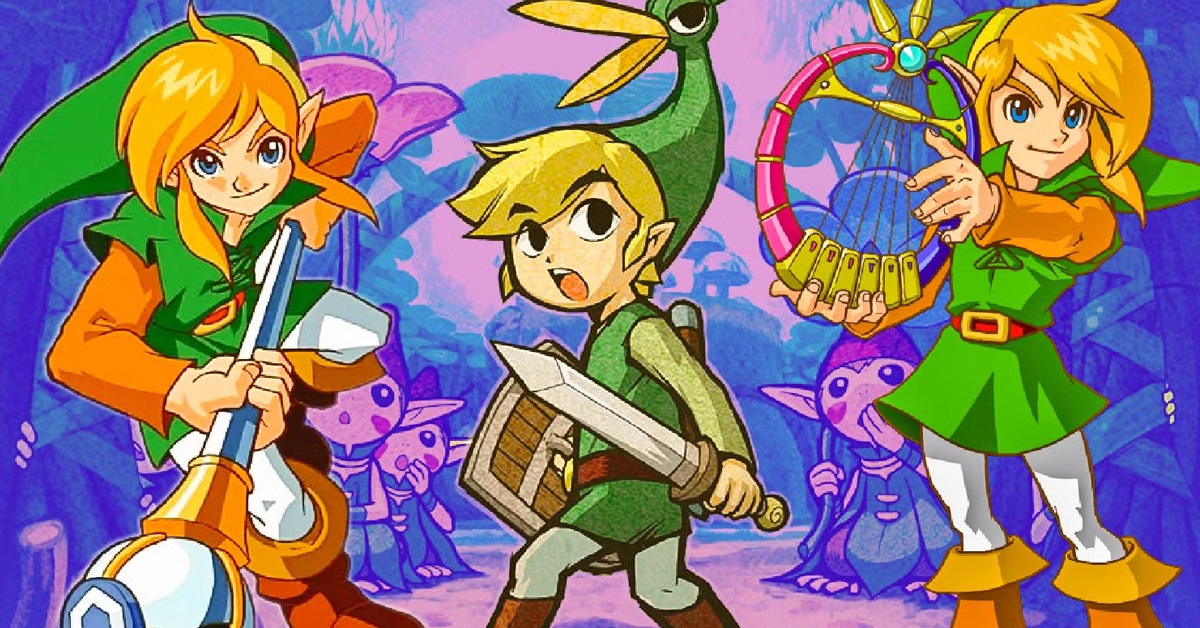
Four games. Three years. Two companies that had no real business making a Zelda game together, and somehow made some of the best cult classics in the series. Plus a fifth game Nintendo built entirely on their own, right in the middle of all this, to prove the idea could stand up without Capcom.
I’m going to walk through how a Street Fighter producer ended up convincing Nintendo to hand him a Zelda game at all, and how that conversation became four games across two handhelds, plus one Nintendo made itself. What those games actually did that the mainline series hadn’t tried yet. Where those ideas ended up years later, in games most of you have already played. Why the partnership stopped in 2004. And what it would actually take for it to start again.
Before we go on, welcome back. I’m Triforce Times. Here, we dive deep into The Legend of Zelda, its design, lore, hidden stories, and everything Nintendo leaves unexplained. If you enjoy that, consider subscribing. Members get exclusive Zelda videos, early access to new content, and an invite to our community Discord. Link’s below.
THE PITCH
To understand how this happened, you have to start with a person most Zelda fans have never heard of, and he isn’t a Zelda person at all.
Yoshiki Okamoto spent the eighties and nineties at Capcom producing some of the biggest arcade games ever made. He’s the reason Street Fighter II exists in the form it does. By 1996 he was running Capcom’s entire development division. Then, in 1997, he stepped away to start something smaller: a subsidiary called Flagship, funded jointly by Capcom, Sega, and Nintendo, built to write scenarios and stories for other people’s games rather than develop them outright. It was a writers’ room for hire, and it happened to have three of the biggest publishers in Japan bankrolling it at once.
In 1999, Okamoto had an idea, and took it to Nintendo. He took it to Takashi Tezuka, the director who’d already shaped Link’s Awakening and A Link to the Past, and who by his own account should have said no on principle. Zelda and Mario weren’t games Nintendo handed to outside companies. But talking with Okamoto, Tezuka came away convinced the man had a real, personal affection for the series, and that Capcom’s team moved fast enough to be worth the risk. So he said yes, on the spot, to remaking the original 1986 Legend of Zelda for the Game Boy Colour, as a way of putting that game in front of a generation of players who’d never touched it.
Then, almost immediately, the project outgrew itself. Okamoto came back with not one remake but six Game Boy Colour Zelda games, split between reworkings of old material and brand new stories. Talked down to something more manageable, that became three new games, each built around one piece of the Triforce. Internally, they were called Mystical Seed of Power, Mystical Seed of Wisdom, and Mystical Seed of Courage.
Three games sharing a world proved to be too much even for that scaled-down version. Mystical Seed of Power eventually became Oracle of Seasons. Mystical Seed of Wisdom became Oracle of Ages. The third one never became anything at all.
Mystical Seed of Courage would have followed the same pattern as the other two: its own Oracle character, Farore, sitting alongside Din in Seasons and Nayru in Ages. Where Seasons is built around action and Ages around layered puzzle logic, Courage was reportedly built around time of day itself, puzzles that couldn’t be solved unless you were playing at the right hour, tied into the same trilogy-wide linking system that was meant to let choices ripple across all three games at once.
That linking system is exactly what killed it. Sometime around mid-2000, months before Seasons and Ages even shipped, the technical work of keeping three separate games’ passwords and cross-game state consistent with each other became too much to manage, and Courage was quietly cut rather than delaying the other two. Farore didn’t disappear from the finished games entirely, though. She survived as the Oracle of Secrets, living inside the Maku Tree in both Seasons and Ages, and her actual job in the two surviving games is running the password system that links them, the very feature that couldn’t scale to a third game in the first place.
Tezuka didn’t just hand the project over and walk away, either. Capcom is based in Osaka, and Tezuka visited their offices repeatedly himself once development started, since Nintendo had never worked with them before. His own description of the difference, years later, was that Capcom struck him as jock-like, while Nintendo was more of a close circle of like-minded people. Two very different working cultures, brought together by one director willing to keep showing up in person until he trusted what he was seeing.
KEEPING IT ZELDA
Trust only gets you so far, though. Somebody still had to make sure a Capcom-made game actually felt like Zelda once it left Nintendo’s building, and that job fell to a Nintendo supervisor most fans have never heard the name of: Yoichi Yamada.
Yamada joined the Oracle project once Capcom already had a working version of the game in progress, and by his own description, what he found was competent but generic. It didn’t have what he called Zelda-ness yet. So he had his team put together written guidelines explaining Nintendo’s house style, down to small habits like always giving the player a low-stakes moment to practise a new item right after they pick it up, and asked Capcom to adjust their map scrolling to match a camera feel unique to the series. When he playtested an early build himself and couldn’t get through it, he traced the problem back to something Miyamoto used to warn Nintendo’s own teams about: a development team that’s been staring at its own difficulty curve for months stops being able to feel how hard the game actually is.
Yamada’s biggest call, though, was structural. Capcom had originally planned to release Ages and Seasons one after the other, as two separate games months apart. Yamada pushed to make them simultaneous instead, and to build the linking system between them into something worth using properly rather than a nice-to-have. That decision is the entire reason two Game Boy Colour cartridges from 2001 still get talked about as a linked pair today rather than as two unrelated games that happened to share a map.
It went both directions, to be fair to Capcom. Yamada was just as clear that the games needed to keep some Capcom-ness too, not get flattened into something indistinguishable from an in-house Nintendo title. The example he gave was the games’ opening sequence, a single, large illustration that pops into view the moment you start, which he said was a presentation trick that only Capcom really knew how to pull off. They kept it in deliberately.
That give-and-take shows up again a few years later, on Minish Cap. Aonuma has said Nintendo’s own teams don’t typically produce much concept art before diving straight into building actual game data. Capcom did things differently, handing over detailed illustrated scenes, a corridor made from the gap behind a piece of normal-sized furniture, a tiny creature curled up inside a barrel, and those drawings are apparently what convinced Nintendo’s side the shrinking concept could carry a full game. Two studios, two completely different working habits, each occasionally handing the other something they wouldn’t have come up with on their own.
What actually shipped, in February 2001 in Japan, was two Game Boy Colour cartridges built on the engine from Link’s Awakening, with a password system that let choices in one game ripple into the other exactly the way Yamada had pushed for. They sold nearly four million copies each. And it proved something nobody had confirmed before: an outside developer could touch mainline Zelda and come out the other side with something the fans would actually defend.
FOUR GAMES, AND THE ONE THAT WASN’T
I’ve already made full retrospectives on some of these games individually. If you want the dungeon-by-dungeon breakdown of Oracle of Seasons, or the full item and Kinstone deep dive on Minish Cap, those videos exist, and I’ll link them below.
What I want to do here is different: pull back far enough to see what all four of Capcom’s games were actually doing, one after another, as a single continuous project rather than four separate ones. And then there’s a fifth game that belongs in this story even though Capcom didn’t touch it, which I’ll get to.
Oracle of Seasons and Oracle of Ages (2001)
These two came out of the same brief, on the same day, sharing an engine, and used that shared foundation to ask two completely different questions. Seasons asks what Zelda looks like when you build everything around commitment, movement, and combat rhythm. Ages asks what it looks like when you build everything around layered logic and patience, using the Harp of Ages to move between two versions of the same world separated by centuries. Neither game is the “real” one and the other a side dish. They’re a matched pair, deliberately split down the middle, and Capcom pulling that off on a Game Boy Colour cartridge in 2001 still doesn’t get enough credit.
Four Swords (2002)
This is the one nobody talks about, and it deserves better than that. Four Swords shipped as part of a combined cartridge with A Link to the Past on the GBA: a Zelda game built entirely around multiplayer, where up to four players each control a Link, split from the same blade, working together and constantly stealing rupees from each other at the same time. It’s competitive and cooperative in the same breath, which nothing else in the series has really tried since. It’s also the game that introduces Vaati and sets up the entire Four Sword mythology Minish Cap would later explain the origin of. If you’ve only played Minish Cap, you’ve read the last chapter of a story without the first one.
Four Swords Adventures (2004) — the odd one out
This one wasn’t Capcom’s. It’s developed entirely in-house by Nintendo EAD, no Flagship, no Capcom credit anywhere on it. Nintendo liked the format enough to build their own sequel to it themselves, on the GameCube, the same year Minish Cap shipped.
It’s structured as eight levels of three stages each, twenty-four in total, with almost nothing carried between them, no persistent items or hearts, closer to how the original 1986 Zelda handled progression than anything else released in the 2000s. And it does something clever with hardware: connect a Game Boy Advance for each player, and the moment your Link walks off the shared television screen into a house, a cave, or certain interior rooms, the action for you transfers to your own GBA screen while everyone else keeps playing on the TV. It’s not a constant private view; it switches contextually, but it lets the game build puzzles around one player secretly seeing something the others can’t.
I’m including it here anyway, because it’s proof of something. Less than a year after Minish Cap, Nintendo had already absorbed the multiplication idea Capcom brought to the series and built their own full game around it without needing Capcom in the building. Keep that in mind; it matters later.
The Minish Cap (2004)
I’ve covered this one in full already, so briefly: it’s the third and final Capcom-made act, the one that finally answers where the Four Sword and Vaati came from, wrapped around a shrinking mechanic and a toolkit of items that behave more like small systems than single-purpose keys. If you haven’t seen that video, it’s linked below, and I’d genuinely recommend it over me repeating myself here.
Taken together, that’s the whole era. Two paired handheld games built around opposite philosophies, a wild multiplayer experiment, and a prequel that ties the whole thing into a bow, all four genuinely Capcom’s. Plus one console game, sitting right in the middle of the timeline, that Nintendo built on their own the moment they saw how far the idea could go. None of them plays it safe.
THE INNOVATIONS
I want to spend a bit of time looking at the innovations Capcom brought to the series, because this is why we still speak about these games over 20 years later.
The world as a state you control, not a place you walk through. Before Oracle of Seasons, changing the state of the overworld in Zelda mostly meant permanent story progress: a bridge appears, a boulder is gone. Seasons made world-state something you actively toggle at will, over and over, for the rest of the game.
Time as a second overworld, not a mechanic. Ages goes further than a simple time-travel gimmick. Whole regions genuinely exist twice, centuries apart, and the game expects you to think of actions in one timeline as decisions with consequences in the other. Plant a tree in the past, and it’s a towering, climbable landmark in the present.
Splitting the player into multiple copies of themselves. Four Swords is the one nobody borrowed from directly, and it’s arguably the strangest idea Capcom brought to the series, letting you exist as more than one Link at once and coordinate between them. It’s worth remembering this the next time you see Link duplicating objects or working with a partner in any later Zelda game, because Capcom got there first, and did it with actual human players instead of a mechanic.
Items as small systems instead of single-purpose keys. This is the throughline I already covered in detail on Minish Cap so that I won’t repeat the item-by-item breakdown here, but zoom out, and you can see it starting earlier than that game. The Rod of Seasons and Harp of Ages aren’t simple unlock tools either; they’re carried into combat, into exploration, into puzzle logic that has nothing to do with the dungeon they were found in. Minish Cap perfected something Capcom had already been building for years.
Two overlapping versions of the same map, occupying the same space. Minish Cap’s shrinking mechanic is the most literal expression of an idea that’s actually present across the whole era in different forms: that a single Hyrule can secretly contain a second one layered underneath or alongside it, and that discovering that second layer is itself the reward.
Four games. Four real, structural firsts for the series. New answers to what a Zelda game is allowed to do.
WHERE IT WENT
By the time Breath of the Wild came out in 2017, the Capcom era was thirteen years in the past, and nobody was drawing the line anymore. The line’s there, and it’s a lot more direct than most people realise.
One person directed every single one of Capcom’s four games. Hidemaro Fujibayashi was the director of Oracle of Seasons, the director of Oracle of Ages, the director of Four Swords, and the director of The Minish Cap. Then, in 2005, he left Capcom for Nintendo. He first worked as sub-director under Daiki Iwamoto on Phantom Hourglass, then took the director’s chair again, this time on Skyward Sword. Then Breath of the Wild. Then Tears of the Kingdom. As of right now, he holds more directorial credits on this series than most, and the run starts on a Game Boy Colour cartridge Capcom made.
That’s the same person’s design instincts, running from Holodrum and Labrynna straight through to Hyrule’s Great Plateau.
So look at the runes in Breath of the Wild with that in mind. Magnesis, Stasis, Cryonis, Remote Bombs. None of them is a single-purpose key for a single-purpose lock. Each one is a small, flexible system that gets reused constantly across combat, traversal, and puzzle-solving, exactly the design philosophy the director of Minish Cap built the Gust Jar and the Cane of Pacci around fifteen years earlier. Giving the player a handful of flexible toys and trusting the world to do the rest is Fujibayashi’s idea, and it shows up in the Capcom games first because he was the one putting it there.
Same goes for Breath of the Wild’s whole approach to the overworld: burnable grass, freezable water, weather that changes what’s possible in a given area at a given moment. That’s world-state-as-toy, the exact idea the director of Oracle of Seasons built an entire game around back in 2001, just running on a much bigger engine with much better tools two decades later, in the hands of the same director. Seasons asked what happens if the player can flip the world’s rules on demand. Breath of the Wild is the fullest answer that question has ever gotten, from the same person who asked it first.
None of this makes Breath of the Wild or Tears of the Kingdom Capcom games. Nintendo’s own team built those, and Aonuma has produced every one of them alongside Fujibayashi. But the next time someone tells you the Capcom era was a strange, forgettable detour the series wandered off on for three years, tell them the director of the two best-reviewed Zelda games ever made spent his first four years on the series working for Capcom, and never really put those instincts down.
WHY IT STOPPED
So why did it end?
The honest answer is less dramatic than you’d want. There wasn’t a falling out. Flagship, the studio at the centre of Capcom’s four games, was fully absorbed into Capcom in 2007 and stopped existing as its own entity. Its director moved on to Nintendo directly. Capcom itself spent the years after 2004 pulling back toward its own franchises, and the handheld Zelda slot Flagship had been filling went to other teams and, eventually, other studios entirely. It wasn’t a breakup so much as a project that quietly ran its course, and nobody restarted it.
WHETHER IT COULD START AGAIN
Capcom is deep into supporting Nintendo’s current hardware, with major releases either out already or confirmed. Zelda just passed its 40th anniversary, which is exactly the kind of milestone that tends to loosen a franchise up rather than lock it down. And Nintendo has been remarkably consistent, on record, about wanting exactly this kind of relationship. Back in 2012, Aonuma was asked directly about outside studios working on Zelda, not long after Grezzo, an independent studio with no connection to Capcom, had handled Ocarina of Time 3D, and he didn’t hedge.
He said Nintendo’s developers will keep working across several different titles, and that he expects to keep relying on outside companies for graphics and other elements that need heavy resources, adding that he’s satisfied whenever a collaboration ends up meaningful for both sides. It’s basically the same instinct that let Okamoto in the door in 1999, restated by Nintendo’s own Zelda producer over a decade later, and it applies to any outside studio, Capcom included.
I’m not reporting a rumour here; there’s no fourth Capcom Zelda in development that I know of, and I’d be doing you a disservice if I implied otherwise. What I am saying is that the specific mix that made the first partnership possible- a willing outside studio, a publisher genuinely open to lending the series out, and a franchise anniversary creating appetite for something unexpected- hasn’t lined up this cleanly since 2004.
So let’s actually do the fun part and imagine it properly, because that’s more interesting than just noting the conditions exist.
The mistake I think it’s easy to make here is imagining a new Capcom Zelda as more of the same, another small handheld entry with a clever gimmick. They got handed Zelda because they were fast, hungry, genuinely loved the series, and Nintendo trusted them to do something structurally strange with a part of the franchise its own team wasn’t actively using. That’s the actual pattern. So the real question isn’t “what would a Capcom Zelda look like now.” It’s “what is Capcom good at right now, the way they were good at 2D art and tight scenario writing back then, and where does that overlap with a corner of Zelda nobody’s touched?”
A few ideas, in no particular order:
A proper multiplayer-first entry, built for how people actually play together now. Four Swords was Capcom’s most ambitious swing in this whole era. Capcom currently ships some of the best-tuned cooperative games on the market, the kind of moment-to-moment coordination Monster Hunter has been refining for two decades. A modern successor to Four Swords Adventures, dropping the GBA-as-second-screen gimmick for proper online co-op, feels like the single clearest overlap between what Capcom does best today and a genuine gap in Zelda’s own catalogue.
A combat-forward spin-off that leans all the way into action. Nobody would call mainline Zelda combat shallow, but it’s never been the series’ whole identity; it shares space with puzzles, exploration, and story. Capcom’s action pedigree, the kind of precise, stylish combat systems Devil May Cry and the RE Engine games are built around, is a genuine specialism Nintendo’s own team has never had reason to chase. A side story built specifically to let combat carry the entire experience, the way Oracle of Seasons let commitment and rhythm carry an entire Zelda game back in 2001, feels like exactly the kind of corner of the franchise Capcom could make their own again.
Capcom handling the remaster of their own back catalogue. This one’s less imaginative and more overdue. Capcom has a genuinely strong remaster and remake track record, and a proper modern package bringing Oracle of Seasons, Oracle of Ages, and Four Swords Adventures together, cross-compatible, online-enabled, feels less like fantasy booking and more like the most obvious gap in Nintendo’s whole modern-classics strategy.
Those are my three. What’s the corner of Zelda you think Capcom could actually make their own again if Nintendo picked up the phone tomorrow? Drop it in the comments; I read every one of them on a video like this.
WHY PLAY THEM NOW
If you came into the Zelda series at Breath of the Wild, or even Ocarina of Time, there’s a real chance you’ve never touched any of these games, and that’s worth fixing. Quickly, here’s the pitch for each one, no spoilers beyond what I’ve already covered.
Oracle of Seasons is the one to start with if you want Zelda that plays fast and rewards commitment over caution. It’s on Nintendo Switch Online’s Game Boy library right now, so there’s no excuse.
Oracle of Ages is the one for players who’d rather think three steps ahead than react in the moment. Play it linked with Seasons if you can; the connected story is worth the extra effort.
Four Swords needs other people, or at least other controllers, but if you’ve got the means to play it, it’s the strangest and most purely fun multiplayer Zelda’s ever made, and there’s nothing else quite like it in the series.
The Minish Cap is the easiest recommendation of the four. It’s on Switch Online right now, it’s short by Zelda standards at around fifteen hours, and I’ve already made an entire video explaining exactly why it’s better than its reputation suggests.
Start anywhere on this list, and you’re looking at three years where two very different companies, plus one solo effort in the middle, kept trying things the safe version of Zelda never would have.
CLOSING
That’s the Capcom era. A producer who used to make Street Fighter cold-pitching Nintendo’s most protected series. Four games in three years that each did something the franchise had never tried before, plus a fifth Nintendo built on their own to prove they’d got the message. Ideas that, whether anyone at Nintendo would put it this way or not, are still sitting inside the biggest games this series has ever made. And a set of circumstances lining back up, twenty years later, that once made all of this possible in the first place.
If you enjoyed this one, the best thing you can do is hit subscribe; it helps a channel like this get in front of more people who love this series as much as we do, and there’s a lot more of this coming.
Before I go, I want to say a proper thank you to everyone who supports this channel through membership. Whether you’re a Hylian, a Sheikah Scholar, or one of our Ancient Sages, this channel doesn’t happen without you, and I mean that.
Speaking of Ancient Sages, huge thanks to DjAntan_YT, supersonicmariokirby, EldritchKhaotic, PrepayingOne, Romulus879, and ElfQuest01. You lot keep this channel running, and I appreciate every single one of you.
If you’re not a member yet and you want in on the exclusive Zelda club, membership gets you access to our growing library of exclusive Zelda videos, early access to everything we put out, and an invite to our community Discord. The link’s down below if you fancy it.
Thanks so much for watching. I’ll see you in the next one.
Leave a Reply