
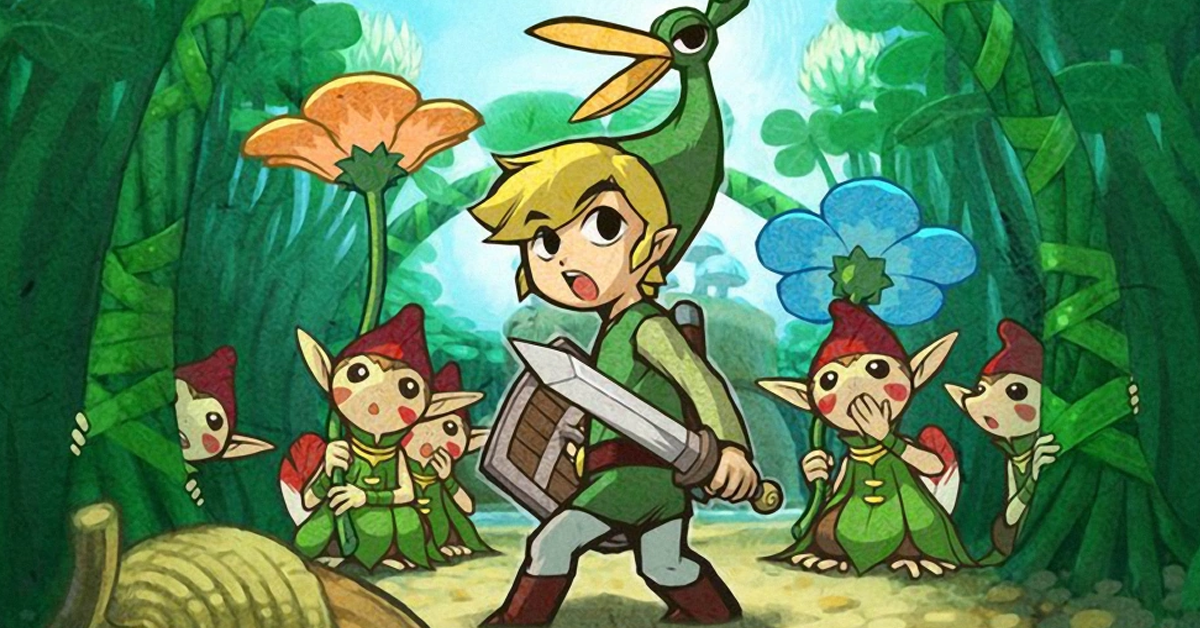
A tree stump sits in a quiet corner of the Minish Woods. Nothing special about it, at first glance. Then Ezlo, the strange talking hat now sitting on Link’s head, tells him to jump onto it. Link does. And the whole world changes shape around him.
Here’s the part most people don’t know. Capcom didn’t invent that idea for this game. They’d already made it once before, in a different Zelda game entirely, and it barely got any attention when it did.
Today’s video is a single mechanic, properly taken apart. Where it actually came from. What it does inside Minish Cap. Why Capcom made it more restrictive than necessary. Where it sits against every other duality mechanic this series has tried. How close it came to a second life in Breath of the Wild, and why that idea got cut. And where it’s turned up since, in places you wouldn’t expect.
Before we go on, welcome back. I’m Triforce Times. Here, we dive deep into The Legend of Zelda, its design, lore, hidden stories, and everything Nintendo leaves unexplained. If you enjoy that, consider subscribing. Members get exclusive Zelda videos, early access to new content, and an invite to our community Discord. The join link is below.
WHERE IT ACTUALLY CAME FROM
Every Zelda game needs a gimmick strong enough to hang an entire cartridge off. The actual load-bearing idea the whole design leans on. For Minish Cap, that idea is scale, and the interesting part is that Minish Cap’s shrinking already existed, as an item, in Four Swords.
It’s called the Gnat Hat. In Four Swords, it’s one of the more obscure pickups in a game already stuffed with items, and it does exactly what it sounds like. You put it on, and you shrink, walk around at that size for a bit, and grow back whenever you like.
Capcom took an item that had already shipped, in a game most people barely remember playing, and asked a much bigger question: what happens if we stop treating this as one item among dozens, and instead build an entire Zelda game around it?
There’s a proper account of how that decision was actually made, from a Nintendo Dream interview with director Hidemaro Fujibayashi and producer Eiji Aonuma, conducted around the time the game was released. Their answer, when asked how they wanted Minish Cap to feel distinct as a Capcom game, was that Link could grow large or shrink down, moving between his normal world and a miniaturised version of it as he explored.
Aonuma described thinking about the pairs of opposites that had defined earlier Zelda games, like light and darkness, and the idea of “big and small” arrived to him as the next one in that lineage. Light World and Dark World in A Link to the Past. Seasons in Oracle of Seasons. Time itself in Oracle of Ages. Every one of those games needed a structural opposite to build the whole world around, something that could double the value of a single overworld without doubling the actual art budget. Minish Cap’s answer was scale.
Most retrospectives treat the shrinking mechanic as something Capcom dreamed up fresh for a new handheld. The truth is closer to a studio going through its own back catalogue, finding an old idea, and then expanding it as a central concept to the whole game.
The Gnat Hat let you shrink whenever you wanted. Minish Cap took that same idea and locked it behind portals: stumps, jars, specific marked spots you have to go looking for. Why would Capcom take a mechanic that used to be free, and deliberately make it more restrictive? We’ll come back to it properly in a minute, because it’s the most interesting design decision in the whole game.
THE HARDWARE THAT MADE IT POSSIBLE
Let’s quickly look at the hardware and how it helped enable this mechanic.
The Game Boy Advance’s sprite hardware actually had built-in scaling at a technical level. The system could hold up to 128 sprites on screen at once, and its object attribute memory included dedicated rotation and scaling data, allowing individual sprites to be resized smoothly in hardware rather than by hand-drawing every intermediate frame. It means smooth, fluid shrink animation wasn’t something Capcom’s artists had to painstakingly draw frame by frame at every possible size. The console itself was built to handle exactly that kind of transformation efficiently.
That doesn’t make the shrinking mechanic an accident of the hardware being good at it. Plenty of GBA games had access to the same scaling hardware and never built anything close to Minish Cap around it. But it does explain why the idea was viable in the first place, on a handheld several console generations behind what Nintendo’s home systems were doing at the time. Capcom found an old idea that happened to line up neatly with what the hardware in front of them was actually built to do well.
TWO WORLDS, ONE MAP
Before getting into what shrinking actually does inside a dungeon, it’s worth placing it alongside every other version of this trick the series has tried, because Minish Cap isn’t the first Zelda game to build a second world on top of a first one. It’s just the version that does it without ever technically leaving the map you started on.
A Link to the Past splits Hyrule into two separate realms entirely. Light World and Dark World are roughly the same map, but they’re treated as two distinct places, with their own name, their own palette, their own rules about which is safe and which isn’t. Moving between them means a transition, a mirror or a portal, and for a stretch of the game you’re not in the world you started in any more.
Oracle of Seasons and Oracle of Ages do something similar with time instead of space. Same map, but the rules governing it shift depending on which season you’re in, or which point in history you’ve travelled to. Again, it’s framed as a switch. You’re choosing which version of the world is currently active, and the other one waits until you switch back.
A Link Between Worlds, years later, goes back to the Light World and Dark World idea, calling them Hyrule and Lorule this time, and lets Link cross between the two by stepping through open rifts scattered across the map, rather than needing a specific mirror or portal location. It also introduces a separate movement trick: merging into a wall to slide along its surface as a flattened, two-dimensional silhouette. However, that’s really a traversal tool within a single world rather than the mechanism for crossing between the two.
Minish Cap does it differently. Shrinking doesn’t take Link somewhere else. It changes what’s already there, right where he’s standing. The room has been revealed to contain more than you could previously see. That’s a different flavour of duality from the light-and-dark or time-based versions that came before it, because nothing about the map itself is different. It’s the scale, and it opens up a whole new world.
WHAT SHRINKING ACTUALLY BUILDS
Let’s have a closer look at why the shrinking mechanic is great, and why it makes Minish Cap memorable.
Take the Armos fight, tucked away in the overworld rather than inside a dungeon proper. An Armos, for anyone who hasn’t played this one, is normally just a statue that wakes up and charges at you. Nothing special. In Minish Cap, there’s a puzzle built around one of them where shrinking down lets you climb inside the statue itself and flip a switch in its internal circuitry to shut it down properly. That’s not “smaller Link fits through a smaller gap.” That’s the game using scale to let you interact with an object from an angle that doesn’t exist at normal size. The statue isn’t an obstacle any more. It’s a mechanism, and you’re standing inside it.
Fortress of Winds does something similar with its final fight, using a size shift mid-battle rather than as a separate traversal step beforehand. Instead of shrinking once to get into a room and then fighting normally, the fight itself asks you to change size while the encounter is still live, adjusting your options against the boss in real time rather than as a one-off key you use once and then put away. Link shrinks down specifically so he can get inside the boss itself and damage it from within, rather than fighting it from the outside like every other boss in the game. The final phase of the final boss fight against Vaati is another fantastic example, and more complex than the Fortress of Winds as you’d expect.
There’s also another version of this same idea running through the overworld itself, away from any specific puzzle or fight. Hyrule Town, at normal size, is a fairly ordinary collection of shops and streets. Shrink down inside it, and the same town becomes a landscape built entirely out of things nobody at full size ever pays attention to: gaps behind furniture, the underside of stalls, and corners of rooms. Most of it exists purely so that a curious player gets rewarded for actually stopping to look. That’s environmental storytelling at work in the background, without a single line of dialogue to explain what it means.
What ties all of this together is that none of it is really about squeezing through gaps. It’s about access, seeing and reaching parts of an object, a fight, or a town that don’t exist from Link’s normal perspective. That’s a different design idea from most Zelda transformations. Most of them change what Link can do. This one changes what the world around him actually contains.
Most Zelda items are additive. The Hookshot adds a new type of movement. The Bow adds a new way to hit targets from a distance. They expand Link’s toolkit without changing how the world itself is built. Shrinking works differently. Every gap, every jar, every statue interior was already sitting there, waiting for a player small enough to notice it. The mechanic is giving Link new eyes and new places to explore. That’s a subtle distinction, but it’s the reason Minish Cap’s version of scale feels different from almost any other transformation item in the series.
WHY IT’S GATED, NOT FREE
The Gnat Hat let you shrink whenever you wanted. Minish Cap took that freedom away and replaced it with portals. That’s a step backwards on paper. In practice, it’s the smart decision and next we’re going to look at why.
Think about what at-will shrinking is actually good for. In Four Swords, it’s one tool among many, in a game built around four players solving puzzles together in real time. Nobody’s building a dungeon layout that assumes a specific player might be small at a specific moment, because you can’t guarantee that. Free-form shrinking works there because the game isn’t trying to control exactly when it happens.
A single-player dungeon game is a completely different problem. If Link could shrink whenever he liked, every single room in every dungeon would need to account for the possibility that he’s tiny at that exact moment, which either means the designers build around that constantly, or the mechanic mostly doesn’t matter to the actual puzzle design, because it’s always available and never required.
Gating it behind portals solves that. The portals limit when Link can actually transform, and that limitation is exactly what let the team use shrinking as a tool for solving puzzles and blocking off areas until the right moment. By deciding where shrinking can and can’t happen, Capcom could guarantee a player is small in a specific room, for a specific puzzle, and build that puzzle with total confidence around exactly that constraint.
Compare it to Link’s usual toolkit for a second. The Bow always works. The Hookshot always works. Once you have them, they’re just always in your pocket, ready whenever a puzzle calls for them. Shrinking doesn’t work like that. It’s less like an item and more like a stage direction. The game is telling you, right here, right now, you’re small, and here’s what that means for this specific room.
There’s a cost to that choice. As shrinking only happens where the game allows it, it can never become a tool you reach for creatively, the way you might use the Hookshot in a slightly unexpected spot to skip part of an area. Every use of it was placed there on purpose, which means the ceiling on player creativity with this specific mechanic is lower than it is with almost anything else Link carries.
It’s not a decision unique to this game once you look at the wider series. Wolf Link in the first half of Twilight Princess is a decent parallel, since that transformation is largely tied to Twilight-covered areas and specific story triggers rather than something the player switches on freely whenever they like.
Majora’s Mask actually runs the opposite way, letting Link swap freely between his Deku, Goron, and Zora forms from the menu at almost any time, no portal or trigger required. That freedom works there because the masks aren’t primarily puzzle-gating tools the way Minish Cap’s portals are. They’re closer to a second full moveset each, and the game is built around the player choosing which one suits a given moment rather than the story dictating it. Put the two side by side, and you get a useful contrast: gate the transformation when you want total control over specific puzzles; leave it open when the point is to give the player three different characters’ worth of options to juggle.
PROS AND CONS
There are definitely pros and cons to the shrinking mechanic.
What works: verticality in how dungeons are built, rooms that mean something different depending on your size, and at least two standout moments, the Armos puzzle and the inside-the-boss fight, that couldn’t exist with almost any other item in the Zelda toolkit. It also does real work for environmental storytelling. Finding a Minish home built from everyday household objects tells you something about the world that no piece of dialogue could convey as efficiently.
What doesn’t: there are only two sizes in the whole game, normal and Minish, with nothing in between. There’s no tiered scale, no third or fourth size to play with, which is a limitation of the format Capcom was working in rather than a lack of imagination. And because the mechanic is entirely portal-gated, it never gets a chance to surprise you the way an item you carry everywhere can. You always know exactly when it’s coming.
A game built around three or four distinct sizes, rather than two, could stack puzzles on top of each other in a way Minish Cap never gets the chance to. Imagine a room that changes meaning three separate times as you shrink further and further, rather than just once. The hardware Capcom were working with, and the timeline they were working to, made a binary system the sensible choice. But it does mean the mechanic’s ceiling was never fully tested within this specific game. What we got is a well-executed version of a smaller idea than the one Capcom might have built with more room to work in.
The mechanic also changes the emotional reaction to parts of the game. A normal-sized Hyrule Town is a pleasant, unremarkable backdrop. A Minish-sized Hyrule Town is genuinely a little frightening in places: cats the size of trucks, gutters that become canyons, the constant low-level threat of being stepped on. Very few Zelda games manage to make their own overworld feel dangerous again after the player’s already spent hours getting comfortable in it.
WHAT ALMOST WAS: BREATH OF THE WILD
In a behind-the-scenes video Nintendo put out around Breath of the Wild’s release, director Hidemaro Fujibayashi, the same director who made Minish Cap, revealed a scrapped feature that would have let Link shrink down to just a few inches tall to explore tiny villages scattered across Hyrule. The video itself doesn’t name-check the Minish directly, but it plays footage from Minish Cap. At the same time, Fujibayashi talks about the idea, which makes the connection about as clear as it could be without an outright confirmation. This wasn’t a stray concept sketch either. There’s early concept art from the same development period showing an actual Minish-style village designed for Breath of the Wild’s Hyrule, tucked away in a Japan-exclusive art book that covered the game’s unused ideas.
Imagine what that would have actually added to the game. Breath of the Wild already rewards exploration: climbing a tower you didn’t need to climb, following a strange light across a field, checking behind a waterfall because something about it looked off. A shrinking mechanic would have taken that same instinct and applied it at a completely different scale: tiny settlements tucked into root systems, inside hollow logs, under loose floorboards in abandoned houses, scattered across a map already built around rewarding exactly that kind of attention. It’s not hard to see why the idea appealed to the team. It’s a natural extension of everything Breath of the Wild was already trying to do, just shrunk down to a size nobody was expecting to find.
So why did it get cut? Fujibayashi actually explained the reasoning directly in that same video, and it’s more complex than a simple time-pressure explanation. He said the team felt it would be difficult to give these small characters a proper place of their own alongside everything else the game already had going on, all its other distinct races and locations competing for the same narrative space, and that despite genuinely wanting them in there for the gameplay itself, the idea had to be given up.
Breath of the Wild already had Zora, Gorons, Rito, Gerudo, and Hylians, each with their own culture, settlements, and place in the story. Adding a sixth group, one built around an entirely different scale of interaction, risked either getting lost in the noise of everything else competing for the player’s attention, or requiring its own dedicated systems robust enough to justify the effort, essentially a game within the game. Rather than build that half-heartedly, the team let it go.
The general shape of the concept- tiny, secretive things scattered all across Hyrule waiting to be discovered by the player- lines up closely enough with the Koroks that made it into the final game that it’s widely taken as the clearest evidence of where the idea actually went. Nintendo hasn’t explicitly confirmed the Koroks are a direct replacement for the scrapped villages. The scale-shifting mechanic didn’t survive. Something very close to the instinct behind it did. Koroks hidden under rocks, inside hollowed logs, disguised as leaves in a breeze, chase the same basic idea as a Minish village tucked behind a waterfall, just solved without needing Link himself to shrink to reach them physically.
Would it have been good? Almost certainly. It would have given players a reason to look twice at the small, easily ignored corners of an already enormous map, using the exact design philosophy Minish Cap pioneered over a decade earlier, in the exact game built to reward that kind of attention better than any Zelda title before it. But it’s hard to argue the final decision was wrong either. Koroks work. They’re everywhere, they’re reasonably rewarding to find, and they didn’t need an entire secondary scale system built around them to function. Maybe we’ll see the shrinking mechanic return in a later Zelda game?
DID OTHER GAMES COPY IT?
Shrinking as an idea is bigger than Minish Cap, and bigger than Zelda. Plenty of games have built themselves around a small hero in a big world. The question worth answering is how many of them do it the way Minish Cap does, and the answer turns out to be almost none of them.
Start with the closest thing to a direct spiritual sibling. Grounded, Obsidian’s survival game that entered early access in 2020 before its full release two years later, casts four teenagers shrunk down to insect size in an ordinary suburban backyard, unable to reverse the effect and forced to survive against bugs, spiders, and environmental threats using an RPG-style progression system. The premise is explicitly drawn from Honey, I Shrunk the Kids, and the appeal is the same core thrill Minish Cap trades on: an everyday space turned genuinely alien once you’re small enough to actually live in it. The structure is completely different, though. Grounded’s characters are small for the entire game, with no normal size to return to and no portal system. It’s a survival game built around permanent smallness, not a puzzle game built around the transition between two states, which is the entire engine Minish Cap runs on.
It Takes Two gets closer. In the “Rose’s Room” chapter, one of the two playable characters, Cody, receives an ability called the Cosmic Belt, which lets him grow or shrink freely at will, while his co-op partner gets a separate traversal tool to complement it. Puzzles built around this include Cody shrinking down to fit inside a pinball machine to guide a ball through a maze, and squeezing through gaps too small for his partner to follow. That’s a close cousin to Minish Cap, using scale specifically to access spaces a normal-sized character can’t reach. The difference is scope. It Takes Two changes its core mechanics every chapter by design, so the shrinking ability exists for roughly one chapter out of seven, then disappears entirely, and it’s free-form rather than gated, closer to the Gnat Hat’s original freedom than to Minish Cap’s portal system. Of everything covered here, It Takes Two is the nearest real point of comparison. It’s just one costume change in a game that’s constantly changing costumes, rather than the single defining idea an entire game gets built around.
Mario’s Mini Mushroom is worth a mention too, mostly because it shows what shrinking looks like as a simple traversal gate rather than a design philosophy. Collecting one shrinks Mario down, letting him fit through small pipes and gaps he couldn’t otherwise reach, while also making him more fragile and unable to survive a single hit. It does its job well, but there’s no environmental storytelling built around it, no hidden civilisation waiting to be discovered. It’s shrinking reduced to its most basic function: access, with none of the additional texture Minish Cap builds around the same core idea.
Look across the wider list of games built around size change, and the pattern holds. Most pick one lane and stay in it. Permanently small, like Grounded. A temporary traversal trick, like Mario’s Mini Mushroom. Or one tool in a rotating toolbox, like It Takes Two, present for a single chapter and then retired. Minish Cap does all three at once without fully committing to any single one.
Tinykin, an indie platformer that put players in charge of a tiny protagonist exploring a giant, ordinary house, isn’t a Zelda game and doesn’t claim Minish Cap as a direct ancestor. But the appeal sits in almost the same place, a familiar space made strange by scale, proof the underlying idea reaches well beyond any one series or studio.
Put all of this together, and Minish Cap’s version of shrinking turns out to be rare rather than just well executed. Survival games commit to permanent smallness. Platformers treat it as a temporary traversal gate. Even the closest comparison, It Takes Two’s Cosmic Belt, only gets a single chapter before the game moves on. Minish Cap is one of the few games, in or out of the Zelda series, that builds an entire adventure’s worth of puzzles, storytelling, and world design around switching between two permanent scales, and keeps that commitment going from the opening act to the credits.
CAPCOM’S INNOVATION
Of everything Capcom put into their Zelda games, the mechanical idea of shrinking has travelled the furthest: Oracle of Seasons, Oracle of Ages, Four Swords, and this one. It nearly made it into Breath of the Wild. It’s the one thing from Capcom’s stretch on this series that’s still finding its way into new games.
Compare that to the other big ideas from Capcom’s run on this series. The seasons and time mechanics from the Oracle games are clever, well-loved, and almost entirely contained within those two games. Shrinking is different. Small hero, overlooked world, a familiar space made strange by scale, is a genuinely universal idea, one that works just as well in a modern indie RPG as it did on a 2004 handheld. Capcom built something closer to a genre convention, and it just happened to arrive wearing a Zelda logo.
What made it work was that Capcom took an idea that had already proven itself interesting once, stripped away the part that was holding it back, and built an entire game’s worth of design intent around it. The best version of an idea isn’t always the first version. Sometimes it’s the second one, built by someone patient enough to go back and ask what the first version got almost right.
CLOSING
If you enjoyed this one, the best thing you can do is hit subscribe. It helps a channel like this get in front of more people who love this series as much as we do, and there’s a lot more of this coming.
Before I go, I want to say a proper thank you to everyone who supports this channel through membership. Whether you’re a Hylian, a Sheikah Scholar, or one of our Ancient Sages, this channel doesn’t happen without you, and I mean that.
Speaking of Ancient Sages, huge thanks to Tarnished_Hylian, supersonicmariokirby, EldritchKhaotic, PrepayingOne, and Romulus879. You lot keep this channel running, and I appreciate every single one of you.
If you’re not a member yet and you want in on the exclusive Zelda club, membership gets you access to our growing library of exclusive Zelda videos, early access to everything we put out, and an invite to our community Discord. Link’s down below if you fancy it.
Thanks so much for watching. I’ll see you in the next one.
Leave a Reply