
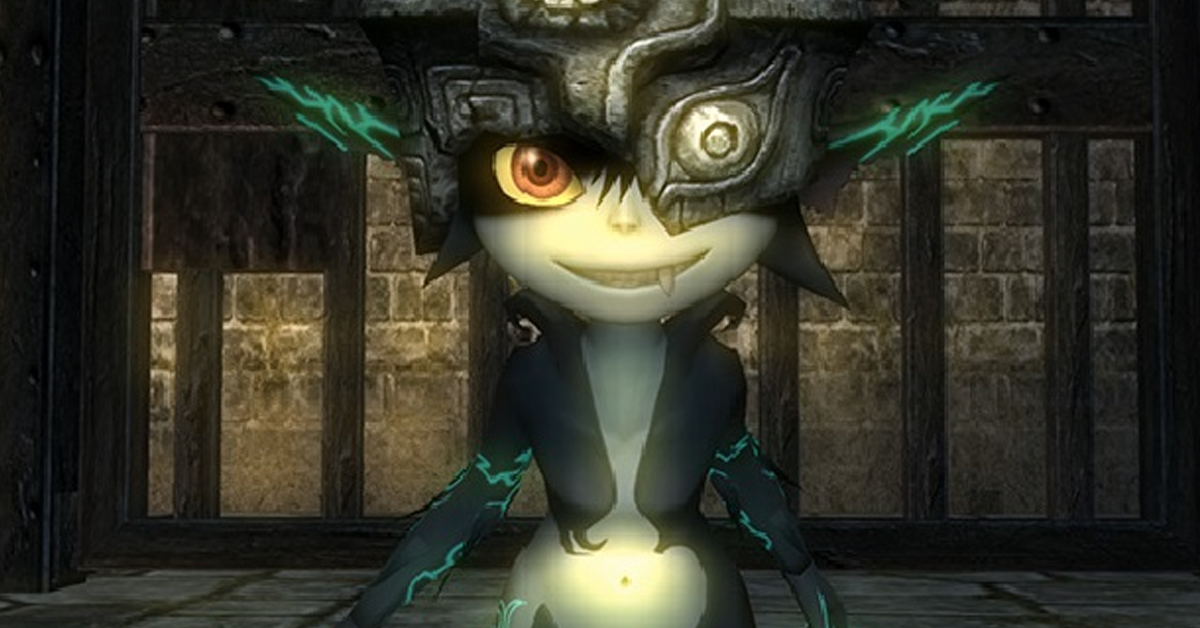
Hyrule Field. Full gallop. Midna is dying in your arms, and you are racing against the clock. If you’ve played Twilight Princess, you’ll remember this moment. Link is trying desperately to save his new friend.
Here’s what’s strange about that, though. Hours earlier, this same character was mocking you and using you. Barely bothering to pretend she cared whether you lived or died. So what happened in between? How does a companion go from that to this, and make you feel every second of the ride?
Today, I’m going to focus on one character. Midna, and why she’s the best companion this series has ever created, and also the riskiest. If that’s your kind of thing, subscribe and stick around. Members get exclusive videos and early access; link’s below. Let’s get into it.
THE COMPANION WHO DOESN’T WANT YOU
Most Zelda companions before Midna want to help you. That’s the job. Navi can be annoying, sure, but she’s never anything but on your side. Tatl mocks you a bit at the start of Majora’s Mask, but within an hour she’s fighting for you because Skull Kid stole her friend. Even Ezlo, who spends half of Minish Cap complaining, is still fundamentally rooting for Link.
Midna doesn’t do any of that. Not for a long time.
The first thing she does when she finds Link, chained up as a wolf in the Castle Town sewers, is strike a deal. Help her, and she’ll help him escape. That’s it. No warmth. No introduction. When Link agrees, she doesn’t soften. She tells him straight: he has to do exactly as she tells him.
Watch how she treats Link’s wolf form. It’s the core of the relationship for the first several hours. Link has just been stripped of everything that makes him the hero: his sword, his shield, his own voice, and the one person who could explain any of it treats his condition as a joke. She laughs at him. She rides him like an animal, using his back as transport before she’s given him any reason to trust her. If you strip away the fantasy setting for a second, what you’ve got is someone at their lowest, most vulnerable point, being handled by the one figure who has all the answers.
She’s not performing coldness for a scene or two before the mask slips. She admits it outright, later in the game, once it’s safe to be honest. She only cared about her own world. She didn’t care what happened to the Light World at all. That’s a companion using you.
Zelda games live and die on the player trusting their guide. You take directions from this character for thirty, forty hours. If she’s unlikeable from the jump, you’re not just risking a rocky start. You’re risking the player bouncing off the whole game. Every other companion in this series front-loads warmth precisely to avoid that risk. Nintendo, in Twilight Princess, chose not to.
So why do it?
Twilight Princess is telling a story about two people who start out using each other and slowly stop. Link needs Midna to survive as a wolf. Midna needs Link as a tool to get her throne back. Neither of them is being honest about what they actually want. And a companion who’s warm from the start doesn’t have anywhere to go. Midna does. That’s the whole engine of the character.
It’s a gamble that could have sunk the entire game if the payoff didn’t land. It landed. We’ll get to why. But look closely at how uncomfortable those opening hours actually are, because the fandom’s memory of Midna has softened into “sassy but secretly kind,” and that undersells what the game wrote. She spies on Link before she ever speaks to him. She mocks his wolf form. She blames Zelda for the state of Hyrule without knowing a thing about what Zelda actually sacrificed to keep the kingdom standing.
Every early favour she grants comes with a condition attached. Every piece of information she gives comes late, and only once withholding it stops being useful to her. This is a companion built to be distrusted.
Set this against how the rest of the series usually handles a guide character, and the gamble looks even bigger. Most games treat the first companion interaction as an onboarding moment, warmth as a design tool to keep a new player comfortable while they’re still learning the controls. Twilight Princess spends that exact window doing the opposite. The first hour with Midna is also, mechanically, the tutorial for the wolf-form controls, the exact stretch where a player most needs to feel oriented and looked after. Instead, they’re getting mocked by the one character meant to be guiding them. That’s not a small risk to take with a new player’s patience.
THE TURNING POINT
So what changes her? Not Link being nice to her. Not some montage of bonding. It’s Zelda.
A third of the way through the game, Zant catches Midna and Link off guard at the Spring of the Spirit Lanayru. He takes the Fused Shadows. And then he holds Midna up against the Light Spirit itself, using its light to tear her apart from the inside. It’s a brutal scene by this game’s standards. Link, transformed back into a wolf and powerless to stop it, carries her dying body to the one person who might save her. Zelda.
Zelda doesn’t hesitate. She gives up her own physical form entirely, pouring her spirit into Midna to keep her alive. Zelda’s spirit doesn’t just briefly patch Midna up and leave. It stays inside her. For the rest of the game, until the fight against Ganondorf, Zelda’s essence is physically part of Midna. When Zelda later needs to fight, she does it through Midna’s body. For a significant stretch of this story, they are quite literally sharing one life.
Midna watches this happen. A princess she’d spent the whole game sneering at, mocking as soft and sheltered, giving up everything without being asked to. Zelda never uses this as a bargaining chip either. She doesn’t ask Midna to be grateful. She doesn’t ask for anything at all. Which is precisely what makes it land on someone who’s spent the entire story assuming everyone operates the way she does, through deals and leverage and self-interest.
And that’s the moment. Not a line of dialogue where she announces a change of heart, though she does eventually say it out loud, admitting that after everything Zelda and Link have given up, she can’t keep pretending the Light World isn’t her problem too.
From here, watch how her dialogue shifts. The mockery softens before it disappears. The jabs at Link get less cruel and more like teasing between people who trust each other. There’s a real difference in tone between how she talks to him in Faron Woods, right at the start, and how she talks to him once you reach the back half of the game. Same dry humour, completely different intent behind it. It’s a slow thaw, and that pacing is the whole reason the ending works. If she’d turned warm in one scene, none of what comes later would land the way it does.
This is also, structurally, the point where the game tells you what kind of story you’re actually in. Not hero versus villain. Two people who now owe each other a debt.
It shows up somewhere unexpected too. Before this point, Midna explains almost nothing beyond what’s strictly necessary to move Link forward. After it, she starts volunteering context she previously would have withheld out of pure self-interest: what a location actually means to her people, what a piece of Twili history actually cost. It’s a small shift, but it’s consistent, and it’s the clearest proof the game gives you that trust, for her, isn’t just an emotional state.
BUILT TO BE WORDLESS
Link doesn’t talk. That’s a problem for a story this personal. You cannot write a two-hander, a story about two people slowly learning to trust each other, if one of them physically cannot speak. So the writers didn’t try to get around it. They built Midna to solve it.
She carries both sides of every conversation. When Link would react, she reacts for him, and often at him, filling silences that would otherwise sit there dead. Every one of Link’s choices gets narrated by her sarcasm, her irritation, her eventual warmth. She’s doing the emotional labour Link’s silence makes impossible for him to do himself.
Look at what she’s given to do, mechanically. She rides on Wolf Link’s back, and while she’s there, she can cut down groups of Shadow Beasts. She warps Link through Twilight portals on command, and not just Link; at one point she moves an entire bridge and a boulder off Death Mountain to help him through. She can disguise herself to remind Link, wordlessly, who else still needs saving. She hides in his shadow when he’s human, a strange design choice if you stop and think about it. His guide becomes, quite literally, part of him.
Then there’s the whole structure built around clearing the Twilight. Every region Link enters is, at first, choked by it, ordinary Hylians reduced to lost, wandering spirits, and it’s Midna who guides him through collecting Tears of Light to restore each area’s Light Spirit. That whole layer of the game, the Vessel of Light, the sense of slowly pushing back a corruption region by region, only functions because she’s the one interpreting it for you. Wolf Link can sense things human Link can’t: scent trails, hidden enemies, patches of ground worth digging, and every one of those senses is framed through Midna’s presence, not as some separate ability Link happens to have.
Every ability she has ties back to the same idea. She’s woven into the mechanics of how you play the game, at every turn. Compare that to how little screen presence some Zelda companions get once the tutorial phase is over. Midna never fades into the background. The game needs her there, doing the talking, doing the emotional work, right up until the very end.
There’s a performance layer to this too. In the original Japanese version, Midna is voiced by Akiko Kōmoto, and in English she mostly speaks in non-verbal sounds, huffs, laughs, sharp little exhalations standing in for words the localisation never gives her directly in several early exchanges. That’s an unusual choice for a character carrying this much of the emotional weight. Most companions this central to a story get a full, consistent voiced performance from the opening scene. Midna partly earns her personality through tone and timing rather than scripted lines alone, which puts even more pressure on the animation itself to sell what she’s feeling.
There’s a small, sharp joke buried in all this that the game plays almost as an aside. When Midna is finally restored to her true form near the end, Link, obviously, says nothing. And she teases him for it directly. “Am I so beautiful that you’ve no words left?” It’s a laugh line. But it’s also the game winking at its own trick.
BUT WHO IS SHE ACTUALLY?
All of that- the arc, the mechanics- explains how Midna works as a companion. It doesn’t explain who she is. Because for most of the game, you’re not looking at Midna. You’re looking at a cursed imp. The real Midna reveals herself in the final act.
THE REVEAL
Everything about Midna’s imp form is designed to read as wrong. A single red eye. Sharp teeth. She’s not built to be cute or even properly menacing. She’s built to unsettle you slightly, every single time you look at her, without you necessarily clocking why.
Nintendo’s own material describes her design as carrying “the air of the Middle East,” directly contrasted against Zelda’s more Western, classical princess look. It’s the same instinct behind Zant’s helmet, which the design team pulled directly from Shang dynasty bronze artefacts. Every major figure in the Twili’s world was built from a real, specific visual language that has nothing to do with typical fantasy design. It’s not just that Midna looks strange. It’s that the whole culture she comes from looks deliberately unfamiliar, deliberately other, right up until you actually understand it.
Which is the point. You’re meant to read her as wrong because that’s how the game wants you to feel about her before you trust her. And this design work wasn’t handled by one person with one vision. The art direction on this game was deliberately split across specialists: different designers led character work, enemy work, and general design, each working from the same brief but bringing their own instincts to it. That’s part of why the Twili as a whole feel so cohesive and so alien at once. Multiple hands, one shared idea of what “other” should look like in this world.
And then the curse breaks.
Her true form stands taller than Zelda. Orange hair, red eyes, a pale complexion touched by the Twilight itself. A hooded cloak that echoes Zant’s own royal garb, which tells you something the game never says outright: that whatever these two once were to each other, they came from the same court, the same bloodline of power. The imp form was never her. It was punishment, by someone who wanted the throne for himself.
It’s easy to forget, watching all of this play out, that she’s meant to be young. Officially she’s twenty-one, ruling a kingdom she never asked to inherit under this exact kind of crisis, which recontextualises a lot of the early arrogance. That’s not an excuse for how she treats Link. But it’s worth having in mind that the character mocking him as a servant for the opening act of the game is, by her own world’s standards, barely more than a girl thrust onto a throne with no real authority left to sit on it.
In early development, Sheikh from Ocarina of Time was floated for the role Midna eventually took. Later in production, Tetra, still in her Wind Waker design, was used as a placeholder rider on Wolf Link before Midna’s own model was finished. You can trace, in those two names, two completely different games this could have been. A more mystical, masked guide, or a cartoon pirate princess riding a realistic wolf through a realistic Hyrule. Neither of those is the character we got. What we got was built specifically, deliberately, to be unlike anything Zelda had put opposite Link before.
It’s a useful exercise actually to picture those alternate versions for a second. A Sheikh-style Midna would have arrived already dignified, already trustworthy by association with a character players already respected from Ocarina of Time. All of Act One’s discomfort disappears in that version. A Tetra-style Midna, brash and immediately likeable in a completely different register, does the same thing from the opposite direction. Both would have made for a perfectly fine companion. Neither would have given the game anywhere to go. The version Nintendo actually built is the only one of the three where the ending has to be earned rather than simply arriving.
THE GOODBYE, PROPERLY
So we come back to where we started.
Palace of Twilight, first. This is where Midna’s growing power stops being a story beat and becomes the actual mechanism of the dungeon; every gauntlet Link fights through here is built around the strength she’s slowly reclaiming as rightful ruler. And then Zant. The fight against him drags Link back through the bosses and arenas of every dungeon that came before, forcing you to recall and reapply tactics you learned hours ago, before it collapses into something far more hostile once those old tricks stop working on him. It’s a fight built entirely out of the game’s own history, and it ends with Zant broken.
Which brings us to Midna’s second sacrifice, against Ganondorf himself, isn’t the one people remember, but it should be. She warps Link and Zelda to safety, transforms using only a fraction of the Fused Shadows’ power; by her own admission, she barely understands what she’s capable of, and throws herself at Ganondorf alone. It fails. Ganondorf crushes her helmet in front of Link. For a short stretch of the game, you’re meant to believe she’s dead.
Compare that ride to the one earlier in the game, when Zelda first saves Midna’s life. Same field, roughly the same desperate urgency, but back then Link barely understood who this creature even was to him. This time, he understands completely. The game doesn’t need new music or a new setting to make this hit harder than the first crisis.
It does. The Light Spirits restore her once Ganondorf falls, and for the first time, Link sees her as she was always meant to look. Midna tells Link and Zelda that light and shadow can’t mix, that this was always going to be true, no matter what any of them wanted. But she softens it, telling them never to forget that there’s another world bound to this one.
Then she cries. One tear. It hits the Mirror of Twilight and shatters it completely, in a way Zant, for all his stolen power, was never able to do. Only the true ruler of the Twili can destroy it outright. She does. And in doing that, she severs the only connection between their two worlds, permanently, on purpose, with her own body’s reaction to her own goodbye.
She chose this. Nobody made her break the mirror. She could have left it standing, could have left the door open. She closed it herself.
WHY NOBODY ELSE HAS TRIED THIS
No Zelda companion before Midna opened this hostile. No Zelda companion since has ended in genuine, permanent loss rather than reunion, or simply moving on to the next game.
Nintendo hasn’t abandoned her, exactly. She’s fully playable in Hyrule Warriors, in both her imp and true forms. She shows up in Super Smash Bros. as an assist trophy and a spirit. The character clearly still matters to the company. But she has never returned to a mainline Zelda game, not as a cameo, not as an easter egg, nothing.
I think it’s because this specific structure, an unlikeable companion who becomes essential, who ends the story by permanently shutting the door behind her, isn’t something you can do twice without it losing all its weight. Midna’s goodbye only works because it’s the only one like it. Repeat that trick, and it dilutes it completely.
Think about what the safer version of this game would have looked like—a Midna who’s a little sarcastic but fundamentally kind from her first scene. A companion who never really tests the player’s patience, never risks the opening hours feeling cold. That game exists in outline in nearly every other Zelda title, and it’s a perfectly good approach. It’s just not this one. Twilight Princess bet that players would stay with a character who gives them every reason to want a different guide, and the bet paid off specifically because it never got repeated afterwards.
That bet is also why she’s held up the way she has. Critical and fan reception at the time and since has consistently singled her out as one of the best-written characters Nintendo produced that decade, with her role regularly compared directly against Navi’s as the measuring stick for what a Zelda companion can be.
Look at what came after, too. Fi, in Skyward Sword, is precise, courteous, occasionally frustrating in her own way, but never once hostile. She’s designed to be trusted immediately, which is a completely reasonable choice for the story Skyward Sword is telling. It’s just a different choice. Nintendo had Midna as a working template sitting right there and didn’t reach for it again, not because it failed, but because it’s not the kind of success you can manufacture twice on purpose.
THE CASE FOR BEST COMPANION IN THE SERIES
So let’s make the actual case not just that she’s memorable, but that she’s better, on the merits, than every companion the series has built around Link. Four categories. Arc, mechanical integration, narrative stakes, and the ending.
Arc. Navi is Navi from the first minute to the last. Helpful, occasionally shrill, static. She doesn’t grow, because Ocarina of Time was never really asking her to. Tatl starts hostile, but her shift happens fast, within the first act of Majora’s Mask, driven entirely by Skull Kid stealing her friend, and stays largely fixed from there once the motivation is established. Fi is the most interesting comparison, actually, because she does change, but her arc runs in the opposite direction from Midna’s. She grows warmer as her own story approaches its end, then dissolves back into the Master Sword entirely, her arc resolving through disappearance rather than transformation. Midna is the only one of the four who ends the game changed, present, and gone from Link’s world for good, all at once. Growth and loss, at the same time, which is a much harder thing to write than either alone.
Mechanical integration. This one isn’t close. Navi’s core function is a lock-on button with a voice attached, genuinely useful, but replaceable by a menu prompt without losing much. Ezlo mostly narrates and occasionally offers a size-changing ability that’s really the game’s mechanic wearing his face. Midna’s abilities are load-bearing in a completely different sense. Warping, wolf combat, disguise, the entire Light Spirit restoration structure- all of it runs through her specifically. Take her out of Twilight Princess, and you don’t have a functioning game.
Narrative stakes. Could you swap Navi for a different fairy and lose much? Probably not. The story of Ocarina of Time doesn’t depend on Navi specifically being the one guiding Link, which is fine, because that’s not the story it’s telling. Twilight Princess falls apart completely without Midna. She’s not accompanying the plot. She is a third of it, alongside Link and Zelda, and every major turn in the story- the sacrifice, the reveal, the ending- happens to her directly rather than around her.
The ending. This is where Midna wins outright. Navi vanishes without explanation, an unresolved thread the series has never picked back up. Tatl says goodbye warmly, but the door stays open, and Termina’s whole cast is designed to be revisited within the same game’s own structure. Fi returns to the sword, technically present forever, technically gone forever, which is its own kind of ending but a much colder, more abstract one. Midna’s goodbye is the only one that’s genuinely final, chosen by her own hand, and given weight by two decades of players who still argue about what her last line actually meant.
She wins on arc. She wins on mechanical integration. She wins on narrative stakes. The only category where she doesn’t automatically win is pure screen-time efficiency; Navi will serve you better and ask less of you.
But that’s not what most players actually remember twenty years later. Nobody’s out here quoting Navi’s dialogue on the game’s twentieth anniversary. Nobody’s debating what Ezlo really meant by anything. The demanding companion is the one people are still talking about, which tells you the trade paid off.
Some players genuinely prefer a companion that helps. Navi’s directness has real value; you’re never confused about what she wants, never made to sit through hostility before you get useful information. There’s a real cost to Midna’s approach, measured purely in how many hours it takes before the game starts feeling generous. If your standard for a good companion is minimal friction and maximum clarity, Midna isn’t the best answer.
Twenty years on, we’re still talking about Midna. That’s a companion who was built properly, the first time, and never repeated because Nintendo knew better than to try.
If you want the deeper cuts on Twilight Princess, the retrospective’s linked in the description, along with an upcoming mysteries episode digging into everything this game never explained.
Thanks for watching. If you enjoyed this, subscribing is the single best thing you can do to help a channel like this reach more people who care about this series as much as we do.
Before I go, a proper thank you to everyone supporting this channel through membership. Whether you’re a Hylian, a Sheikah Scholar, or one of our Ancient Sages, this channel doesn’t happen without you.
Speaking of Ancient Sages, huge thanks to Tarnished_Hylian, supersonicmariokirby, EldritchKhaotic, PrepayingOne, and Romulus879. You lot keep this channel running. If you’re not a member yet, membership gets you exclusive videos, early access to everything we make, and an invite to the Discord. Link’s below. See you in the next one.
Leave a Reply