
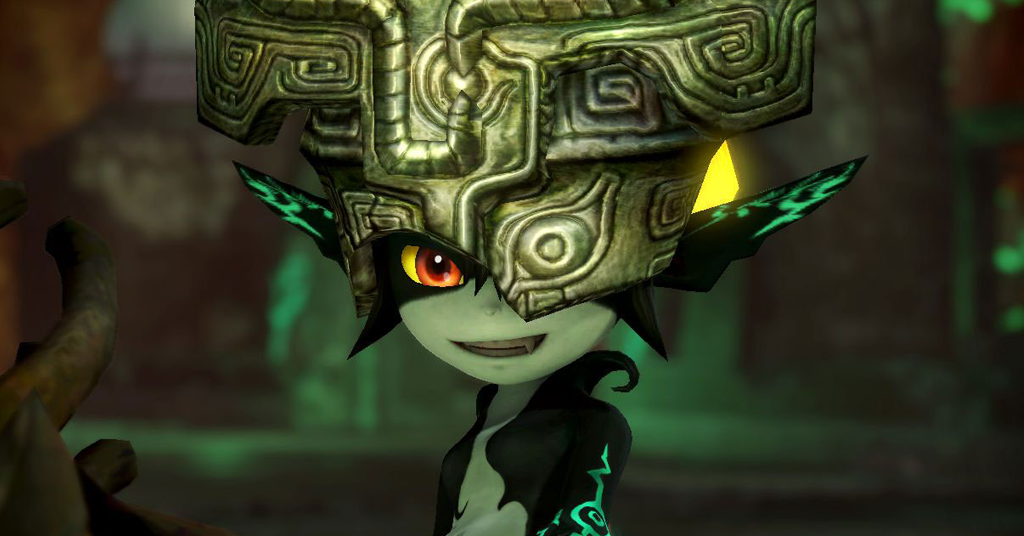
Watch the very last thing Midna does in Twilight Princess. She cries. One tear falls, it hits the Mirror of Twilight, and the Mirror shatters completely. Not cracks. Not fractures into four pieces you’ll spend the second half of an epilogue collecting. Gone, permanently, on purpose.
Here’s the part that gets skipped over every time someone talks about that scene. That single act, the one that closes the door between two worlds forever, is something nobody else in the entire game could have done. Not Zant, even with a god’s power behind him. Not Ganondorf, holding a third of the Triforce. Only Midna. The game tells you this directly, more than once, and then buries it under twenty years of people talking about how sad the goodbye is.
So today I want to ask a colder question than the one I asked last time. Last video was about whether Midna is the best companion this series has ever built. This one isn’t about companionship at all. This one is about power. Who’s allowed to have it in the Twilight Realm, who took it anyway, and what it actually costs a legitimate ruler to spend thirty hours unable to prove she’s real.
If that’s your kind of thing, subscribe and stick around. Members get exclusive videos and early access, link’s below. Let’s get into it.
THE MONARCH YOU MEET MID-EXILE
Start with the basic fact the game hides in plain sight for hours. When Midna finds Link chained up in the Castle Town sewers, she isn’t a sarcastic imp with a grudge against Hyrule. She’s a deposed head of state. She has been for some time. The character striking that first cold bargain with Link, help me and I’ll help you, has already lost a war before the game’s story properly begins.
Most Zelda games introduce their guide characters as exactly what they are from the first scene. Navi is a fairy. Fi is a spirit bound to a sword. There’s no gap between the role and the presentation. Midna is the one exception in the entire series where what you’re looking at and who you’re actually dealing with are two completely different things, and the distance between them isn’t a twist saved for the ending credits. It’s the entire structure of the plot.
She’s an imp because someone did that to her. She’s hiding in shadows and making desperate deals with a cursed stranger because the alternative, the actual seat of power she’s supposed to be sitting in, is currently occupied by the person who took it from her. Every choice she makes for the first two thirds of this game, the manipulation, the coldness, the constant transactional logic, has to be read through that lens first. This isn’t a character being difficult for the sake of drama. This is a government in exile, operating with zero resources, trying to claw back a country.
That reframing changes what the early hours are actually about. It’s not simply “will this character learn to be nice.” It’s “how does someone with a legitimate claim to power operate when every visible symbol of that power has been stripped away, and the only tool left is a half-cursed stranger who doesn’t even speak.”
THE SUCCESSION CRISIS NOBODY TALKS ABOUT
So how did she lose it. The game is more explicit about this than its reputation as a simple fairy tale suggests. Before the story starts, the Twili throne sat empty, and the people needed to settle on who’d take it. Zant, a court insider who’d served the Twili royal family for years and clearly expected the job to fall to him, was passed over. Midna was chosen instead.
Zant never lets you forget how badly this sat with him. Late in the game, cornered and finally honest about his own motives, he all but shouts the wound out loud: he believed he was owed the throne, and the Twili refused to acknowledge him as king. That’s not subtext. That’s the character telling you exactly what set everything in motion, in his own voice.
Why was he passed over. The reasoning the game gives ties directly back to the oldest wound in Twili history, the one this video isn’t going to dig into fully because there’s a whole separate piece coming on it, but the short version matters here. The Twili’s ancestors were banished to the Twilight Realm in the first place because they were consumed by a hunger for power they weren’t entitled to. Zant carried that exact same hunger, visibly, and the Twili recognised it. They didn’t just prefer Midna. They actively rejected the one trait in Zant that echoed the reason their entire people ended up trapped in permanent twilight to begin with.
There’s something worth sitting with in how that decision was made at all. Zant wasn’t some outsider with no claim. He’d served the royal family for years, worked inside the court, presumably had every procedural reason to expect the job. The game never spells out the exact mechanism, whether this was a formal vote among elders, a decision made by whatever passed for a Twili council, or something closer to a collective judgement the whole community arrived at. What it does make clear is that the throne wasn’t simply his by default, and it wasn’t simply Midna’s by default either. Somebody, or some body, looked at both candidates and actively chose. That’s a meaningfully different structure to how most Zelda games treat royal succession, which is almost always a straight hereditary line nobody questions. The Twilight Realm, whatever else it is, runs on a system where the crown can be denied to the person who expected it, on the stated grounds of character. Zant is proof the system can identify the wrong candidate correctly. He’s also proof that identifying the wrong candidate correctly doesn’t stop that candidate from taking the job by force anyway.
Which makes what happens next almost darkly funny, if it weren’t a coup. Denied the throne specifically because of his greed, Zant responds by finding the single fastest, most extreme source of borrowed power available to him and taking the throne anyway. The Twili elders looked at this exact impulse and said no. Zant heard the no and went and found a god.
THE FOREIGN POWER THAT MADE IT POSSIBLE
Because that’s what happens next. Ganondorf, banished into the Twilight Realm himself after events elsewhere in Hyrule’s history, doesn’t stay quiet in exile. He finds Zant. Specifically, he finds the one Twili nursing a grievance large enough to be useful, and he appears to him as something enormous and spectral, a towering presence that the isolated, magic-starved Twili mistake for genuine divinity. One of the game’s Sages later reflects on this with something close to dark irony, noting that Ganondorf, by nothing short of a cruel accident, had also been touched by the power of the gods himself. Two men who’d both been denied a throne through some mechanism of divine judgement, finding each other in exile.
Ganondorf offers Zant exactly what he can’t produce on his own: raw power, enough to overturn a legitimate succession by force. In exchange, Zant serves him. That’s the whole transaction. No grand ideology, no shared cause beyond convenience. A domestic figure with a real grievance and a foreign power willing to supply the muscle he can’t provide himself, in exchange for future obedience. It’s a shape you’ll recognise from outside fantasy fiction entirely, because it’s one of the oldest patterns in how power changes hands anywhere: legitimacy lost at home, replaced with force borrowed from somewhere else, at a price that gets collected later.
It’s worth pausing on Ganondorf’s own position here too, because it adds a third failed claim to power sitting underneath this whole story, not just two. He isn’t ruling Hyrule when this game begins either. He’s been dealt with, exiled into the Twilight Realm himself, stripped of the throne he wanted there specifically because the people and forces around him decided he couldn’t be trusted with it. That’s the same basic shape as Zant’s situation, a man convinced he deserves power, denied it by the people positioned to make that call, and looking for any route back to it that doesn’t require going through the people who said no. The difference is scale, not structure. Ganondorf simply has more raw ability to make that route work than Zant does alone, which is exactly why Zant needs him and exactly why the arrangement flows the way it does.
Line the three of them up and the pattern gets hard to miss. Ganondorf, denied dominion over Hyrule, exiled. Zant, denied the Twili throne, resentful. Both respond to rejection the same way: not by building a legitimate case, but by finding force wherever it’s available and using it to overwrite a decision that was already made about them. Midna is the only one of the three who was actually handed power through whatever process the Twili use, and she’s the only one who spends most of the game without any power at all to show for it. The story keeps circling back to the same question from different angles. Does power belong to whoever seizes it, or to whoever was actually given it. Twilight Princess answers that question mechanically, through the Mirror, rather than through a speech, but it answers it the same way every time it comes up.
Zant takes that power and does something swift and total with it. He turns the Twili people themselves into an army of Shadow Beasts, seals away the Sols that light the Twilight Realm, and moves against Midna before she can properly claim the magic that comes with the throne. She’s overpowered, cursed into the impish form you spend most of the game looking at, and cast out. The coup succeeds completely, in what looks, from every angle the game gives you, like a single night.
Notice what this means for how we should read Zant for the rest of the story. He isn’t a self-made tyrant in the way Ganondorf is. Every scrap of power he wields for the entire game is on loan. He’s a client, not a sovereign, propped up by somebody else’s magic, sitting on a throne he could never have taken through his own strength alone. Keep that in mind. It matters later, mechanically, not just thematically.
TWO FOREIGN ALLIANCES
Here’s a comparison the game sets up almost by accident, just by structuring both of its major relationships the same way. Zant strikes a deal with an outside power to seize a throne. Midna strikes a deal with an outside power, Link, to take it back. Same basic shape. Completely different substance, and the differences are exactly where this story’s politics live.
Start with what each side actually understands about the deal they’re making. Zant believes he’s speaking with a god. He isn’t. He’s speaking with a banished war criminal from another world entirely, wearing borrowed grandeur, and Zant either can’t tell the difference or doesn’t want to. He enters his alliance on false premises, handed to him by the more powerful party specifically to keep him compliant. Midna, by contrast, never pretends to Link that this is anything other than transactional. She tells him outright, from the very first bargain, that he has to do exactly as she says. There’s no divine theatre, no god act. It’s cold, and it’s honest about being cold. Whatever else you want to say about how she treats Link in those early hours, she isn’t lying to him about what this is.
Then there’s the direction the power actually flows. Ganondorf gives Zant strength and takes obedience in return, a relationship with an obvious and eventually collectable price. Midna and Link’s arrangement runs the opposite way for most of the game. She has almost nothing to offer him materially. No army, no magic she can freely give away, nothing but information doled out grudgingly and the promise that helping her might eventually help him too. If anything, Link is the one supplying the strength in that partnership for a very long time, and Midna is the one whose currency is knowledge, direction, and eventually, once it’s earned rather than assumed, trust. One alliance is built on a lie about divinity and a debt that gets called in violently. The other is built on a genuinely uneven bargain that slowly, unglamorously, turns honest.
That’s the real difference between a foreign power that enables a coup and a foreign power that enables a restoration. It isn’t really about who has more might. Ganondorf and Link are both outsiders lending strength to a Twili with a claim to press. What separates them is whether the person on the receiving end understood what they were agreeing to, and whether the alliance itself was ever meant to be permanent. Zant’s arrangement only works if he never sees Ganondorf clearly. Midna and Link’s only works because, eventually, they do see each other clearly, and choose to keep going anyway.
WHAT LEGITIMACY ACTUALLY COSTS
Here’s where the political read starts paying for itself, because it explains something the companion-focused version of this story tends to gloss over: why Midna spends the entire middle of the game behaving the way she does.
Zant gets the throne room. He gets the armies, the helmet that visually announces him as ruler, control over the Sols, control over an entire occupied population turned into monsters on his command. Every outward symbol of Twili kingship now belongs to him. Midna gets none of it. She gets a curse that strips her of her true form, and she gets thrown into a world that has no idea who she is or why any of this should matter to them. She isn’t just powerless. She’s unverifiable. There’s no court to vouch for her, no seal, no crown, nothing to point to and say, this is who I actually am.
Watch what she does with that. Every early transaction with Link, the cold bargains, the information doled out only when it stops being useful to withhold, isn’t just personality. It’s the only currency a deposed monarch with zero institutional backing has left: leverage, secrecy, and the ability to make herself useful enough that someone keeps helping her without asking too many questions about who she really is. A ruler with an army doesn’t need to negotiate like that. A ruler with nothing does.
There’s a detail buried in how the game handles titles that makes this sharper still. For most of the story, if anyone in Hyrule assumes a “Twilight Princess” exists at all, the game lets that assumption drift toward Zelda rather than Midna. Whether that’s a deliberate piece of misdirection on Midna’s part or simply the natural result of nobody having a reason to correct the record while she has no power to back the claim up anyway, the effect is the same either way: the actual title-holder spends most of her own story letting somebody else wear the label, because correcting it does nothing for her and might cost her the one advantage she has left, which is being underestimated.
Even her physical appearance in true form gestures at this. When the curse finally breaks, she’s revealed standing taller than Zelda, in a hooded cloak that echoes the exact silhouette of Zant’s own royal garb. That’s not just a visual clue about shared bloodline. Under this reading, it’s the state itself, the actual regalia of Twili kingship, being fought over by the two people with competing claims to wear it. One of them is currently wearing a version borrowed from somebody else’s power. The other one has been walking around for thirty hours looking like nothing at all.
There’s also the simple matter of what she’s competing against visually, every single time she and Zant might theoretically be compared by anyone paying attention. Zant’s helmet and armour are unmistakably regal, deliberately so, built to read as authority at a glance even to someone who’s never heard of the Twili before. An imp riding on the back of a cursed wolf reads as exactly the opposite, no matter how sharp her dialogue is. If legitimacy were a matter of first impressions, this contest would already be over before it started, and Zant would win it every single time anyone looked at the two of them side by side. The entire back half of the game is Midna clawing her way toward the one form of proof that doesn’t care what either of them looks like.
Worth putting a number on this too. Officially, Midna is twenty-one. That means the succession crisis that put her on the throne, the one Zant lost, wasn’t some settled inheritance she grew up expecting. It was a live political emergency she walked into young, with whatever institutional support existed around her presumably thin at best, given how completely and how fast Zant was able to undo it. The arrogance she shows Link in the opening hours reads differently once you place it against that timeline. This isn’t an established monarch being cruel to a servant out of habit. It’s someone who has already lost one political fight this year, badly, being handed a second one she has no resources to win, and falling back on the only tools she has left: information control, leverage, and refusing to let anyone see how little power she actually has.
THE RULER LINK NEVER MEETS
Here’s a strange fact about Twilight Princess once you notice it. For most of the game, you never actually see Midna govern anything.
You see her fight. You see her scheme, manipulate, warp Link between worlds, ride him into battle. What you almost never see, until the very end, is her exercising the kind of authority a ruler is supposed to have: giving orders that get followed by people other than one cursed knight, making decisions with consequences for a population, sitting in a room and being treated as what she actually is. The entire adventure plays out as something closer to a resistance campaign run by a government-in-exile than a fairy tale about a princess and her knight. There’s no court in exile to consult. There’s no cabinet. There’s Link, and there’s her, and that’s the entire apparatus of the rightful Twili monarchy for the whole of Act One and most of Act Two.
Even when you finally reach the Palace of Twilight, the actual literal seat of her power, it’s occupied. Every hallway you walk through belongs to Zant’s forces. The one place in the entire game that should be unambiguously hers is enemy territory by the time you get there, and taking it back is framed as a dungeon to clear, not a homecoming.
The two moments where she does exercise something like real sovereign force are worth separating from each other, because they’re not the same kind of act. Reclaiming the Fused Shadow’s power to strike down Zant is a use of force, brutal and decisive, but force is something anyone with enough borrowed magic could theoretically manage, Zant included. It proves she can fight. It doesn’t, by itself, prove she’s the rightful ruler. The other moment does that job on its own, and we’ll get to it properly in a minute.
There is one quieter form of rule running underneath all of this, easy to miss because it’s framed as a traversal mechanic rather than a political act. As Link clears each region of the twilight covering it, the ordinary Twili civilians caught inside, transformed against their will into Shadow Beasts, get restored back to their original forms. Midna is present for this, guiding it, every single time. Zant governs the Twili he controls through fear and transformation, turning his own people into weapons pointed at Hyrule. Midna, meanwhile, without a throne, without an army, without anyone acknowledging her authority, is quietly undoing exactly that damage to individual Twili citizens one region at a time, as a side effect of a quest that’s ostensibly about getting her power back. It’s the closest thing to an act of care for her own subjects that the game gives her the chance to perform, and it happens entirely without ceremony, buried inside what looks like a checklist of areas to clear.
Set that against Zelda for a second, because the contrast sharpens both characters. Zelda’s authority in this game is never in question. Hyrule’s soldiers still answer to her, the castle still recognises her, and even under occupation she’s treated by everyone around her as exactly what she claims to be. Her kingship is uncontested, even while her kingdom is overrun. Midna’s is the opposite condition entirely: her kingdom is, for a stretch, at least partly reclaimable by force, but nobody outside a handful of Sages and Zant himself would even recognise her claim to it if she stated it outright. Two princesses, both dealing with invasion, and only one of them has to spend the whole story also fighting to be believed.
ZANT AS DARK MIRROR
It’s worth taking Zant seriously for a moment before this all resolves, because the game does. His grievance is legible. He served the royal family for years, believed the throne was owed to him, and watched it go to someone else. That’s a recognisable, almost sympathetic shape of resentment, and Twilight Princess doesn’t ask you to feel nothing about it. By the time you meet him properly, that resentment has curdled into something closer to a breakdown than simple ambition, a man who’s spent however long since that rejection convincing himself the slight was unforgivable.
But the story is careful, almost pointedly so, about where his story goes wrong, and it isn’t the rejection itself. It’s what he does immediately afterward. Denied the throne because of a hunger for power that echoed his own ancestors’ downfall, he proves the elders right within what feels like the same breath, by seeking out the single most extreme, most borrowed form of power available anywhere in this story. He doesn’t out-argue the decision. He doesn’t build a legitimate case for himself over time. He finds a shortcut, and the shortcut has a price he apparently never stops to consider.
There’s a kind of tragedy available in Zant’s arc if you’re willing to look for it, and the game doesn’t fully deny it to him. A man spends years in service, watches the job he expected go to someone he presumably saw as less experienced, and instead of accepting that or building a legitimate case for himself over time, finds the fastest possible route to power and takes it, consequences unexamined. That’s not an alien psychology. It’s recognisable, almost mundane, which is part of why he lands as more than a simple monster even while doing monstrous things. The game lets him keep a sliver of dignity in his own telling of events, right up until the moment it makes very clear, mechanically, that dignity was never the same thing as a rightful claim.
His fatal error, in the terms this game actually sets up, is mistaking the performance of kingship for the fact of it. He has the throne room. He has the helmet, the armies, the captured Sols, total command over an occupied population. Every visible marker a casual observer would use to identify a king, he has. What he doesn’t have, and what the game is scrupulous about never letting him fake, is the one piece of magic tied specifically to legitimate rule rather than borrowed strength.
That’s the Mirror of Twilight. A Sage tells Link directly that only the true leader of the Twili can utterly destroy it. Zant, for all his stolen power, could merely break it into pieces. Read that carefully. The game isn’t saying Zant is weaker than Midna in raw power, for a long stretch of the story he demonstrably isn’t. It’s saying the Mirror doesn’t respond to power at all. It responds to legitimacy, specifically, mechanically, in a way brute strength categorically cannot fake. That’s about as close as this series gets to writing a working definition of what a rightful ruler actually is, and it does it through a game mechanic rather than a speech.
THE PALACE, THE FIGHT, AND WHAT THEY’RE ACTUALLY DECIDING
By the time you reach the Palace of Twilight itself, the stakes of all this have stopped being background reading and turned into the literal shape of the dungeon. Every gauntlet Link fights through there is built around Midna’s growing strength as she reclaims what’s rightfully hers, room by room, the game translating a political restoration into level design without ever needing a cutscene to explain it. And then Zant, the confrontation the whole game has been building toward, drags Link back through the bosses and arenas of every dungeon that came before, forcing a recall of tactics learned hours earlier before collapsing into something far more chaotic once those old tricks stop working. It’s a fight built entirely out of the game’s own history, which feels appropriate for a conflict that is, underneath everything else, an argument about who Twili history actually belongs to.
Zant loses that fight. But losing it doesn’t restore Midna. Her curse holds, and Zant, even beaten, gets to deliver one last piece of the puzzle: the curse was never his to lift in the first place, because it was never really his power to begin with. It belongs to Ganondorf, and only Ganondorf’s defeat will undo it. That’s the game confirming, out of Zant’s own mouth, at the exact moment he’s lost everything, that he was a client the entire time and not a sovereign for a single second of his reign. He took a throne he was mechanically incapable of actually holding.
THE GOODBYE, REREAD
Which brings us back to where we started.
We’ve talked before, in the last video, about how the mirror shattering plays as an emotional beat, the tear, the finality, the fact that she chose it herself and nobody made her. That reading still holds completely. This isn’t about replacing it. It’s about noticing there’s a second thing happening in the exact same three seconds of footage, one that only makes sense once you’ve tracked everything that came before it.
She isn’t only saying goodbye in that moment. She’s performing the one governmental act available exclusively to her, as the confirmed, legitimate sovereign of the Twili, and to nobody else in the story, not Zant with his borrowed god-power, not Ganondorf holding a third of the Triforce. Sealing the border between two entire worlds, permanently, unilaterally, without needing anyone’s permission or ratification, is a political act as much as an emotional one, and the game has spent the whole runtime making sure only one person on Earth is capable of doing it. When she does it, she isn’t just choosing to let Link go. She’s exercising the single power that proves, beyond any argument Zant or anyone else could make, that the throne was always hers.
And then she goes home to a country that just spent an entire arc occupied, its ordinary citizens transformed into monsters against their will, its palace fought through room by room by a stranger and a knight from another world. Rebuilding that is not something the game shows you. It happens entirely off-screen, forever, the moment the credits start. Whatever legitimacy she just proved she has, she’s about to spend it on the least glamorous job imaginable: putting a broken kingdom back together with no allies left in either world to help her do it.
WHY THIS READING MATTERS
Twilight Princess is telling two stories layered on top of each other, and almost everyone who talks about this game only ever engages with one of them. There’s the story most people remember: a cursed imp, a silent knight, a slow thaw into trust, a tearful goodbye. That story is real and it’s good, and it’s the one the last video was about.
Underneath it, quietly, without ever forcing you to think in these terms, is a story about a coup enabled by a foreign power, a usurper who mistakes borrowed strength for the real thing, and a rightful monarch who spends nearly the entire game unable to prove she’s who she says she is. The reason this reading rarely comes up isn’t that it’s a stretch. It’s that the emotional beats are so well executed they crowd everything else out of the conversation. Nobody’s thinking about succession law while Midna’s dying in Link’s arms on Hyrule Field. That’s the correct reaction. It’s just not the whole picture.
For a series that spends an enormous amount of time on royal bloodlines and rightful heirs, mostly by simply asserting them and moving on, Twilight Princess might be the one entry that actually interrogates what makes a claim to a throne real, rather than treating blood or ceremony as automatically sufficient. Zelda herself, across most of this franchise, is a princess because the game tells you she’s a princess, and nobody within the fiction ever seriously disputes it. Midna has to prove it, structurally, through a mechanic that responds to nothing but the truth of who she is, in front of a rival who genuinely believed, at least for a while, that force alone would be enough to settle the question permanently in his favour.
That’s a more interesting argument about legitimacy than this series usually bothers making, and it’s easy to miss entirely, because Twilight Princess never asks you to think about it directly. It just builds the machinery, hands it to exactly one character, and lets the story’s biggest emotional beat double as the proof. You don’t need to have noticed any of this on a first playthrough for the ending to land. That’s rather the point. The politics were always working underneath the feeling, not against it.
None of this changes how the ending feels. If anything, it sharpens it. She wasn’t just choosing to let go of someone she’d grown to love. She was, in the same motion, finally getting to act like the ruler she’d been the entire time, for the first and only moment the game ever lets her.
It also changes what a replay looks like, if you’re the kind of player who goes back to this game every few years the way a lot of us do. Watch the opening hours again with this framing in mind and the coldness reads completely differently. That first bargain in the sewers isn’t a character being difficult for its own sake. It’s a head of state with nothing left but a stranger’s help, choosing distance over honesty because honesty has never once protected her before. By the time you reach the Palace of Twilight, you’re not just watching a companion get her powers back. You’re watching a legitimate ruler finally reach the one piece of magic in the entire game that can prove, beyond argument, that she was right the whole time. Twilight Princess never insists you notice any of this. It just quietly built the case, the whole way through, and let the goodbye carry all of it at once.
Thanks for watching. If you enjoyed this, subscribing is the single best thing you can do to help a channel like this reach more people who care about this series as much as we do.
Before I go, a proper thank you to everyone supporting this channel through membership. Whether you’re a Hylian, a Sheikah Scholar, or one of our Ancient Sages, this channel doesn’t happen without you.
Speaking of Ancient Sages, huge thanks to Tarnished_Hylian, supersonicmariokirby, EldritchKhaotic, PrepayingOne, and Romulus879. You lot keep this channel running. If you’re not a member yet, membership gets you exclusive videos, early access to everything we make, and an invite to the Discord. Link’s below. See you in the next one.
Leave a Reply