
There’s a shot in the Ocarina of Time remake trailer that lasts less than two seconds. Mido, standing in Kokiri Forest, arms crossed, doing what Mido does best. And on his arms, faint white body paint.
Look closely. That’s not a random design. That pattern belongs to Queen Sonia. Zelda’s mother. From Tears of the Kingdom.
A game set tens of thousands of years after this one.
Nobody’s explained that. Nintendo didn’t mention it in the Direct. It’s not in the press release. But it’s there, frame by frame, if you know where to look. And it’s not the only one.
Impa has a mark on her forehead in this remake that she never had in the original. Sheik is holding a harp that shouldn’t exist for centuries. The Sheikah eye is being stitched into fabric that was designed in 1998, before that symbol meant anything at all. And Hyrule itself has had buildings moved, mountains reshaped, and entire rooms added that were never there before.
This isn’t a coincidence repeated four times. This is a decision. And by the end of this video I think you’ll agree it’s the most interesting thing Nintendo has done with this remake, and almost nobody’s talking about it, because everyone’s too busy arguing about Link’s face.
Welcome back to Triforce Times. If you’re new here, this is where we go past the trailer breakdown and actually dig into what a Zelda game is doing and why. Today, Ocarina of Time on Switch 2. Not a spec list. Not “everything new.” We’re going to build a case, piece by piece, for what Nintendo is actually doing with this remake, and what it might mean for where the whole series is headed. There’s a section near the end that ties every single one of these details together into one idea, and I’ve genuinely not seen anyone else make that connection yet. Stick around for it.
A WORLD THAT DOESN’T MATCH YOUR MEMORY
Let’s start with the obvious thing first, because you need it before anything else makes sense. This remake is faithful. It is not one to one.
Kakariko Village is the clearest example. Watch the shot of Link riding a cuckoo down from a rooftop, sailing over the village. You can map it against the original almost perfectly. The windmill’s there. The graveyard’s roughly there. But Impa’s house, the one under construction, and the House of Skulltula have all shuffled position. The Skulltula house used to sit near the windmill. Now it’s further out, and you can only tell it’s the same building because of the cobwebs on the door. The cuckoo lady’s moved too. Same shadow, different spot.
Small stuff on its own. But it adds up fast once you start counting. Lon Lon Ranch no longer sits on its little plateau. It’s flat, level with the rest of Hyrule Field. And here’s the detail that actually matters: that’s not just an aesthetic choice. In Breath of the Wild and Tears of the Kingdom, the ruins of Lon Lon Ranch sit flat on the ground too. Nintendo appears to have gone back and adjusted 1998 geography to match ruins they designed decades later, in games that hadn’t been made yet when Ocarina of Time first came out. Think about what that actually means. Somewhere in a design meeting, someone decided the past should be redrawn to match the future.
Goron City’s had a layout pass. The hanging island where you’d find the Goron’s Ruby has been swapped for a rocky ledge, and the old staircases between levels are gone, replaced with chain-link fences you climb. It fits the industrial look of the Gorons well enough, but it’s a genuine mechanical change to how you traverse that space, not just a texture upgrade. And Death Mountain itself looks different from a distance. The opening at the top, where the crater and the volcano’s mouth should be, appears more open in this version than it ever was on N64. It might be nothing. But if it’s not, it could change how the Fire Temple and the summit actually play when you eventually get up there.
The thieves’ hideout in Gerudo Valley has picked up small additions too, vines now growing outside the jail cell, nothing that changes how you’d solve anything, but enough to suggest every location in this game has been individually reconsidered rather than just given a fresh coat of paint.
And then there’s Castle Town, which is where the changes stop being small. In the original, once you got past the gate, that was it, a gatehouse and some guards. In this version, buildings appear to continue much further up the hill toward the castle itself. There’s a clip on the Japanese website of Link crawling through the passage that leads to the courtyard, and instead of coming out straight into the gardens, he emerges into something that looks a lot like a sewer. That’s not a texture change. That’s new space that didn’t exist in 1998, connective tissue Nintendo built because the original jump from crawlspace to garden apparently didn’t hold up to modern scrutiny.
Even the dungeons aren’t safe from this. There’s a bombable wall in the Water Temple that isn’t in the original game at all. If you’ve ever spent an evening of your life hunting for the right water level in that dungeon, you’ll understand why even one new wall is worth mentioning.
So before we go any further, hold onto this idea: this game is willing to change actual geography, not just detail. Keep that in your back pocket, because it’s going to matter a lot later in this video.
WHAT THE CLOTHES ARE MADE OF
Here’s a detail that’s easy to scroll past and completely changes how you read this remake once you notice it.
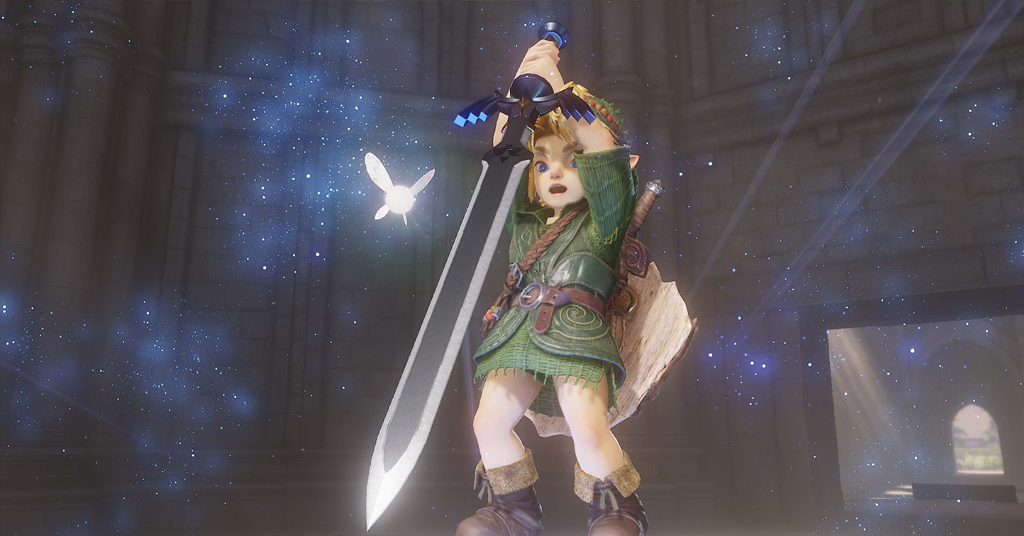
Look at Link’s Kokiri outfit. Properly look at it. It’s not fabric with a leaf pattern printed on it. It looks like it’s built from actual leaves, ferns, woven vegetation. His bed in Kokiri Forest is the same story, made from leaves and hay instead of a wooden frame with proper sheets. The Kokiri have always been described as forest dwellers, but this is the first time the game has actually committed to what that means physically. These aren’t people who like the forest. These are people whose entire material culture comes from it, because they’ve never left it.
And once you clock that, other things start making sense. The swirl pattern on adult Link’s tunic isn’t decoration either. It matches the forest dweller’s armour set from Breath of the Wild, gear that’s explicitly said to be made by the Korok for the Hylians. The Korok are the descendants of the Kokiri. The Kokiri sword even has the same leaf-bladed shape as the forest dweller’s sword from that game.
So Nintendo isn’t just making Kokiri Forest look prettier. They’re building a material culture for a Breath of the Wild era item, decades before that item exists, and quietly implying the Korok inherited the idea from somewhere. From here.
Then there’s the feather. Adult Link now has a small feather tucked behind his ear, and it’s new. On its own, that’s nothing. A costume flourish. But this remake also adds a proper jump button, meaning Link can jump wherever he wants for the first time in Ocarina of Time’s history. And the item in this series that lets Link jump on command is the Roc’s Feather, from Link’s Awakening, the Oracle games, Four Swords Adventures. Is a feather behind Link’s ear, in the exact game that adds free jumping, really a coincidence?
Maybe. Probably not. And there’s a smaller version of the same instinct in Malon’s design. Her dress originally had a plain blue pattern along the bottom. In this remake, that pattern has been redrawn as tiny blue horses. It’s the kind of detail that changes nothing about the game and everything about how much care went into it.
DIALOGUE, VOICES, AND WHAT THEY MIGHT REVEAL
There’s a piece of this remake that’s had almost no discussion, and it might end up being the most consequential change of all: full voice acting, and new dialogue to go with it.
During the gameplay demonstration, Link talks to Saria, and she responds with lines that weren’t in the original script. That confirms something important. NPC dialogue in this remake has been touched, not just re-recorded. And if Saria’s got new lines, there’s no reason to assume she’s the only one.
This matters because Ocarina of Time has always hidden its best material in throwaway conversations. Zelda games bury lore in offhand comments from background characters, not cutscenes. If Nintendo’s writing team has gone back through every NPC in Hyrule with the freedom that full voice acting gives them, you have to assume some of what comes out is going to shift or expand what we think we know.
The scenes worth watching closely: Ganondorf’s betrayal in the throne room. Link’s backstory, the little we get of it, delivered by the Deku Tree. Zelda’s visions of Ganondorf from the tower. All three of those moments are thin on detail in the original game, more implication than explanation, and all three are exactly the kind of scene a writer handed a voice cast and a bit of extra breathing room might choose to flesh out. Matt Mercer is confirmed back as Ganondorf, having first voiced him in Tears of the Kingdom, so at minimum you’re getting a performance with real range behind Ganondorf’s dialogue for the first time in this specific story. What that means for Zelda, Sheik, Malon and Kaepora Gabbora’s voices remains to be seen, and it’s fair to say reactions from the Direct footage were mixed. Voices are always the hardest thing to judge from a handful of snippets, so we’ll reserve full judgement until launch.
And this is where it starts to get properly interesting, because everything so far has been Nintendo referencing games that came after Ocarina of Time and folding them backward into it. That’s the pattern. Once you see it in the clothes and the dialogue, you start seeing it everywhere. Including on the characters you’d least expect, and in the actual buttons you’ll be pressing.
THE SHEIKAH RETROFIT
The Sheikah are one of the most underused ideas in classic Zelda. A handful of NPCs, Impa, some vague lore about a shadow folk serving the royal family. Then Breath of the Wild happened, and Nintendo built an entire ancient civilisation around them, technology, architecture, the eye symbol, a visual language that’s now instantly recognisable to anyone who’s played a Zelda game in the last decade.
This remake is retroactively giving Ocarina of Time that visual language. Impa now has the Sheikah eye mark on her forehead. She never had it in the original 1998 game. That mark comes from later designs, Skyward Sword gave Impa a version of it in white, and the Breath of the Wild era Sheikah wear it in blue. This remake’s version is red. But the point stands: this is a design element invented well after Ocarina of Time, being added into Ocarina of Time.
When Link puts on the new Lens of Truth, now redesigned as a pair of goggles rather than a magnifying glass, the effect that appears around him is the exact Sheikah swirl pattern from Breath of the Wild. You can see the same pattern worked into the leather on Impa’s armour. And Kakariko Village itself has shifted architecturally, leaning more Japanese in influence than the medieval European look of the original, which lines up neatly with the aesthetic Nintendo built for the Sheikah after Breath of the Wild.
And then there’s Mido, back to that opening shot. His arms now carry white body paint that closely resembles the markings worn by Queen Sonia in Tears of the Kingdom’s flashback sequences. Nobody at Nintendo has explained this. It might be nothing. It might be an art asset that got reused because it looked right on the model. But it’s specific enough, and it’s sitting right next to three other Sheikah-era callbacks, that it’s hard to write off as accidental.
Here’s the theory that actually holds all of it together. Doylist explanation first, meaning the real-world reason behind the curtain: this remake is being built after all of these designs already existed in the series. So putting them into Ocarina of Time isn’t technically a retcon, it’s Nintendo saying, this is where it all started, these symbols and this aesthetic were already here, we just hadn’t shown you properly yet.
Watsonian answer, meaning the in-universe explanation: if you buy into the idea that this remake is being framed as a story told from some point in the far future, and we’re about to get to exactly why that matters, then maybe what we’re watching isn’t strictly 1998’s Hyrule at all. It’s a legend, retold, filtered through everything that happened after. Including the Sheikah’s golden age under Breath of the Wild.
THE LENS THAT ISN’T A LENS ANYMORE
Quick one, but it deserves its own moment, because it’s easy to file this under “cool redesign” and move on when it’s actually another data point for everything we just covered.
The Lens of Truth has always had one of the odder silhouettes in the series. In the original, it’s a literal magnifying glass, something Link holds up to one eye to reveal invisible platforms, hidden enemies, secret passages. Functional, a little clunky, very 1998.
In this remake, it’s gone entirely. In its place, a pair of purple-tinted goggles. And the design isn’t arbitrary. Those goggles carry a fringe detail around the lenses that reads a lot like the eyelash flourish on Purah’s glasses, the Sheikah scientist’s signature look from Breath of the Wild and Tears of the Kingdom. That’s not a huge leap once you’ve sat through the last section. It’s another piece of Sheikah-era, Breath of the Wild-adjacent design being folded backward into 1998’s Hyrule, on an item that’s about to become one of the most-used tools in the entire game.
There’s a mechanical shift buried in this too, not just a visual one. In the original, using the Lens of Truth had zero effect on Link’s model. You pulled it out, the screen did its thing, that was it. In the remake, there’s a clip showing Link’s head give a small, deliberate nod as he puts the goggles on, the same kind of animation you’d expect from equipping any other piece of headgear. That’s new. It suggests the Lens of Truth isn’t being treated as a special-case magic item anymore. It’s being treated as equipment, in the same category as the masks, which lines up with everything we just covered about D-pad up almost certainly being a dedicated head slot.
And if the Lens of Truth now behaves like a genuine piece of equipment rather than a held-up prop, it’s worth wondering whether the actual puzzle design changes with it. The original required you to hold the item raised, freezing your other options while it was active. If this version can simply be worn, toggled on and off the way boots now are, that changes the rhythm of every Shadow Temple and Bottom of the Well puzzle built around it. Small redesign. Genuinely large ripple effect if it plays out that way.
SHEIK, TWICE OVER
Sheik’s redesign deserves its own section, because it’s the one change generating the most discussion online right now, and for good reason.
In the original game, Sheik is Zelda in disguise, hiding from Ganondorf as a man. The game never has Sheik state a gender, but every character refers to Sheik with male pronouns, and the original design leans deliberately androgynous. Broad shoulders, a flat chest, nothing that reads as feminine at a glance.
This remake’s Sheik is visibly more feminine. Long golden hair in a braid, softer proportions. And this design isn’t new, exactly. It’s built on an unused Sheik concept from Twilight Princess, a version of the character that never made it into that game but later resurfaced in Super Smash Bros. So Nintendo has reached back into their own scrapped concept art from one game, that got a second life in a completely different one, to build this remake’s version of a third game’s character entirely. That’s three decades of design history compressed into a single silhouette.
The counterargument, and it’s worth taking seriously rather than dismissing it, is that by making Sheik read as more obviously Zelda, the remake loses some of what made the disguise interesting in the first place. Part of the original’s tension was that everyone in the room, including you as the player, is meant to genuinely believe Sheik is someone else entirely. If the design gives it away before the reveal, does that cost the story something? It’s a fair question, and it’s one that will only really be answerable once we’ve seen how the remake’s writing handles the actual reveal scene, since dialogue and voice direction could easily paper over what the character model gives away.
The harp Sheik plays has changed too. It’s now visually identical to the Goddess Harp from Skyward Sword, an instrument Link and Zelda use in that game, set thousands of years before this one. That’s not a new connection Nintendo’s inventing on the spot for this remake. Hyrule Historia already ties the two together, and Aonuma discussed it in interviews around Skyward Sword’s release. This is old, established lore. What’s new is seeing it actually rendered, the physical object handed down through generations of the royal family, sitting in Sheik’s hands in the exact game where that connection was first implied but never shown.
There’s also official Ocarina of Time artwork showing Link and Sheik fighting side by side, with Sheik using a small blade worn on the back. That blade is present on this remake’s design too, and it’s the same blade you can spot in the cutscene where Bongo Bongo escapes the well. So even in the middle of a fairly bold redesign, Nintendo’s clearly gone back through the original art assets and pulled forward the details that were always there but never fully realised in the N64 game’s limited polygon count.
THE ITEM WHEEL PROBLEM NOBODY’S SOLVED
Now for something that’s not lore, it’s pure design, and it might matter more to how this game actually feels to play than anything we’ve covered so far.
The original Ocarina of Time let you assign items to the C-buttons freely. Bombs, hookshot, Deku Nuts, whatever you wanted, and you could swap between them mid-action without pausing. This remake appears to be moving to a single item button instead, closer to how Tears of the Kingdom and Echoes of Wisdom handle their expanded item lists. Press one button to bring up a slider, scroll to what you want, confirm.
That’s a real trade-off, and it’s worth being honest about both sides of it. On one hand, this fixes a genuinely dated piece of the original game. The Iron Boots are the obvious example. In 1998, you had to pause the entire game every single time you wanted to put them on or take them off, and the Water Temple demands you do that constantly. This remake finally lets you assign boots to the D-pad and toggle them instantly, no pause required, which the 3DS version also fixed years ago. There’s a clip on the Japanese website showing exactly this, full HUD visible, boots swapping with a single press.
On the other hand, a single universal item button risks the exact problem Echoes of Wisdom has, a slider that works fine when you’re only ever reaching for your two or three favourite tools, and becomes genuinely clunky the moment you need something specific buried in a long list. Ocarina of Time’s item count is small compared to something like Tears of the Kingdom’s echoes or Zonai devices, especially once you account for young Link and adult Link each having access to different tools. So the practical impact might end up being minor. But if there isn’t a dedicated slot for your ranged weapon, the bow or slingshot depending on your age, that’s the one swap players will be making constantly throughout the entire game, and that’s exactly the kind of decision that either disappears once you’re used to it, or becomes the thing every review mentions in its first paragraph.
There’s also a slot reserved for D-pad up, separate from the boots slot on D-pad down, and so far the only thing that’s been shown equipped there is the redesigned Lens of Truth. That strongly suggests up is reserved for head-slot items generally, which matters because Ocarina of Time has a small stack of masks, the trading sequence masks, plus the Zora, Goron, Gerudo and Mask of Truth you get later. Nintendo has also confirmed new amiibo will unlock N64-style polygonal masks of Link and Zelda for use in-game. If head slot items get their own dedicated button, swapping masks stops being the fiddly menu chore it always was, which is a small change with a genuinely large quality of life payoff for anyone doing the full trading sequence.
COMBAT LEARNED SOMETHING
Back to something more directly satisfying: this remake’s combat has actually been touched, not just re-skinned.
There’s a clip of Link facing a Beamos in the Spirit Temple. He raises the Mirror Shield and reflects its laser straight back at it. In the original game, that’s impossible. The Mirror Shield only ever reflects very specific attacks, Twinrova’s magic and nothing else, a limitation that’s felt arbitrary for nearly three decades. This remake has clearly expanded what the shield can actually do.
Separately, there’s a shot of Link tanking a full axe swing from an Iron Knuckle. In 1998, blocking that attack still sent you flying, full stagger, a chunk of hearts gone, didn’t matter that your shield was up, the Hylian Shield simply wasn’t strong enough to stop it. In the remake, Link staggers but holds his ground. That’s a real combat rebalance, not a visual flourish, and it brings Ocarina of Time’s blocking closer in line with how Breath of the Wild and Tears of the Kingdom handle heavy enemy attacks, where a strong enough hit staggers you rather than launching you across the room.
Your shield also appears to stay raised automatically while Z-targeting, the way it’s worked in every 3D Zelda since Twilight Princess, rather than requiring a dedicated button press the way the N64 original demanded. It’s a small thing on paper, but it removes a piece of genuinely dated friction that’s been sitting in this specific game for nearly thirty years, and it should make combat feel noticeably more responsive without changing the actual rules of engagement.
Whether these changes net out to a harder or easier game overall is genuinely hard to call from a handful of trailer clips. Being able to tank an Iron Knuckle hit sounds like it makes the game easier. But an expanded Mirror Shield opens up more aggressive options against enemies that used to only be solvable one specific way. It’s entirely possible this evens out, and we simply won’t know until we’ve got a controller in hand.
THE TAPESTRY THAT KNOWS TOO MUCH
Now the part that ties this whole video together.
Ocarina of Time’s remake replaces the old quest log with something called the Threads of Time, a tapestry that fills in as you play. And it’s framed, explicitly, as a story being told after the fact. The opening narration doesn’t just say “long ago there was a kingdom of Hyrule” the way Zelda games always have. It leans into it. This is a legend, being retold, from some point beyond the events you’re about to play.
Fans have already started mapping out what the finished tapestry should contain, dungeons, rewards, the final battle sitting in the centre where the sages’ medallions presumably go. And once you account for everything the main story actually covers, there are seven segments left over. Unexplained space. Room for side content nobody’s confirmed yet, things like Lon Lon Ranch’s full story or the Gerudo Fortress, or room for something else entirely that hasn’t been revealed.
Now put that next to everything from the last thirty minutes. The Sheikah symbolism that shouldn’t exist yet. The Breath of the Wild armour patterns on a Kokiri sword. The Skyward Sword harp. The new dialogue that could be filling gaps in scenes the original game only implied. If this whole game is being told as a legend from some point deep in Hyrule’s future, a future that’s already lived through the Sheikah’s golden age, then all of it stops being a pile of unrelated inconsistencies. It becomes the framing device doing exactly its job. You’re not playing 1998’s Ocarina of Time. You’re watching someone in the far future retell it, filtered through everything Hyrule became in between.
I’m not going to tell you that’s confirmed. It isn’t. But it’s the only explanation I’ve found that accounts for every single one of these details at once, rather than explaining them away individually as unrelated coincidences that all happen to point the same direction.
THE BIGGER PICTURE
Zoom out for a second, because this remake isn’t arriving in isolation, and the timing tells its own story.
The Legend of Zelda movie is confirmed for the 30th of April 2027, roughly half a year after this remake launches. The 40th anniversary orchestra tour has just been announced, bringing Symphony of the Goddesses-style live performances back for the first time in a decade. There’s a Zelda Notes companion app rolling out for this specific game, and 40th anniversary special edition hardware already selling out within hours. None of that is unusual for a big anniversary year on its own. What’s unusual is the specific choice to make Ocarina of Time, out of every game in the series, the centrepiece of all of it.
That’s not a small decision. Nintendo could have built this entire anniversary campaign around Breath of the Wild, still by most measures the series’ biggest commercial success. They chose the 1998 game that split the timeline into three instead. And now that same game is quietly being redressed in the visual language of everything that came after it, the Sheikah aesthetic, the Skyward Sword harp, armour that belongs to a game set centuries later. If you wanted to position one single game as the true origin point of the entire modern Zelda identity, retroactively making it look like it always contained the seeds of everything that followed, this is exactly how you’d do it.
THE STUFF THAT DIDN’T CHANGE
One last thing, because it’s easy to only talk about what’s different and forget what Nintendo deliberately chose to leave alone.
The remake keeps intentional loading screens between areas. Hyrule Field, Kakariko, all of it, still separated the way it was on N64, even though the Switch 2 could easily run this as one seamless open world the way Breath of the Wild does. That’s not a technical limitation. That’s a decision to preserve pacing that’s been part of this game’s identity for almost thirty years, and it’s the kind of small design feature that will make a genuine difference to how the game feels without most players ever consciously noticing why.
And the title screen survives. After Breath of the Wild, Tears of the Kingdom and Echoes of Wisdom all quietly dropped the traditional Zelda title screen in favour of something subtler, there was a real fear this remake would do the same. It doesn’t. The shots in the trailer are lifted straight from the game’s actual title screen, and Nintendo’s already released a rendition of the title theme on Nintendo Music ahead of launch. Some things, apparently, you don’t touch, no matter how much else around them gets rebuilt.
CLOSE
So here’s where that leaves us. This is a remake willing to move buildings, reshape a mountain, rewrite combat, and redesign a main character built on decades-old scrapped concept art. But it refuses to touch a loading screen or a title theme that most players would barely register either way.
That’s not an inconsistent approach. That’s a studio being extremely deliberate about which thirty-year-old choices are sacred and which ones were always meant to be revisited. And if the Sheikah symbolism, the tapestry framing, and the callbacks across four decades of Zelda mean what I think they mean, this isn’t just a remake of Ocarina of Time.
It might be Nintendo’s attempt to make Ocarina of Time explain itself, and to make itself the true beginning of everything the series has become since.
We’ll know more on the 5th of November. Until then, let me know down below what you think the seven empty tapestry segments are hiding. I read every single one of them.
Leave a Reply