
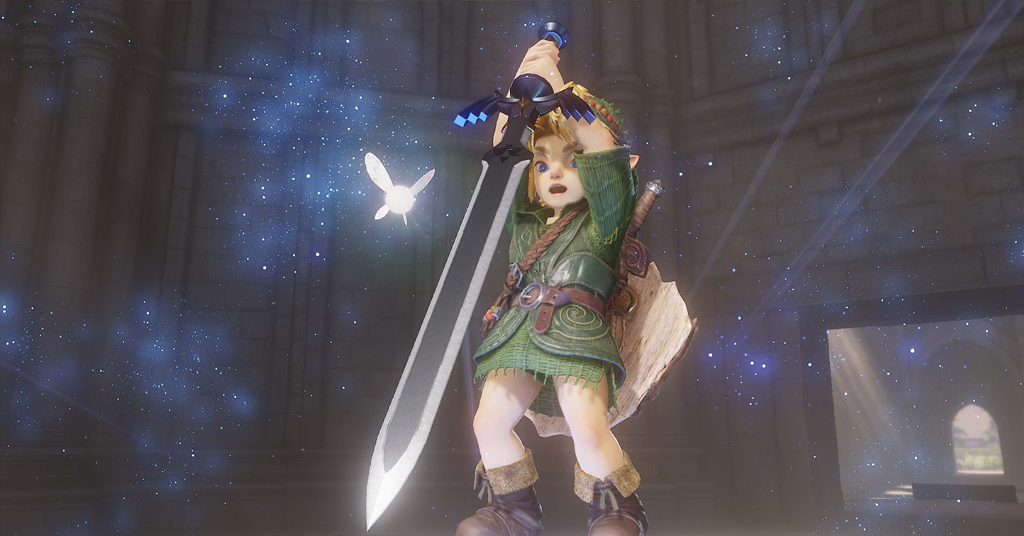
Link is lying in bed. That’s how it starts, in the trailer, in the original game, in every version of this story we’ve had for almost thirty years. But then, on Switch 2 the Triforce appears on the back of Link’s hand.
That’s new. That’s not how it happened in 1998. In the original Ocarina of Time, you don’t learn that Link carries a piece of the Triforce until hours into the game, well after Kokiri Forest, well after you’ve gotten to know this boy without a fairy.
Nintendo has called this a faithful remake. Aonuma said as much. But before a single dungeon has been shown, before we’ve even met Navi properly, they’ve already changed when we find out who Link is.
So the question I want to ask today isn’t “is this a faithful remake?” It clearly is, mostly. The question is: once you start letting a story reveal itself differently, where does that stop? Ocarina of Time isn’t just any Zelda game. This is the one where the timeline splits. If Nintendo’s willing to touch the small stuff, the stuff nobody would blame them for touching, what does that mean for the big stuff. The stuff that we’ve been discussing and debating for many, many years.
Let’s go through it all.
Before we go on, welcome back. I’m Triforce Times. Here, we dive deep into The Legend of Zelda, its design, lore, hidden stories, and everything Nintendo leaves unexplained. If you enjoy that, consider subscribing. Members get exclusive Zelda videos, early access to new content, and an invite to our community Discord. The link is below.
What Nintendo Has Said
Before any of the speculation, let’s ground this in what’s actually confirmed. I don’t want to spend the next half hour building theories on top of theories. Everything from here has a source, and I’ll tell you what kind of source it is as we go.
Start with the Direct itself. Aonuma called this “a faithful interpretation using modern technologies.” He was explicit that this isn’t Breath of the Wild, isn’t a go-anywhere-do-anything reinvention. It’s the same journey, rebuilt. He walked us through Kokiri Forest, through Hyrule Field, through Castle Town, all of it recognisable, all of it clearly the same map we’ve walked a hundred times before.
But then there’s Nintendo’s own press release, and this is the line worth looking at twice: “expanded character dialogue.” Not “more voice acting.” Not “improved cutscenes.” Expanded dialogue. That’s a specific thing to call out, and it’s the one doing a lot of the work in this video, because expanded dialogue for existing characters is a very different thing from new plot beats. However, it still means characters are going to say things they never said in 1998.
Then there’s a line Nintendo nearly buried in the small print. Their own product page, describing the day-night cycle, says new faces, and new foes, may surface after the sun goes down. Read that again—new faces. Not old faces behaving differently at night. New characters who weren’t in the Nintendo 64 version at all. Worth remembering, in the original, Castle Town’s clock genuinely stopped the moment you walked in. Time only passed outside in Hyrule Field. The Direct confirmed that’s gone; time marches on everywhere now, day into night, no matter where you are. That single system change is what opens the door for new faces to exist.
This remake is faithful to the structure, the world, the beats you remember. But it is not one-to-one. It’s already promised new dialogue and new faces. The faithful remake and the expanded remake are the same game, and the rest of this video is about figuring out where the line between the two actually sits.
What We’ve Spotted in the Footage
Let’s start at the shallow end. These are all things you can see, frame by frame, in the trailer, the gameplay footage, and the stills on Nintendo’s Japanese site.
First, the Kokiri. Mido now has white body paint on his arms. And if that rings a bell, it should, because it looks a lot like the markings Queen Sonia wears in Tears of the Kingdom’s flashback sequences. I don’t know what that means yet. But it’s not an accident. Nobody at Nintendo puts specific, recognisable body paint on a background character’s model without a reason, and Sonia’s markings aren’t generic fantasy face paint; they’re a design choice built specifically for her, tied to her role in Tears of the Kingdom. Seeing an echo of that on a child in a forest, in a game made decades before Sonia existed, is exactly the kind of retroactive thread I am interested in.
Then there are Sheikah eye markings, turning up in places they weren’t in the original, worked into details across a few environments. Small, easy to miss, but Sheikah imagery doesn’t get sprinkled in for texture. It usually means something. Every mainline Zelda game since Ocarina of Time has treated the Sheikah eye as a marker of something hidden, something watching, something the surface story hasn’t caught up to yet. Seeing it appear where it never used to raises the obvious question of whether the remake is quietly expanding how present the Sheikah actually are in this era of Hyrule.
And then there’s Link himself. Adult Link’s tunic now carries a swirl pattern that echoes the Forest Dweller’s armour, the set tied to the Koroks in Breath of the Wild and Tears of the Kingdom. The Kokiri Sword’s even picked up the same leaf-blade shape as the Forest Dweller’s Sword. Nintendo is drawing a visual line from young Link’s childhood weapon to the equipment his forest friends’ descendants would wear generations later.
Here’s what makes all these details interesting. None of these connections existed when Ocarina of Time came out. The Forest Dweller armour didn’t exist. Sonia didn’t exist. This is Nintendo taking design language from games made after 1998 and folding it backwards into the game that started the whole timeline. That’s something closer to a retrofit, building connective tissue between eras that, in 1998, hadn’t been written yet. Keep that idea in your back pocket. We’re coming back to it.
The Confirmed Story Change
Let’s go back to that Triforce mark, because this is the one place where we’re not reading tea leaves off a tunic pattern. This is an actual, on-record change to how the story unfolds.
In the original game, the Triforce of Courage doesn’t appear on Link’s hand until much later. It’s not something you’re shown in the opening minutes. The whole first stretch of the game is Young Link going to see what’s wrong with the tree that raised him. The Triforce connection is something later, alongside everything else Link learns about who he is.
In the teaser, it’s there before he’s even out of bed.
Now, on its own, that’s not a huge deal. It’s a striking image for a trailer, and trailers can rearrange things for impact. Plenty of games show you the ending in the opening thirty seconds. That’s marketing.
Put it next to expanded dialogue. Put it next to “new faces”. What you get is a pattern. Nintendo is repeatedly choosing to foreground Link’s identity and his connection to the Triforce earlier and more directly than the original ever did.
Is that a problem? I don’t think it has to be. Some of Ocarina of Time’s mystery was always more implicit, things the player pieces together rather than things the game hides on purpose. But it does tell you something about the remake. Given the choice between preserving a slow reveal and making sure new players understand what they’re looking at from minute one, Nintendo appears to be choosing clarity.
So far, everything we’ve covered is either confirmed outright or visible in the footage. From here, we’re moving up the scale. Minor visual continuity, into “how would this actually work” territory, and by the end, into the biggest unresolved question the entire series has never properly answered. If you’ve made it this far, stick around, because the rest of this video is where it gets properly speculative.
Sheik’s Redesign and the Goddess Harp
Let’s talk about Impa first, quickly, because it sets up why Sheik matters so much.
Impa is established from the very start of Ocarina of Time as Zelda’s attendant and a member of the Sheikah. When Ganondorf storms the castle, Zelda flees with her. And when Zelda needs to hide for seven years, she doesn’t just vanish. She disguises herself as a Sheikah, like Impa, specifically because that identity reads as separate from the princess. It’s camouflage that works because Sheikah and royalty look and feel like two different things.
Which is why her redesign is worth talking about. In the footage so far, Sheikh reads as noticeably more feminine than the original: long golden hair worn in a braid, and a much softer silhouette than the deliberately androgynous design from 1998, when Sheikh was voiced and referred to with male pronouns specifically to sell the disguise.
And then there’s the harp. Sheikh’s harp in the new footage closely matches the Goddess’s Harp from Skyward Sword. Now, this isn’t new. Aonuma said back in 2011 that the design is the same as the harp Sheik carries in Ocarina of Time.
Skyward Sword didn’t exist in 1998. Neither did that implied connection. What we’re looking at is Nintendo taking a piece of lore that only became lore thirteen years after this game was released, and building it visibly into the remake, reinforcing the idea that this harp has passed down the royal bloodline across the entire timeline. It’s a lovely piece of continuity on its own terms. A princess practising on Skyloft, centuries before Hyrule as we know it even exists, and that same instrument turning up in the hands of her descendant, disguised, teaching our hero a song.
So put those two changes side by side. A disguise that worked, in 1998, partly because it obscured Zelda’s identity. And a redesign that, in 2026, makes that same disguise read more clearly as Zelda in hiding. I’m not saying that breaks anything. The plot twist still works on plenty of levels beyond appearance. But it’s worth asking whether a generation of new players will find that reveal landing the same way it did for us.
Minor Lore: The Background Cast
Now, the “expanded dialogue” from before. Where’s the most obvious place for it to actually show up?
It’s not a new character. It’s Mido and King Zora.
Go back to the original ending. After Ganon falls, there’s a party at Lon Lon Ranch. Everyone’s there. Talon and Ingo, hugging, laughing, forgetting years of resentment for one night. Gorons dancing. Gerudo dancing. The Cucco Lady juggling her chickens while Medigoron watches on. It’s a genuinely joyful sequence, stitched together from dozens of tiny character beats, all of it silent, all of it told purely through where the camera lingers.
Then it finds Mido and King Zora, sitting apart from it all, because they believe Saria and Ruto are gone for good. Two figures who, for most of the game, exist mainly as obstacles or minor helpers, given a moment of grief, in complete silence, right at the emotional peak of the ending. Then they see lights crossing the sky and realise their loved ones, in a sense, are alive.
That’s a moving beat. And it was built entirely out of a wordless camera pan, because that’s what the Nintendo 64 could give you in 1998. No dialogue box. No voice line. Just body language and music doing all the work.
Given that Mido already has a confirmed design change, and given Nintendo’s own description of expanded dialogue, this feels like the single most obvious candidate for meaningful, low-risk story enrichment. Just giving a moment that already exists the voice it never had the technology for. Imagine that same scene, fully voiced, Mido actually saying something about Saria, King Zora actually naming what he’s afraid of. It costs Nintendo nothing. It touches no plot beat. And it turns an already well-constructed silent moment into something a new player might actually remember.
Now, I want to push back on my own argument here. In an interview around the Ocarina of Time 3D era for Iwata Asks, Miyamoto compared his approach to character writing to Twin Peaks. What interested him wasn’t who’s whose cousin, or old grudges explained in detail. It was simply having a lot of distinct characters appear and do something. He said that he’s more interested in a character’s presence than their history. And there’s a related line, from Aonuma via Iwata, that the script itself was never that epic on paper. The epic feeling came from what the player experienced, not from dense lore delivery.
Worth pointing out, this is Miyamoto, not the current Ocarina of Time Switch 2 team, and it’s over a decade old. It’s not proof of anything about this remake specifically. But it is a real, on-record account of the design philosophy this exact game was built on. And it’s a fair question whether “expanded dialogue” is really about giving characters history, or just giving them more presence, more voice, more moments like Mido’s, without necessarily explaining anything new about who they are.
These are minor changes. But they’re the changes I’d bet on actually happening. Give the supporting cast more depth. Shout-out to Elf Quest in the Triforce Times Discord; this is the type of character development you have been talking about.
Navi’s Ending
Right, let’s talk about Navi. Navi’s ending. Link returns to the Temple of Time for good, places the Master Sword back, and Navi leaves without saying a word. She’s gone, the moment the job is done.
For a companion who talks at Link constantly throughout the adventure, sometimes to the point of parody, that silence has never sat right with many players. It’s not that the game owed her a tearful farewell. It’s that the absence of words feels like an oversight, especially compared to how carefully Mido and King Zora’s moment was staged in that same sequence. One background pairing gets a wordless beat that still lands emotionally. The character who’s been by your side the entire game gets nothing.
Given that expanded dialogue is already confirmed, this is about as low-risk a change as you could make. All it would take is a handful of lines, even just one, at the moment she leaves. Something that acknowledges what the two of them went through together, rather than a fairy simply switching off.
I think this is close to a certainty. Not because I’ve seen anything confirming it – I haven’t; this is speculation like everything in this stretch of the video. But because it costs Nintendo almost nothing, fits the expanded dialogue promise perfectly, and fixes something a huge number of players have wanted fixed for nearly thirty years. If there’s one change in this entire video I’d put real money on, it’s this one.
The Sheikah and Impa
Let’s go back to the Sheikah markings from earlier.
In the story as written, Impa is Zelda’s protector, a member of a tribe we’re told almost nothing concrete about within Ocarina of Time itself. She teaches Zelda’s Lullaby. She flees the castle. She reappears as one of the Sages. And that’s more or less it, for a character whose people apparently exist to guard the Royal Family’s secrets. For a tribe this central to the plot, that’s remarkably thin characterisation.
Given the visible Sheikah pattern work already spotted in the footage —in architecture, in markings across a few environments —there’s a real opening for the remake to do more with what the Sheikah actually are, and by extension, what Impa’s responsibility actually involves—without rewriting her. Expanding what’s implied but never stated. What does it actually mean to be one of the last surviving members of a tribe sworn to protect a bloodline that barely acknowledges you exist? A remake built around expanded dialogue has an opportunity to.
This is where I’d put this firmly in the moderate-to-major tier, higher than Mido, higher than Navi, because it touches established lore rather than just adding texture to an existing scene. Give Impa more dialogue about what the Sheikah’s duty actually is, and you’re filling in worldbuilding that the original game deliberately left vague. That’s a bigger swing. It’s also, I’d argue, one of the more defensible big swings on this list, because “faithful remake with expanded dialogue” supports doing exactly this kind of deepening, without touching a single plot beat.
Think about how little the original game actually asks of Impa. She loses her princess for seven years, watches Hyrule fall into darkness, and the game never once pauses to let her react to any of it. She reappears, functional, ready to help. A remake with room for more dialogue could give her even a handful of lines that acknowledge what those seven years actually cost her, and it would cost the plot nothing to do it. It’s the same trick as the Mido and King Zora beat, just applied to a character who’s present for the entire adventure rather than one who mostly waits in the wings.
The Extreme End: the Timeline Split
Right. Here’s the big one. I want to be clear: everything in this segment is speculation. No leak, no interview, nothing from Nintendo suggests any of this is coming.
Ocarina of Time’s ending famously splits Hyrule’s history into three. The Child Timeline, where Link returns to warn young Zelda and Ganondorf is captured early, eventually leading into Majora’s Mask and, further down the line, Twilight Princess. The Adult Timeline, where the world carries on without a hero, and Ganon eventually escapes into The Wind Waker, Phantom Hourglass, and Spirit Tracks. And the Downfall Timeline, where Link loses to Ganon in the final battle, the branch that eventually leads all the way to the very first Legend of Zelda game.
Two of those three timelines play out on screen, in the game’s actual ending. Both the Child and Adult splits have a cutscene. You see the consequences. You see Hyrule’s future change, one way or the other. The Downfall Timeline doesn’t. It only exists as a game over screen. For almost thirty years, there has never been a single frame of narrative resolution for what happens when Link loses. No cutscene. No dialogue. Just a defeat, and a reload.
That’s a gap that’s been sitting in this game since 1998, hiding in plain sight, because most of us never think of a game over screen as part of the story at all.
So here’s the question. Nintendo is rebuilding this exact ending, with modern cutscene tools, voice acting throughout, and an explicitly stated interest in expanded dialogue. Is this the first time we could actually see that branch acknowledged? Not necessarily played through; that’s a much bigger ask, and would mean building out an entire alternate ending sequence rather than a line or two of dialogue. But even gestured at, even given the same kind of wordless closure the other two branches got in 1998, would represent something Nintendo has never done before in this story.
Now, is any of this likely? I don’t know. But I’d point back to something Miyamoto said in that same set of interviews: that the series’ stories don’t always line up as it’s gone on, and that Nintendo spends real effort trying to make them match anyway. It tells you continuity has mattered to the people running this series for a long time, not something dreamed up for a fortieth anniversary marketing push. If there was ever a version of Ocarina of Time built with the tools and stated intent to close that gap finally, this is probably it.
I wouldn’t bet the house on it. But given everything else we’ve walked through today, the design continuity, the expanded dialogue, the willingness to touch things Nintendo never used to touch, it’s not a stretch either.
And it’s worth remembering what’s actually at stake if they don’t. Every single mainline Zelda game released since 1998 sits somewhere on one of these three branches. That’s decades of stories, all built on top of a single ending that only ever half-resolved itself. Nintendo doesn’t need to solve the whole timeline in one remake. But even a small gesture toward the branch that’s never had one would be the biggest lore statement this series has made in years.
Everything we’ve gone through today sits on a spectrum. At one end, you’ve got things that are basically confirmed: a fairy’s silent exit finally getting a line, a background character’s existing grief finally getting a voice. In the middle, you’ve got real worldbuilding opportunities around the Sheikah and Impa, expansion that fills in gaps the original game left on purpose. And at the far end, you’ve got the biggest structural gap in the whole series, one that’s been open since 1998, potentially getting addressed for the first time in a remake built specifically around the promise of expanded storytelling.
And running through all of it is that same thread we kept coming back to. The Forest Dweller armour. Sonia’s markings on Mido. The Goddess’s Harp. None of that existed when this game first came out. Nintendo are using Ocarina of Time as the canvas to visually assert how every era of this series connects back to the one that started the whole timeline. Once you see that, the timeline question stops looking like a huge leap.
Wisdom, power, courage. Three virtues, three timelines, one remake with an actual opportunity to finally tie them together, or to leave that gap exactly where it’s always been. Which do you think it’ll be?
If you enjoyed this one, the best thing you can do is hit subscribe; it helps a channel like this reach more people who love this series as much as we do, and there’s a lot more coming.
Before I go, I want to say a proper thank you to everyone who supports this channel through membership. Whether you’re a Hylian, a Sheikah Scholar, or one of our Ancient Sages, this channel doesn’t happen without you, and I mean that.
Speaking of Ancient Sages, huge thanks to Tarnished_Hylian, supersonicmariokirby, EldritchKhaotic, and Romulus879. You lot keep this channel running, and I appreciate every single one of you.
If you’re not a member yet and you want in on the exclusive Zelda club, membership gets you access to our growing library of exclusive Zelda videos, early access to everything we put out, and an invite to our community Discord. The link’s down below if you fancy it.
Thanks so much for watching. I’ll see you in the next one.
Leave a Reply